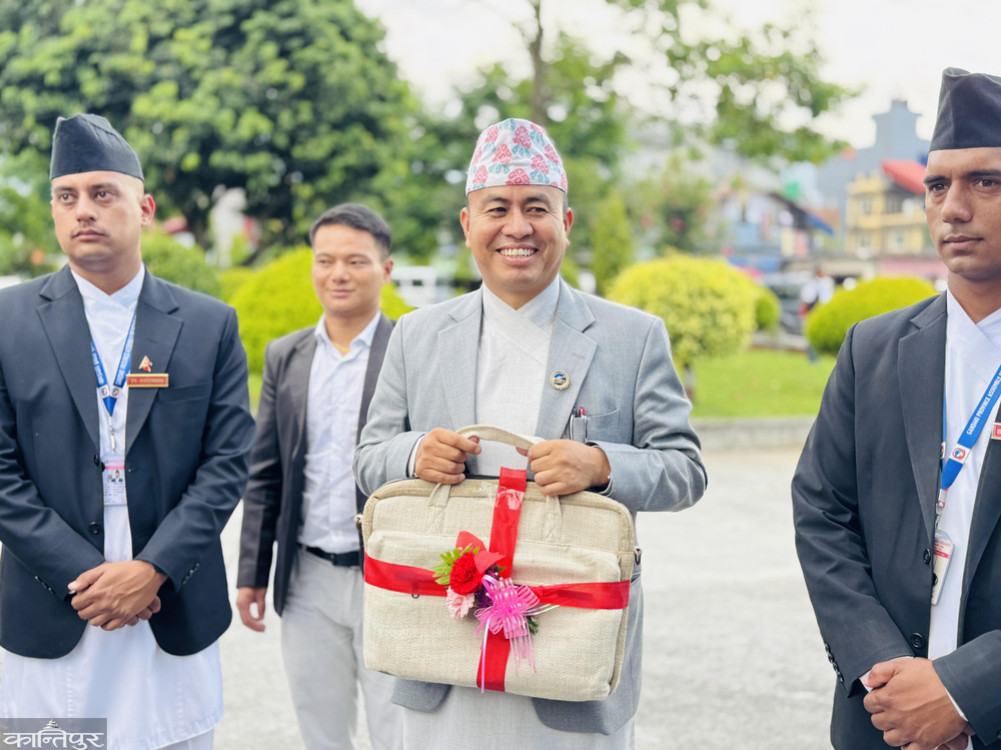
The concept of a province is more related to decentralization of governance and identity. And its success is only ensured when citizens can experience an improvement in their standard of living.
We use Google Cloud Translation Services. Google requires we provide the following disclaimer relating to use of this service:
This service may contain translations powered by Google. Google disclaims all warranties related to the translations, expressed or implied, including any warranties of accuracy, reliability, and any implied warranties of merchantability, fitness for a particular purpose, and noninfringement.
The governments of all seven provinces have released their budget statements for the fiscal year 2083/84 on Monday, with a sense of restraint in some areas and a sense of misguidance in others. Programs that reduce spending, keep the budget size within a relatively practical range, and help improve the living standards of the province's residents have been given priority in the budget.
What is different this time from the past is that there are governments of different parties in the union and provinces. This situation can be seen not as an obstacle but as an opportunity to collaborate between different ideological beliefs and policy priorities. On the other hand, it is also seen that the large size of the budget, which fails to present a reliable basis for resources, is being copied from the federal government's budget, and is interested in large infrastructure. Nepal has three levels of federalism in practice, of which the concept of provinces is more related to the decentralization and identity of governance. And, its success is ensured only when citizens can feel an improvement in their living standards. They see their representation in the governance process as meaningful. Therefore, the provincial government should be able to effectively implement the programs targeted in the budget to improve the living standards of citizens, provide them with opportunities, and realize the benefits of development.
A budget of Rs 40.4498 billion has been allocated to Koshi Province. Similarly, a budget of Rs 41.1386 billion has been allocated to Madhesh, Rs 66.9333 billion to Bagmati and Rs 32.9999 billion to Gandaki. Similarly, a budget of Rs 37.3845 billion has been allocated to Lumbini, Rs 35.3985 billion to Karnali and Rs 37.70 billion to Sudurpaschim.
Koshi, Gandaki, Karnali and Sudurpaschim have increased the size of their budgets compared to the current fiscal year. Bagmati, Madhesh and Lumbini have reduced their budgets, citing limited internal revenue sources and cuts in grants received from the union. Koshi, Madhesh, Bagmati, Gandaki and Lumbini have reduced their budget allocations for the current fiscal year. Karnali has increased the budget under both current and capital headings. Despite reducing the current budget, Koshi, Madhesh, Bagmati, Gandaki and Lumbini have increased the capital budget.
Some provinces have tried to address the public criticism about the number of ministries and ministers in the provinces. They have said in the budget that they will reduce the number of ministries. The Madhesh government has made policy reforms in the budget and has made arrangements for a 9-member council of ministers including the Chief Minister. Similarly, the budget has been allocated by reducing the 14 ministries in Bagmati to 8.
The Lumbini provincial government has put forward a policy of conducting work through eight ministries and reviewing the posts. Such issues are not only addressing public grievances, but are also an attempt to streamline the cumbersome system and reduce expenses. At a time when the federal government has also recently given a positive message by reducing the number of ministries, it is a good thing for the provinces to move forward by correcting past wrong practices.
The provinces have also put forward programs to promote tourism. Under which, there are issues ranging from declaring a tourism year to prioritizing infrastructure development in the tourism sector. Tourism can be a key sector for increasing the economic strength of the provinces. Provinces including Madhesh and Bagmati have also emphasized sports infrastructure. In the Far Western Province, the salary of employees has been increased by 10 percent. In Lumbini, it has been announced to provide an additional transportation allowance of 3,000 rupees for employees.
Provinces have announced programs such as grants and assistance targeting the lower classes. For example, Koshi has introduced a program for free treatment of pregnant women and children under 12 years of age at the provincial hospital. Similarly, the Madhesh government has introduced the 'Madhesh Startup Fund' program to provide subsidies to farmers. Bagmati has introduced a housing program for thousands of extremely poor families. Such programs may be necessary. But the state should be able to advance the program for resource growth and distribution in a balanced manner. Otherwise, the pressure on resources will increase.
The budgets of the provinces have failed to present creative programs that create employment and increase entrepreneurship. General grant and assistance programs have been announced, but such programs are incomplete. Because unemployment is a problem of all provinces. The federal government's policy is also meaningful in ending this problem. However, the responsibility of finding opportunities within the provinces lies with the provincial governments. There can be various sectors such as agriculture, tourism, information technology, innovation, and provincial projects, through which employment can be created and capital can be built. However, the provinces have become nothing more than a mechanism for distributing the budget that is collected without much effort.
What is different this time from the past is that there are governments of different parties in the union and the provinces. This situation can be seen not as a difficulty but as an opportunity for cooperation between different ideological beliefs and policy priorities. For this, the provincial governments themselves should make more efforts. Similar efforts should be made with the local governments as well. The most important emphasis is on the full implementation of the programs and priorities announced through the budget. In particular, being able to spend the development budget and achieve the targeted economic growth rate is a challenge for all provinces. Only through cooperation with the union and local levels can the provinces achieve the declared goals.