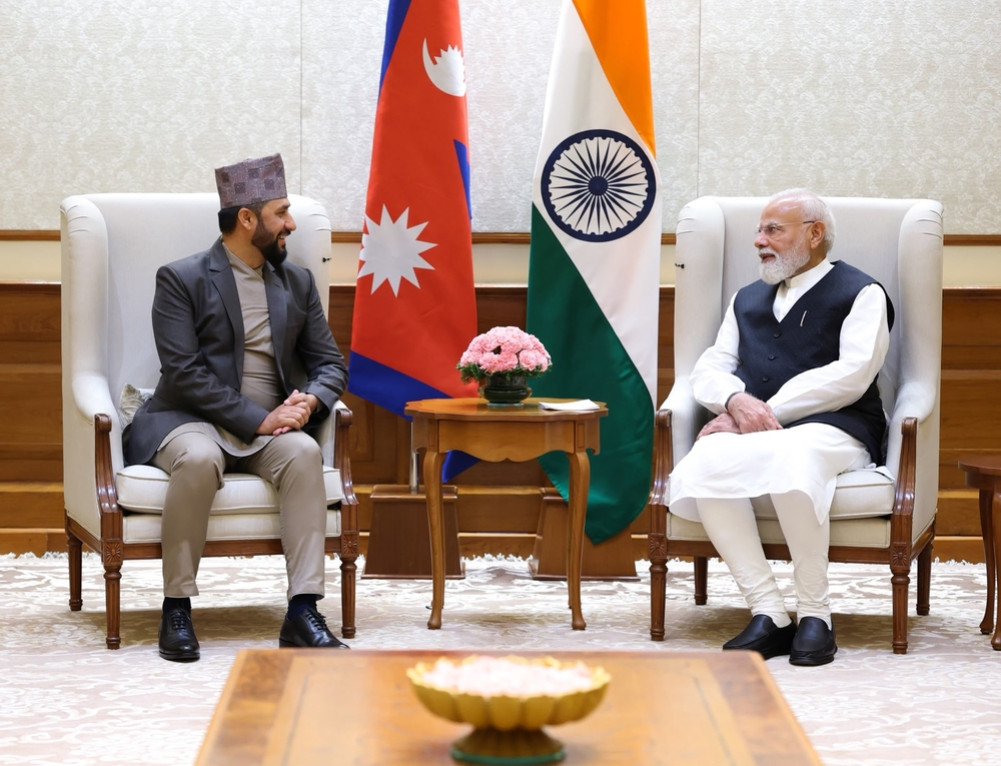
There is some hope in Nepal-India relations, but only the coming days will tell how permanent it will be. But the initial thinking and initiative of the Rashtriya Swayamsevak Sangh (RSS) is positive.
We use Google Cloud Translation Services. Google requires we provide the following disclaimer relating to use of this service:
This service may contain translations powered by Google. Google disclaims all warranties related to the translations, expressed or implied, including any warranties of accuracy, reliability, and any implied warranties of merchantability, fitness for a particular purpose, and noninfringement.
Nepal-India relations are currently in the news . But the nature of the discussion this time is different from before . Since the characters and the environment are different, it is natural to see some newness in the old patterns or styles . It is impossible to say whether the bilateral relations will continue like this in the future or whether they will return to the old pattern . What can be said is that no matter how much change there is, the Nepal-India relations are permanent in essence, but there is a difference in the style and speech of the characters to create their own interests and a new nationalist image . The king after 2007 and most elected prime ministers have adopted anti-India strategies with the ambition of becoming popular . Foreign policy was politicized to save their system (royalty) or to win elections after 2046. When personal ambitions and national interests were mixed, many found it difficult to distinguish between the two . In 2017, King Mahendra, with the help of the army, gave a new cover to foreign policy to maintain the non-party system imposed through a 'coup'. At that time, when geopolitical tensions increased due to the conflict between India and China, the king had tried hard to get the support of other powerful countries by dressing up the autocratic rule as a panchayat and seeking stability. The atmosphere in which China was seen as a counterweight to India allowed the monarchy to be established.
This is how the negative use of political balance has led to the latest change of power. Khadga Prasad Sharma Oli played an active role in getting the Mahakali Treaty ratified by the parliament, and Oli later became a thorn in the side of India. Even now, he is maintaining the view that outsiders played a role in his downfall. Accordingly, he is spreading ideas by believing that the Gen-G rebellion of Bhadau was carried out from outside and that his government had been overthrown.
The Gen-G rebellion was not for a change in the system, but out of anger towards the government and the old parties. But amidst the chaotic situation, an interim government was formed under the leadership of former Chief Justice Sushila Karki, which was formed outside the parliament. It was taken as a product of the principle of necessity. It successfully concluded the elections in Falgun 2082 as per its commitment to hold general elections within 6 months and hand over power to elected representatives. In this election, the Rashtriya Swayamsevak Sangh (RSS) won about two-thirds of the seats in the House of Representatives and the party's senior leader Balendra (Balen) Shah became the Prime Minister. In this process, the old established parties were boosted by the electoral blunder. The Rashtriya Swayamsevak Sangh (RSS), which was formed four years ago, established itself as a strong party in Nepali politics.
The formation and style of the Rashtriya Swayamsevak Sangh (RSS) government is strange. Ravi was encouraged to form a party by his popularity. Balendra Shah's entry only happened after the Falgun elections were decided. Ravi had proposed the post of Prime Minister to use his popularity. Even though he was facing a difficult case, Ravi did not covet becoming the Prime Minister. Coincidentally, the dice turned in electoral politics and Balen Shah became the Prime Minister. But Balen's popularity was not due to politics, but to music (rap). His clean image has remained intact to this day, but Balen seems immature in politics and diplomacy. Since he is a leader of a parliamentary system, he has proven to be weak in process and accountability. There are suspicions that the President may be harmed by things like interrupting the government's policy while reciting it, speaking without doing the necessary homework on some foreign affairs issues and raising unnecessary issues instead of improving relations, and stopping meetings with necessary foreign representatives due to the order of precedence.
In the context of Nepal-India relations, Rashtriya Swayamsevak Sangh (RSS) President Lamichhane seems more mature. He was previously a prominent television presenter (yanker) and his attractive style and raising issues of public concern made him popular. Lamichhane had no other background, like other party leaders who had been imprisoned, nailed, and handcuffed. The fight at that time was against feudal dictatorship. Principled activists had dedicated their precious lives. But after achieving political objectives, the lifestyle of all of them became bourgeois. They were overwhelmed by the greed for power and wealth. Politics was commercialized, and politics itself was corrupted by the chaos of fake capitalism. As a result, they were displaced by the Gen-G movement that arose on the strength of the people's great disappointment and anger. Coincidentally, and because of the Gen-G youth's dedication to democracy, the country did not turn towards dictatorship. Democracy took the path.
Even though rebellions changed power in two other South Asian countries, Sri Lanka and Bangladesh, they did not destroy the established democracy. The military also did not create an environment in which it could rule itself by staging a 'coup'. Although it is a 'byproduct' of the Gen-G movement, it is not a government formed by Gen-G in the true sense. However, it cannot be said that it is not because of the majority of youth. After the change of power, the results of the voting conducted on the basis of discontent and anger towards the leaders of the so-called old parties brought it to power. The government formed on the strength of the people's wave, led by all the youth, is hopeful for them.
It is natural to be curious about what Nepal's neighboring policy will be in this political background. India is also a very close neighbor. Nepal is a country of geopolitical importance. Therefore, the criteria for Nepal's foreign policy are considered to be India and China policies. The third important country is considered to be the United States. Because America's hands are spread all over and it needs various kinds of support.
There is no clear roadmap for the Balen government's foreign policy. The manifesto of the Nepali Congress Party (NCP) does not provide any other explanation than development-oriented diplomacy and a neutral foreign policy. Regarding what Ravi Lamechhane said and wrote during his visit to India, the India policy of the NCP government has been clarified and development is considered the basis of foreign policy. The issue of no longer carrying the historical political burden and moving forward with the agenda of partnership in development has been mentioned in Lamechhane's articles and meetings. Therefore, Indian Prime Minister Narendra Modi has praised the goal of coming out of the circle of negative nationalism and dedicating himself to the development of the country. In fact, Nepal's neighborhood policy requires a so-called strategy for survival and a determination to get rid of constant fear. Stability and confidence increase only when we believe that the development of the country is the creation of true nationality. If a non-politicized foreign policy is adopted, Nepal's existence will automatically be protected.
Nepal-India relations can be viewed at various levels. The first level is based on the people's level, which should have a good analysis of the small problems and the situations they create. This includes the movement of people across the border, the tradition of the general public bringing general household goods from the Indian market across the border without any hindrance, and many other daily problems. The next level is employment. The 1950 treaty between Nepal and India states that the people of both countries will be treated equally. Although the people of both countries will get employment opportunities, in practice, disputes have arisen from time to time in the process of managing it. Nepal is obliged to reach timely decisions and keep the population balanced. Because the size of Nepal's territory and population is different, the problem may increase.
Although clear statistics have not been prepared, a large number of Nepalis are getting jobs in India. Therefore, it is considered a safety valve for Nepal. Similarly, today, three to four million youth are working in other countries and earning a living. But when the changing world situation becomes unfavorable, no one can say what will happen to those Nepalis.
The third level of Nepal-India relations is policy and strategic differences. Problems remain as they are due to mutual suspicion and harshness in policies. It has been 30 years since the Mahakali Treaty was signed. Despite the commitment of the Prime Ministers of both countries to implement it from time to time, not even a detailed project report has been prepared. If there is no agreement on water sharing, why has no solution been found? Will the Rashtriya Swayamsevak Sangh and the Modi government be able to find a solution through cooperation as they have said? Similarly, there are complaints from the flood-affected people, the solutions of which are mentioned in joint statements from time to time but are never implemented. Small obstacles on the border always arise. The work of increasing the activity of local bodies to solve those problems is slow. What is found in the process of studying the border is that mechanisms have been created but they are not active. There are many such local problems, which neither the Indian government nor Nepal can solve. The forest elephant problem has been present in the districts of the eastern Terai for many years, but to this day, the elephant herds continue to destroy crops and pose a threat to lives. The elephant problem is increasing in the eastern part of Jhapa. Even if such problems are solved, it is not easy to solve them.
Another main level of Nepal-India relations is the border dispute. Problems continue to arise at the local level due to the open border and these are common issues. But it is difficult to understand why disputes like Susta have dragged on for so many years. The dispute over the territory of Kalapani, Lipulekh and Limpiyadhura is of a complex nature. The issue of Kalapani was known to the government as early as 1962, but King Mahendra did not raise this dispute when India was in trouble, as has been said by high-level officials at the time. Today, since the issue of the western border has become a special issue for both sides and its solution is not easy, the current government's thinking of not getting stuck on such serious issues and hindering other development work is very practical and positive. Since such special issues include border disputes and security, the objective of the current Nepal government seems to be to develop development-oriented relations. Not carrying the historical political burden can now be interpreted as seeking the cooperation of all friendly countries in the development of the country without politicizing foreign policy and protecting it from negative nationalism.
As far as the newness in Nepal-India relations is concerned, there is no scope for structural change in the relationship. Since the time of King Mahendra, many communist governments have not made any effort to change such a security structure. But communist leaders and their fraternal organizations have not stopped raising the slogan of revoking the unequal treaty. Even though the treaty was controversial since the day it was signed in 1950, they did not dare to replace it. This is not a trivial matter, it is for the benefit of Nepal. Many have been saying that going up and down on this will open a 'Pandora's box' (a flood of problems). Therefore, everyone must be aware that foreign policy slogans and populism cannot work.
There is some hope in Nepal-India relations, but only the coming days will show how permanent it will be. But the initial thinking and initiative of the Rashtriya Swayamsevak Sangh (RSS) are positive. Chairman Lamichhane has appeared a little more mature after this election, which has also affected the foreign policy of his party and government. He has created an environment where the image spoiled by the Prime Minister can be repaired. Although the India-Nepal relationship seems simple at first glance, it is very complex. It requires such art and skill to always keep it in the right place. The biggest issue is timely, practical thinking and its implementation.