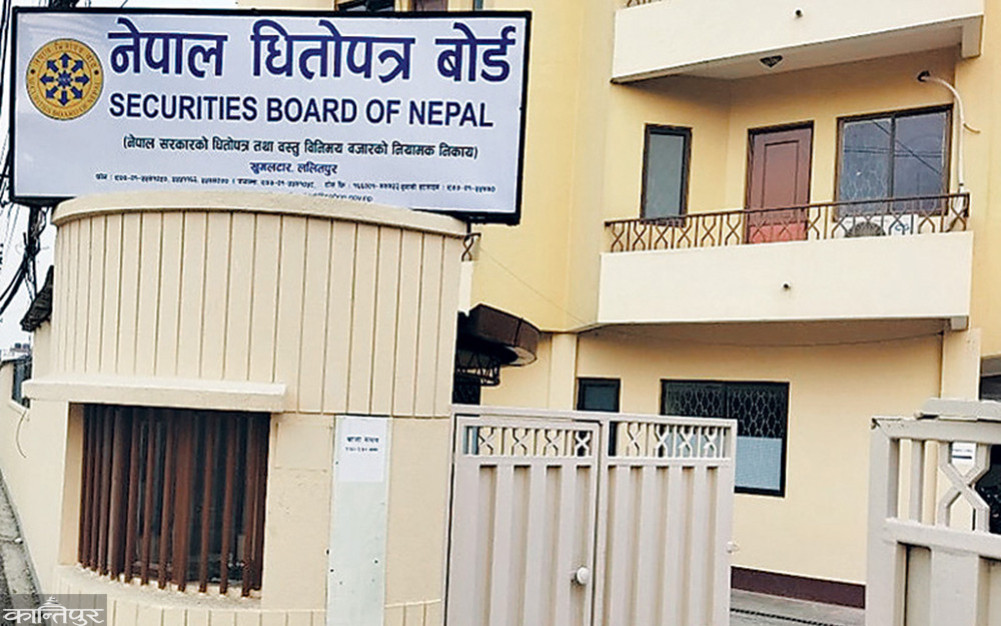
Currently, about 7.9 million investors are directly involved in the stock market. The Securities and Exchange Board of Nepal (SEBON) is responsible for maintaining the trust of these investors and making the Rs. 4.6 trillion stock market fair and transparent.
We use Google Cloud Translation Services. Google requires we provide the following disclaimer relating to use of this service:
This service may contain translations powered by Google. Google disclaims all warranties related to the translations, expressed or implied, including any warranties of accuracy, reliability, and any implied warranties of merchantability, fitness for a particular purpose, and noninfringement.
The Securities and Exchange Board of Nepal is not only the regulatory body of the capital market and commodity market but also the sole advisor to the Government of Nepal on capital market matters. Along with formulating policies for the development and expansion of the stock market, the Board is also responsible for granting permission for initial public offerings (IPOs) of companies, regulating market institutions including brokers and merchant bankers, and protecting the interests of investors.
Currently, about 7.9 million investors are directly involved in the stock market. The Securities and Exchange Board of Nepal is responsible for maintaining the trust of these investors and making the Rs. 4.6 trillion stock market fair and transparent. Therefore, the leadership of the board is not an ordinary administrative position, but an important responsibility with high ethics, good governance, and honesty linked to the reliability of the financial system. However, there has always been a problem in the appointment of the chairman of the board. The current government should put an end to this trend.
The chairman position in the Securities and Exchange Board of Nepal is executive. That is why the chairman determines regulatory priorities, advances market reform policies, and makes the final decision on controversial issues. In recent years, the process of appointing the chairman of the board has always been controversial. It has been found that vested interests have begun to dominate the selection of leadership on the board. If you can send your own people to the leadership, you can work according to your interests, you can get the company's license and share issuance permission as you want, you can not take action even if you trade shares illegally, and even if you do, it will only be for show. For this, interest groups started using as much power as they could. There was intense competition among business houses to influence the government and send their people to the board. After this, the board chairman has always been in trouble.
The issue of appointing the chairman in the Securities and Exchange Board of Nepal is so powerful that the controversy over its appointment has created a situation where the government itself can be sustained or toppled. Former Prime Minister Pushpa Kamal Dahal himself made a statement in Asad 2081, linking the appointment of the board chairman as one of the reasons for the collapse of his government. There is an example in the past when it took 11 months to make one of the three people recommended by the chairman selection committee the chairman.
This time too, the post of chairman has been vacant for about two months. It is ironic that a new chairman could not be appointed for two months after the resignation of the then chairman Santosh Narayan Shrestha on April 4. Many works have been stalled due to the lack of appointment of a chairman in the board. Even now, more than 100 companies are waiting for the initial public offering (IPO). There is a risk of increased volatility in the market. Regulation and supervision are weakening in the absence of a chairman. Due to this, the influence of interest groups in the market has increased.
Regulation and supervision have also not been effective in the absence of a chairman. Not only the approval of all types of share issuance including IPOs, but also internal transfers of the board, changes in responsibilities, hearing of complaints and action have been stalled. Currently, 104 companies have applied to the board for 472,294,163 units of IPO worth Rs 69.3 billion. This number becomes much higher when other groups including right shares, bonus shares, debenture issuances that are in the process are also included.
The capital plans of those companies have been affected by not being allowed to issue shares for a long time. The chairman position in the Securities and Exchange Board of Nepal is an executive one. That is why the chairman sets regulatory priorities, advances market reform policies, and makes the final decision on controversial issues. It is not natural for the leadership of such an important institution to remain vacant for a long time.
Even though the selection of the vacant board chairman has reached the final stage for two months, the government has not been able to finalize the appointment process. The current government, which was formed with a promise to end corruption and maintain good governance, has also raised suspicions due to its delay in appointing the board chairman. To prevent this, the government should not delay in appointing a qualified, experienced, and honest person as the board chairman as soon as possible. Because, there are trends of corruption in the capital market sector.
The longer the chairman appointment process, the more corruption will increase. The citizens will mainly question the ability of the new government to identify qualified people and make decisions. It is not only a matter of making appointments quickly, but also of gaining public trust in the appointment process and character. Therefore, the board chairman appointment process should be made transparent, competitive, and credible. The candidate selection criteria should be fully followed and the recommendation process should be kept away from political influence.
The capital market is a system that operates on the basis of information and trust. The primary responsibility of maintaining that trust lies with the regulatory body. However, if questions are repeatedly raised about the leadership selection of the regulatory body, the market cannot be expected to be credible. Citizens' money cannot be protected either. Therefore, the current need is not just to appoint a new chairman. Rather, the leadership selection of the Securities and Exchange Board of Nepal should not be allowed to become a matter of controversy and should be made an example of institutional good governance.