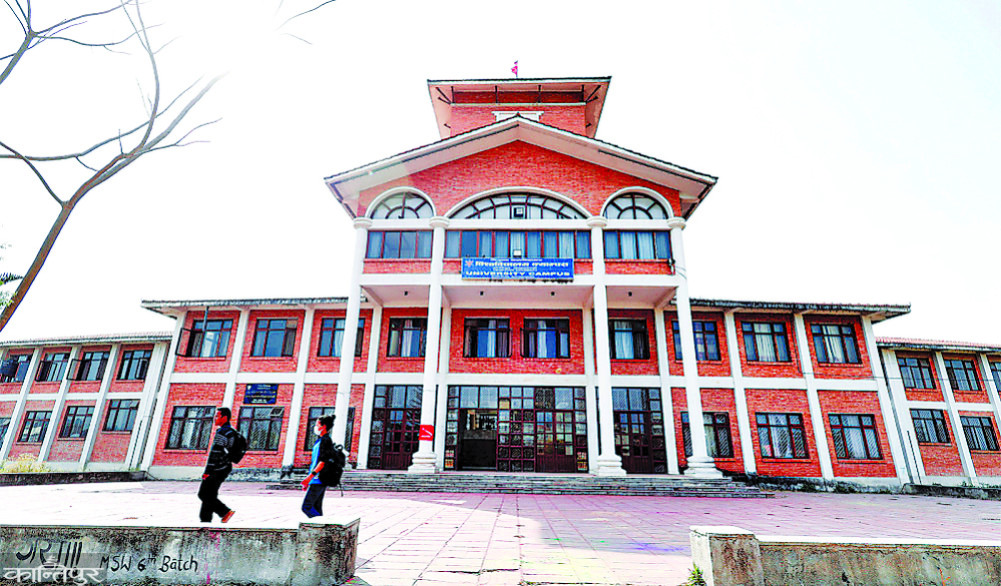
Students are forced to become ‘human capital’ that can be sold in the market rather than becoming thoughtful citizens. They are not taught to question – they are taught to obey, not taught to analyze – they are taught to memorize, not taught to be creative – they are taught to imitate.
We use Google Cloud Translation Services. Google requires we provide the following disclaimer relating to use of this service:
This service may contain translations powered by Google. Google disclaims all warranties related to the translations, expressed or implied, including any warranties of accuracy, reliability, and any implied warranties of merchantability, fitness for a particular purpose, and noninfringement.
The question that is repeatedly raised in the contemporary intellectual landscape of Nepal is not a simple curiosity, but a fundamental question of our national existence. Are we really heading towards the end of the intellectual generation? Rather than raising this question superficially, it is imperative to analyze its historical, structural and philosophical dimensions. There is an absence of debate in university rooms, silence in libraries, and superficiality prevails in public discourse instead of depth. These are just symptoms; the real problem is much deeper and structural. This situation is not just a crisis of our national consciousness, but a process of disintegration of collective intellectual identity, which is pushing the entire nation towards intellectual poverty.
The transformation that has taken place in the educational sector of Nepal in the last two decades is not just a change, but a structural collapse. This collapse is the result of the blind imitation of neoliberal economic policies, the tendency to retreat from the educational responsibility of the state, and the view of viewing education only as a market commodity. Universities were once centers of knowledge creation, critical thinking, and social transformation. They have now turned into degree-granting factories and profit-oriented industries.
This transformation is not accidental, but a planned process. The state, the market and political forces are involved in it. State investment in education is declining, the private sector is looking at education as a source of profit. And, political parties are using educational institutions as a means of expanding their sphere of influence. Instead of becoming thoughtful citizens, students are forced to become ‘human capital’ that can be sold in the market. They are not taught to question – they are taught to obey, not to analyze – they are taught to memorize, not to be creative – they are taught to imitate.
The almost complete lack of quality research, the gradual decline of critical thinking and the epidemic of fake educational certificates have destroyed both the moral and intellectual foundations of our educational system. This situation is like a wormhole in the foundation of a country called home. Everything looks fine from the outside but is completely hollow inside.
The university has degrees but no knowledge, certificates but no qualifications, institutions but no educational environment. The situation of Tribhuvan University is a vivid example of this. According to statistics, in 2067 BS, the university's publishing department published an average of 20 research journals. Today, that number is limited to 5-6. In 2075 BS, only 3 PhD holders applied to one department, while in 2065 BS, there were 35 qualified candidates for the same position. Many of today's professors have not published a single research paper in the last five years.
Universities were once centers of knowledge creation, critical thinking, and social transformation. They have now turned into degree-granting factories and profit-oriented industries. The role of teachers has also changed fundamentally. They are no longer sources of knowledge, intellectual guides and harbingers of social change, but have become instructors who pass exams, textbook teaching machines and political party workers. The curriculum is outdated, the teaching method is traditional, invoking the memory of the colonial period. And, instead of encouraging students to question, doubt and explore independently, they are suppressed and discouraged. How can intellectual curiosity and original thinking flourish in such an oppressive environment? It is like keeping a plant in a closed room and it cannot survive.
The fact that even after three decades of democracy, a free and autonomous intellectual environment has not been created in Nepal is the biggest failure of our democratic transition. This failure is not accidental, but structural. Political parties have turned universities into factories for expanding their sphere of influence and producing future cadres. From Tribhuvan University to small campuses, a web of factionalism, domination, and interference by political parties has been spread.
Student politics was once a platform for ideological debate, a platform for social concerns, and a laboratory for change - now it has become an arena for factionalism, violence, and opportunism. Instead of making students thoughtful political activists, students are made blind followers, instead of being taught to debate, they are taught to chant slogans, instead of being encouraged to analyze, they are forced to accept the decisions of the party. This process is destroying the intellectual capacity of a generation.
Academic appointments are not based on merit but on political exhortations, party loyalty and nepotism. From university vice-chancellors to department heads, from campus heads to professors, political connections have become the deciding factor rather than merit in appointments. This has frustrated qualified and talented teachers, brought about a decline in educational quality. And, poisoned the entire educational environment.
There is also a gradual but continuous contraction in freedom of expression. Intellectuals, researchers and teachers who raise critical voices are pressured in various ways – sometimes subtle threats, sometimes direct attacks, sometimes financial pressure, sometimes social boycott! Debate takes place on social media, but it is often superficial, emotional and divisive. There is a lack of depth, a lack of facts and a lack of logical analysis. Everything is limited to the game of ‘like’, ‘share’ and ‘comment’, serious discussion and intellectual dialogue have almost disappeared.
The revolution in digital technology has connected human civilization with unprecedented possibilities, but in the context of Nepal, it has created a strange paradoxical situation. We have an ocean of information but a desert of knowledge, access but lack of depth, tools but lack of intellectual capacity. The younger generation spends hours on social media but lacks the time, desire and ability to read serious books. ‘Viral’ content has displaced valuable ideas, serious analysis and knowledge of long-term significance. The culture of
short videos, memes, reels and ‘trending content’ has destroyed the tradition of long-term reflection, intensive study and patient acquisition of knowledge. Attention span has declined, deep thinking practice has declined and addiction to instant gratification has replaced long-term intellectual goals. The ‘cut-paste’ and ‘copy-paste’ culture has killed originality, creativity and critical thinking. Students are losing the ability to develop their own ideas, think independently and write original essays – they search for answers on Google, copy information from Wikipedia and write essays with artificial intelligence. How can critical thinking, independent analysis and original thinking develop in such an environment? As a result, intellectual dependence increases, mental laziness is promoted and the ability to think independently is gradually destroyed.
The continuous exodus of talented youth from Nepal is our greatest national tragedy and a serious intellectual loss. It is not just a ‘brain drain’, but a ‘brain hemorrhage’ – a situation where the nation is continuously losing its most valuable asset. Every year thousands of talented students migrate abroad in search of higher education, employment and a better future, and very few of them return. Even those who return do not get a suitable environment, opportunities and encouragement to use their knowledge, skills and experience.
The reason for this exodus is not only economic, but also structural and psychological. The state does not value, respect and reward talent and talent. Political connections and financial capital have replaced talent. Those who are here are also disappointed, frustrated and helpless. There is no funding for research, no opportunity for publication, no social and economic evaluation of intellectual work and no hope for the future. In such a depressing environment, how can intellectual tradition survive, how can knowledge be created, how can critical thinking develop?
The most talented children of the country have left, those who remain in the house are discouraged and disappointed. How can this house prosper? How can it compete with other houses? Talent goes away because there is no environment, and the environment is not created because there is no talent. Until this vicious cycle is broken, Nepal's intellectual renaissance is not possible.
Despite all these challenges, problems and crises, it would be an exaggeration and extreme pessimism to say that the intellectual generation has completely ended in Nepal. Quality education is still being provided in some universities, some young people are engaged in serious study, research and intellectual work, some teachers are distributing knowledge with dedication and sincerity. Some organizations, groups and individuals are constantly trying to keep intellectual discourse alive.
However, this is not enough. This structural crisis cannot be solved by sporadic efforts and individual dedication alone. We need systematic, institutional and long-term efforts. There is a need for fundamental reform of the education system, massive investment in research, constitutional-practical protection of intellectual freedom, and the creation of a conscious knowledge-based society. An environment must be created where there is not only freedom to question, doubt, criticize, and present new ideas, but also encouragement and rewards.
Is this the end of Nepal's intellectual generation? The answer is neither a complete 'yes' nor a complete 'no'. We are in a crucial transition period, a dangerous but promising juncture. We can either move towards intellectual renaissance or plunge completely into intellectual emptiness and cultural death. This is a historical dividing point, where the choices we make will determine the future of the next generation.
If we can give today's generation quality education, equal opportunities, intellectual freedom, and hope for a bright future, Nepal's intellectual tradition will not only be revived, but will also reach new heights. However, if we continue at this pace, maintain this structure, and adopt this policy, we will be moving towards an intellectual dark age, cultural death, and national decline.
Are we ready to emerge from this crisis? How much can we sacrifice? How much change can we accept? The time to decide is now, it will be too late, by then the damage will have been done.
The foundation of the house of the nation must be repaired, strengthened, and to rebuild it, the collective efforts of the state, society, teachers, students, parents, intellectuals, and politicians are indispensable. This is not just a personal desire, it is a question of national existence. It is not just an intellectual concern, it is a decisive factor for the collective future. This task is not easy, but it is not impossible either. History has shown that nations can come out of intellectual darkness, bring about an educational renaissance, and build a knowledge-based society. However, political will, social awareness, and collective commitment are indispensable.
The next generation will ask us: What did you do when the country was in crisis? Now we must answer with our actions and decisions. Time is limited, the opportunity is in our hands. And, the decision is ours.