The Rashtriya Swayamsevak Sangh (RSS) is a party that was born out of opposition to the working style and wrong traditions of the old political parties. However, the biggest contradiction of this party is that it has not been able to show itself to be different from the old ones in any sense.
We use Google Cloud Translation Services. Google requires we provide the following disclaimer relating to use of this service:
This service may contain translations powered by Google. Google disclaims all warranties related to the translations, expressed or implied, including any warranties of accuracy, reliability, and any implied warranties of merchantability, fitness for a particular purpose, and noninfringement.
The ruling Rashtriya Swayamsevak Sangh (RSS) is on the verge of its first national convention. The party, which has been preparing for its central convention through wards, villages, towns, districts and provinces, is currently at the center of politics. The general public is watching every activity of the country's largest party with interest.
Indeed, the miraculous rise of this party is a new example of politics. The RSS, which entered the elections within 6 months of its establishment and became the fourth largest political force, emerged as the most powerful party in the country in less than four years. And, it is now leading the government with almost two-thirds of the public vote.
When it was established, many people gave the RSS the name of an 'apolitical wave'. Their argument was that the RSS was born on the basis of disappointment and dissatisfaction with the old and traditional ruling class. However, Chairman Ravi Lamichhane repeatedly argued, ‘The RSVP is not an apolitical wave, nor is it just a disappointment, but the culmination of the hopes of the common people.’
After four years, the RSVP has become the largest party in parliamentary politics. However, the question remains, was the RSVP born from the womb of dissatisfaction and disappointment or did it emerge as a beacon of hope? Is it a force with a political character or a group of apolitical individuals/trends? And, will it be just a temporary expression of dissatisfaction with the old party or will it also be politically institutionalized? Many such questions about the RSVP have not been raised that much. The working style of the RSVP leaders, who became the new holders of power after achieving an extraordinary victory in the elections, is the source of these questions.
Political parties are the product of movements. We have examples of parties emerging from large-scale mass movements. The movement against the Tsarist Rana gave birth to the Praja Parishad and the Nepali Congress. After the Panchayat dictatorship, the Communists appeared in the movement for pluralistic political freedom along with the Congress. The Maoists emerged after the second people's movement of 2063. Madhesh-centric parties were born from the movement for the right to identity. Unlike those parties that have now reached the traditional level, the rise of the Rashtriya Swayamsevak Sangh (RSS) did not occur through a movement. This party emerged under the guise of intense dissatisfaction with the old rulers in society, the search for alternative leadership against party system or limited leader system, and the leap in digital technology and its impact.
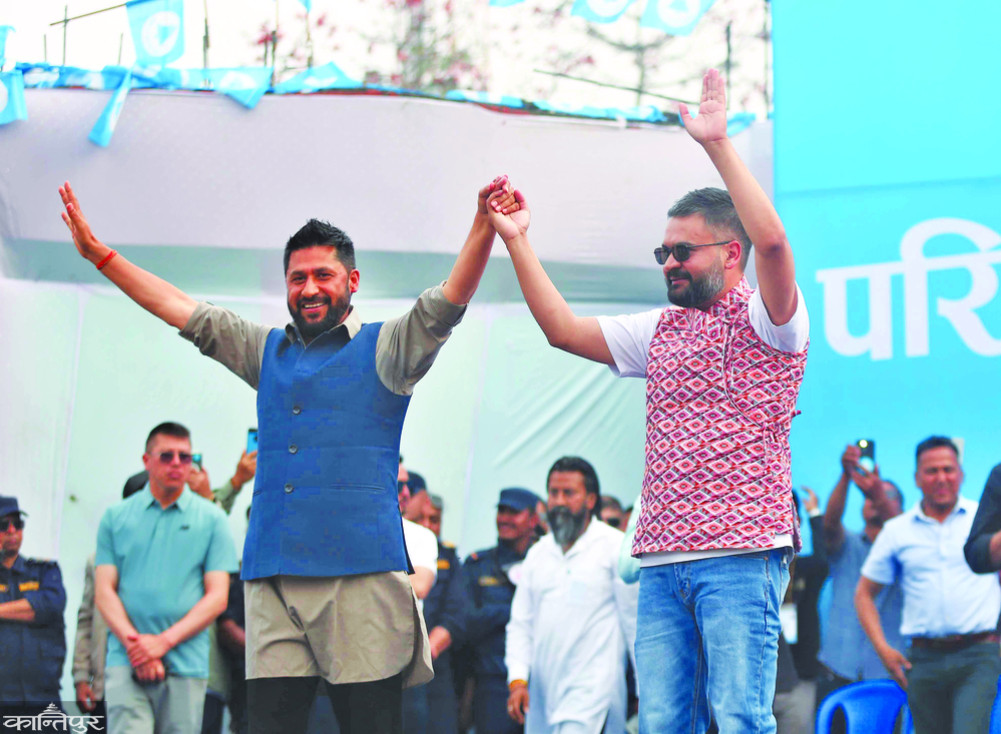
The RSS still has a majority of individual-centered politics. Founding President Ravi Lamichhane was there, now senior leader and Prime Minister Balendra Shah has become another pillar of power in this party. In this party, which is based on the popularity of individuals, personality dominates over ideas. The public opinion outraged against party system gave the RSS an extraordinary political success by giving it an 'instant mandate'. But, what after that? How long will the victory achieved by the RSS last or be able to last? The reason why these questions are being raised at this time is that the real test of political power is not in its rise, but in the journey that follows.
Reaching the center of power in the midst of discontent and anger is an achievement. However, institutionalizing that achievement in a pro-people manner is an even more difficult task. The Rashtriya Swayamsevak Sangh (RSS) won the public vote, but it has yet to be tested for maturity in party operation, organization/expansion, and state administration. It has started to fail in its initial days of power exercise. This column has been prepared on the eve of the RSSW's general convention to discuss its strengths and weaknesses, problems, possibilities, and challenges.
Let's start the discussion with the RSSW and the government. The current government formed under the leadership of Prime Minister Balendra Shah is a single-minded government of the RSSW. Shah is a senior leader of the party. Except for one independent MP, Mahabir Pun, all of Shah's cabinet members are members of the RSSW. However, looking at Prime Minister Balen's speeches and working style, the question arises, is this the government of the Rashtriya Swayamsevak Sangh (RSS)? Seeing the helplessness of the Prime Minister's working style, the question also arises, is this the government of the Rashtriya Swayamsevak Sangh (RSS)?
Of course, the main responsibility of running the government lies with the Prime Minister. It is not appropriate for the party to control the Prime Minister in every context and decision, as in communist parties. The agreement that the Rashtriya Swayamsevak Sangh (RSS) would run the party with Lamichhane and that the government would be run by Balendra Shah was not inappropriate. However, in that case, is there not a minimum coordination between the party and the government in parliamentary practice? Can the party remain completely unaware of the Prime Minister's behavior, working style and decisions?
In a parliamentary system, the government is the means of implementing the political program of the party. The relationship between the party and the government is sought in policy, common political vision and organizational accountability. However, in the Rashtriya Swayamsevak Sangh (RSS) the party president goes on a visit to India. The government expresses ignorance about it. After returning, the President does not even consider it necessary to formally inform the government about the visit.
The Prime Minister, breaking the rules, stands on the rostrum and makes controversial statements on sensitive issues, saying that 'Nepal has also encroached on Indian territory'. The President listens indifferently. He tries to defend it based on weak arguments. The party does not dare to ask for clarification. The Prime Minister forms and expands the Council of Ministers arbitrarily. The party's role is not even visible at the level of making suggestions. Within a few days of the formation of the government, ministers get embroiled in controversies. Some are removed. Some are removed and reinstated as if the formalities of the investigation have been completed. The party does not seem to have any role in that either.
It has not even been a hundred days since the government was formed. However, the members of the Council of Ministers have been embroiled in controversies one after another. Recently, Finance Minister Swarnim Wagle has been in controversy over allegations of manipulating tax rates. The frenzied style he has shown in his post-conflict response has shown that the power mania is not limited to Balen, but is gradually spreading to everyone. Home Minister Sudan Gurung has been at the center of discussion and controversy since the Gen-G movement. How did a 'volunteer' who came to distribute water in the movement become an overnight leader of the movement and an influential player in national politics, how did he reconcile Ravi Lamichhane and Balendra Shah, and how is he playing the second innings of the Home Minister amidst the controversy? His skepticism is in the realm of question.
There is a rush to do something in some of the government's decisions. It seems as if he is trying to do something about the issue of protecting encroached land and good governance. The Prime Minister reaches Singha Durbar early in the morning. He calls a cabinet meeting as if it were a day. He tries to decide to appeal to the people in some way. However, he sometimes disappoints people by making cheap jokes. Due to which the enthusiasm for this government does not seem to have awakened in the general public. Instead, it feels like the government is moving forward in a hurry due to passion, revenge, and immature manner. There is more fear than trust in the government at the public level.
The scene in Parliament is even more pitiful. Are the RSP MPs representatives of the people or 'slaves' of the Balen regime? Their innocent role is being questioned as well as criticized. When the Prime Minister stood on the rostrum and made the statement that 'Nepal has also encroached on India's land', after applauding and approving such a sensitive issue, both the role and competence of the RSP MPs have been questioned. The country is sky-high in cost. People's lives are becoming economically precarious day by day. There are many issues that affect the people's daily lives. Ignoring all of them, the MPs have come to the defense of the Prime Minister's controversial speech, and he has gained the reputation of being a 'stupid' who does not understand diplomatic sensitivity.
The RSP is a party born by opposing the working style and wrong culture of the old political parties. However, the biggest contradiction of this party is that it has not been able to show itself as different from the old ones in any sense. Now, even during the practice sessions for the general convention, the tension between factions and sub-faction was seen. The MPs openly sided with the factions in the general convention. There was a lot of talk about selecting those who know and democratic culture, but the Rashtriya Swayamsevak Sangh (RSS) could not establish any new standards in terms of internal democracy. Instead, in many places, the convention process had to be postponed due to conflicts and disputes. Due to this, the leaders and workers of the RSS made the convention a means of gaining office rather than strengthening democratic methods or building an organization. There was a competition for leadership rather than ideological debate. This was a topic that was seen in the old parties called traditional in the past. The same thing was now shown by the RSS during the practice sessions.
Old parties openly form factions in the name of ideological groups. They are influenced and manipulated by factions in terms of opportunities rather than political qualifications and policy ideas. One of the main reasons for the downward journey of old parties is factionalism. The Rashtriya Swayamsevak Sangh (RSS) rejects factional politics in words, but in practice, various factions were seen during the convention. This was revealed on the surface by the interference of MPs and central leaders in the selection of local leadership.
The main problem of the RSS is that it is a party built on the popularity of one person. Former television journalist Ravi Lamichhane founded the RSS four years ago to embody his ambitions to enter politics. Within six months of its establishment, it became the fourth largest political force. However, as quickly as Ravi rose, controversies did not leave him. He was famous as a television journalist, but he was also involved in many controversies. He is still an accused in the cooperative fraud case. He has been convicted by the court in a citizenship abuse case and is still accused of using passports of two countries at the same time. Despite this, he is a popular leader. This has been confirmed by his repeated landslide victories in elections from Chitwan.
The image of Lamichhane, who was the Home Minister twice in the previous coalition with the old parties, has also fallen at the same rate due to his impulsive and controversial actions. During the Gen-G movement, when he was released from Nakkhu by a mob, he faced widespread criticism from the Gen-Gs. The incident damaged his image so much that he was on the defensive. However, in the second week of Poush before the elections, Ravi's image also rose and the Rashtriya Swayamsevak Sangh (RSS) came to the center of national politics.
The Rashtriya Swayamsevak Sangh (RSS), which has faced many ups and downs in a short time, still has a majority of individual-centered politics. The founding president was Ravi Lamichhane, but now senior leader and Prime Minister Walendra Shah has become another pillar of power in this party. In this party, which is based on the popularity of individuals, personality prevails over ideas. That is, individualism, ideological ambiguity, and organizational immaturity are the biggest obstacles to the party becoming institutionalized. Another problem is that even though the party was established with the rhetoric of alternative politics, the behavior of the RSP is not in line with that. Ad-hoc behavior and working style dominate.
At present, people are entering the RSP to fill many opportunities. The party claims that the number of members has crossed 500,000. In other words, there is a huge crowd inside. But the party leadership is struggling to manage people from many groups, parties, and campaigns. The leadership seems incapable of setting standards for internal adjustment and management within the party. Even though there is talk of a clean and democratic process and competition, the squabbles and gnashing of teeth between leader-centered factions are equally prevalent in this nascent party. Just as the second generation was not able to rise in the old parties. It was as if the top leadership had forbidden it in a way. The second generation leaders also had a tendency to avoid risks and were oriented towards opportunism. A similar trend is seen in the RSP. This party also has only teeth to show internal democracy and new culture.
The practice of the RSVP reminds us of a character in Greek myth, 'Icarus'. Icarus was the son of Daedalus, a famous craftsman from the island of Crete. Both father and son were imprisoned by King Minos. Since the king had a strong guard on the sea route, Daedalus came up with a trick to escape from the island by flying. And, he collected the feathers of birds and made wings, which were attached with wax. The thing to pay attention to was that when flying with wings attached with wax, it was not possible to go too high or too low above the sea level.
If you fly too low, the wings could become heavy due to the cold of the sea, and if you go too high, it could melt due to the heat of the sun. This balance was important when flying. Daedalus had warned his son Icarus by giving him wings. However, the child Icarus, who had wings, had a mania for flying. उसले पिताले सचेत गराएको विषय सुनेन र झन् माथि–माथि उड्न थाल्यो । फलतः सूर्यको रापले मैन पग्लियो र उसका पखेटा खसे र ऊ पनि समुद्रमै खस्यो ।
इतिहासमा कैयौं राजनीतिक शक्तिहरू अयोग्यता र पराजयका कारण मात्रै पतन भएका होइनन्, बरु आफ्नै सफलताको भारले किचिएर ढलेका छन् । सफलताको उन्मादमा संकटमा परेका यस्ता ‘इकारस’ हरू इतिहामा थुप्रै भेटिन्छन् । पहिलो महाधिवेशनको संघारमा उभिएको रास्वफाले यो ग्रिक मिथकबाट केही सिक्ने कि ?