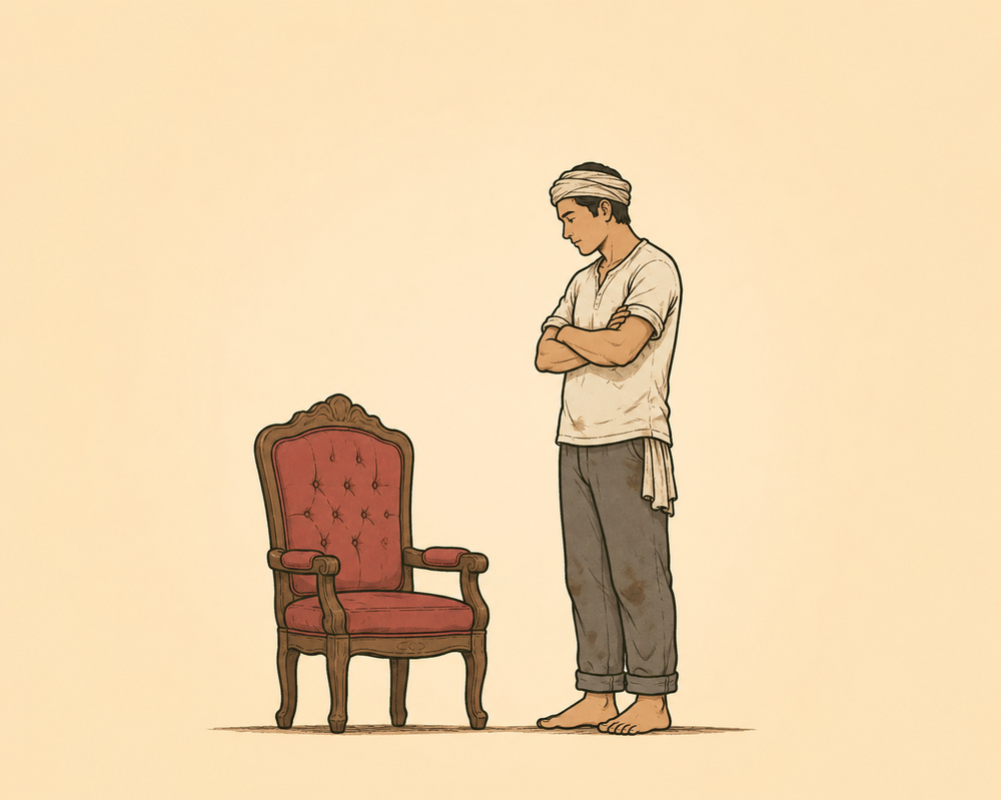
Let us not fall into the psychology of a powerful government and seek – a responsible government. A government that is accountable to the constitution, the law, the opinions and wishes of citizens. A government that is subordinate to the people. A democratic government that the people can control.
We use Google Cloud Translation Services. Google requires we provide the following disclaimer relating to use of this service:
This service may contain translations powered by Google. Google disclaims all warranties related to the translations, expressed or implied, including any warranties of accuracy, reliability, and any implied warranties of merchantability, fitness for a particular purpose, and noninfringement.
One of the oldest questions that is inseparable from political philosophy is the question of the relationship between the government and the citizen (the people). Which is connected to it, many subsidiary questions come up. For example, is the government greater or the citizen? Is the state greater or the people? Who should have power – the citizen or the government? Who is decisive – the state or the people? Should the state control the people or should the people control the state? In fact, the questions mentioned here are not just debate questions. These are questions that have the power to determine the political character of any country. These are questions that draw the line between democracy and dictatorship. Which give meaning and dignity to citizen supremacy, human rights, constitutionalism and the rule of law.
At the beginning, I must clarify that I have deliberately confused the state and the government here, the meaning of which will be understood according to the context. However, after thinking about the above questions, some may think, the government is big . The state is big . What is the value of the people if they are not in front of the government ? Or they may think, what is the meaning of the citizen if they are not in front of the state ? Because this is the answer that comes at first glance . Some think that the state has an army, a police force, a court, an administration, the power to make laws and the power to implement . Therefore, a person must obey the orders of the state . Because a person is subject to the state (government).
From a simple and straightforward perspective, a person is definitely subject to the state . In practical life, no citizen can put himself above the law . For example, a person must pay taxes . He must obey the court's decision . He must follow public rules . If he commits a crime, he must be punished . It is true that if a person starts considering himself above the state, chaos spreads in society . Therefore, it is generally true that the existence of a person is inherent in the state . But, who is the person mentioned here? He is also the Prime Minister, the judge, and the worker. As an individual, neither the Prime Minister has the right to break the legal and constitutional boundaries, nor does the judge or the police chief. Because, they are all individuals and everyone must obey the laws of the state in the same way.
But saying this alone does not provide a complete answer to the above questions. Because there are three more issues that need to be clarified. The first issue is the issue of understanding the definition of individuals and people. The second issue is the issue of understanding the difference between saying state or government and saying any position (like Prime Minister). The third issue is the issue of looking at the source and legitimacy of the power that the state or government obtains.
Of course, the individual is subject to the state. But in political philosophy, the individual and the people are not the same. That is, when millions of people unite in a common political consciousness, collective will and a sense of public interest, then they are no longer just individuals, they become the people. They become voters. They become citizens. They become movements. The basic assumption of democratic principles is that in that case, the people are sovereign. They are so sovereign and powerful that they can overthrow the government, change the government. Or if they want, they can change the Prime Minister and form a new government. In such a situation, the state or government is subordinate to the people and remains under their control. From this meaning or principle, the government is the servant of the people, not the master.
Secondly, many may think that the positions themselves are the state or government. The Prime Minister may think that he himself is the power. He himself is the government. Whatever he says applies. Or the minister, the army chief or the police chief or the Home Minister may also think the same. This is a very false and misleading view. Moreover, this is a very undemocratic and totalitarian approach. Because positions are neither the state nor the government. State or government is a systemic matter. It is an institutional matter. It is a structural matter. Positions are only very small units of it. When the power or government itself is under the control of the people, there is no question of the small unit (position) of the power or government being above the citizens.
Third, where does the state or government get its power from? Or what is the source of the power they use? The issue is clear, here the power that the government (state) receives is the power provided by the people or citizens, which is ensured through legal and constitutional provisions and agreements. In this way, the positions that exist in the government or state and the power that is vested in those positions are the constitutional or legal power provided by the people. Which the people can take away, change or abolish.
Here, there is another question to consider to understand the question of who is greater (sovereign) between the government and the citizens, the question of why the state was formed and who formed the state. Of course, there are various theories about the origin of the state. But the most influential theory in modern political philosophy is the theory of social contract, i.e. ‘social contact theory’, which can be understood by Thomas Hobbes (1588–1679), John Locke (1632–1704) and Rousseau (1712–1778). Who have explained the theory of social contract in different ways. According to Hobbes, the natural character of man is very chaotic and conflictual. Therefore, a powerful state is necessary to maintain peace and security in society. Therefore, the state was born with the permission and activity of the citizens themselves. But Locke believed that man is born free. He believed that man has natural rights to life, liberty and property. And, to protect it, a state or government is needed. Similarly, Rousseau believed in the sovereignty of the people. According to him, the legitimacy of the state comes from the collective will of the people. Therefore, rulers are not allowed to be different from the collective will of the people.
The main point to be mentioned here is that all these three theories say that states are structures built by citizens for their own needs. That is, the people are not made for the state, the people have made the state.
The question may arise, what happens when citizens violate the orders of the state? Or, does the state always wait for the orders of the citizens? No. Because both have made an agreement to regulate the relationship between the state and the citizens, and that agreement is the document that organizes and balances the relationship between the state and the citizens. Which we call the constitution and based on that, we make laws. What does this mean? It means that neither the state or the government is above the constitution, nor the citizens. Neither the president nor the prime minister is above the constitution and the law, nor the farmers or workers. Neither the police are above the law, nor the ordinary citizen. Here, everyone is guided by an agreement to respect the constitution, and that is the basis of the balance of power between them. But the people have such additional (or special) power that if they want, they can change the constitution and make new laws. In this sense, the power that the government itself has is not more than the power that the people have. And, what power it has, is the power it receives from the people.
So what is the legitimacy of the government? As long as the elected government operates according to the will of the people, the constitution, and democratic values, it gains legitimacy. But if the government itself distances itself from the people, becomes oppressive, and violates the constitution, its legitimacy ends. This is why elections happen in a democracy. There is a parliament. There is a free press. There is a civil society. There are courts. The purpose of all of these is the same - to protect the natural power vested in the people. To regulate the constitutional contract between the state and the citizens. And, that is why in a democracy, multiple levels of control over the government are ensured. For example, the people control through elections. The parliament controls the executive and seeks accountability from the prime minister. If necessary, the court conducts judicial (legal) review of the government. The mass media questions and increases surveillance. Civil society asks questions to the state and creates pressure to be accountable. This is called 'checks and balances' or balance of power and separation of powers. And, this is the most beautiful aspect of democracy.
But this is not the case in a dictatorial system. In a dictatorship, the state (or individual) is supreme. There, the duty of the citizen is to simply follow the orders of the state or government. Where the people vote, but the election is influenced by more than political agenda and conscience. In a dictatorship, the executive is supreme. It neither gives the parliament the right to ask questions, nor does it have the obligation to answer. The courts keep the executive's decisions outside of constitutional and legal scrutiny. And, the ruler becomes dominant everywhere. As a result, attempts are made to control the questions of the mass media and civil society begins to become the target of the government. The rulers feel that the constitution and law are for the common people, they are above them. And, thus, the system of 'checks and balances' or the balance of power and separation of powers breaks down.
But history shows that whenever the government rises above the people, there is a movement. For example, the original slogan of the 'French Revolution' was - sovereignty should not be in the king, but in the people. The American Revolution also established the same principle that government is legitimate only by the consent of the governed. Here, the term governed means the citizens. The fascist and totalitarian regimes of the twentieth century considered the state to be supreme. And, considered office as the source of power. As a result, civil liberties were destroyed and a long series of rebellions continued. But democratic countries considered the people as the source of power. As a result, even though the government changed there, the state continued to exist, because the source of legitimate power was the people.
Nepal's modern politics also seems to revolve around this question. The question is, the people or the state? Who is more powerful? Who is decisive? The movement against the Rana regime, the struggle against the Panchayat, the people's movement of 2046, the people's movement of 2062/63— the basic message of all was the same, citizen supremacy. Needless to say, when the collective consciousness of the people became stronger through the movement, even the seemingly powerful rulers could not survive and citizen supremacy became stronger. It should be clear here that the people are not the crowd. Because, the crowd is driven by emotion. The crowd is driven by ‘algorithms’. The crowd is driven by impulse. The people are driven by consciousness. They are driven by agendas. The crowd is transient. But the people are not transient, because the people are connected to the historical process and are conscious, decisive and unbroken. Here, the supremacy of the people is a concept linked to responsibility. Because the power of the people is and should be prudent, constitutional and responsible.
Conclusion: In a democratic system, it is just a myth to say that a powerful government is a matter of myth. Because the power does not belong to the government. Rather, it belongs to the citizens. Therefore, let us not get caught up in the psychology of a powerful government and seek – a responsible government. A government accountable to the constitution, law, citizen opinions and wishes. A government subordinate to the people. A democratic government that the people can control. Is our government accountable to the citizens? Is the government committed to citizen supremacy and accountability? Let us test the government with these questions without delay. Otherwise, let the powerful government itself not hijack the powers vested in the citizens, let us be aware in time.