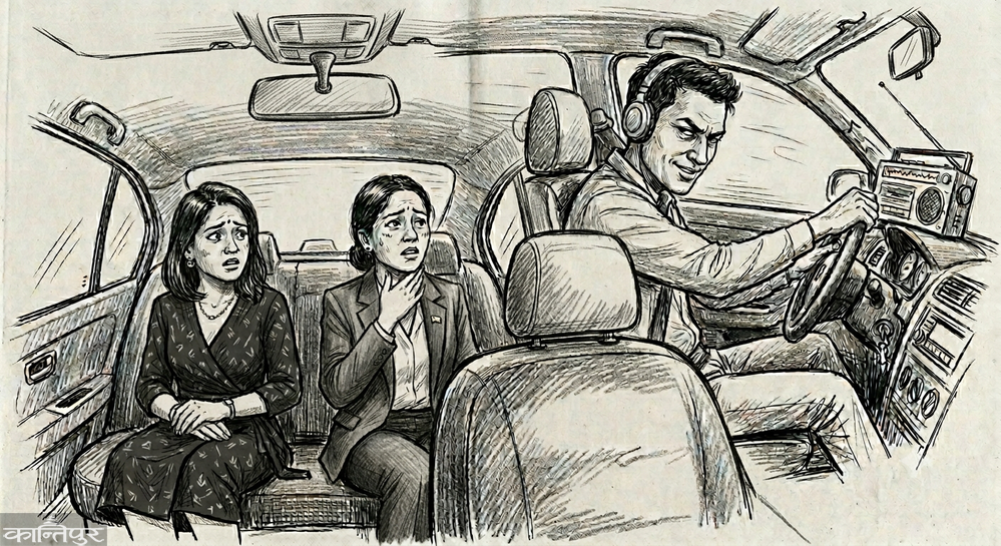
Ride-hailing platforms should provide drivers with training not only in driving skills, but also in gender sensitivity, passenger rights, and dispute management. What action was taken after a complaint was filed against a passenger? Passengers should know that.
We use Google Cloud Translation Services. Google requires we provide the following disclaimer relating to use of this service:
This service may contain translations powered by Google. Google disclaims all warranties related to the translations, expressed or implied, including any warranties of accuracy, reliability, and any implied warranties of merchantability, fitness for a particular purpose, and noninfringement.
Recently, my friend and I went to Godavari. After spending a few hours there, it was time to return home. It is easy for us middle-class citizens these days – wherever we go, there is an online ride, and now Uber has added even more. We booked a ride from an online app. After 15 minutes, the car arrived, it looked comfortable. It was a comfort class private car. We expected that the journey would be easy and safe. However, the journey was neither comfortable nor safe!
Since my friend has a physical problem in the car, she sat in the front seat. As soon as she entered the car, the strong cold of the AC hit her. After sitting in the seat, she said, ‘Dai, please turn off the AC, we will feel cold again.’ This was not a big demand, it was a normal request.
The driver’s reply was, ‘Shall I buy a jacket?’
Let’s think for a moment – ‘Shall I buy a jacket?’ is a common sentence to hear. But, what was inside it? One, the service provider sarcastically mocking the most common request of the passenger? Two, looking down on a woman? We were speechless. I got angry. I said, ‘Don’t buy it, where are you going to buy it? Didn’t you say you were going to buy a jacket?’ Then the driver didn’t say anything and turned off the AC.
After some time, I tried to open the car window but it wouldn’t open. The driver added, ‘The window doesn’t open, only the AC.’ My friend and I looked at each other, then fell silent again. But, not willingly, but out of compulsion. The real reason for our silence in the middle of the road with an unknown driver inside a closed car was – an unspoken fear. The driver increased the speed of the car unnaturally, drove recklessly. I said, ‘Dai, go slowly, don’t drive at such speed.’ He didn’t care at all. The car kept driving at high speed. We both knew that we had no control over the car – Neither on the AC, nor on the speed, nor on the new situation.
When we were about to reach Bandegaon in Lalitpur, the driver suddenly played a song that shook the car, while we were talking to each other. My friend said, ‘Dai, don’t play it! We are chatting.’ The driver said, ‘I want to listen, I am getting bored.’
I said in a calm voice, ‘Dai, we are your passengers. If you don’t want to listen to us, listen when you are alone.’ He said, shaking, ‘I will listen. If you don’t want to listen, you would have got off and gone to another car.’
‘Yes, stop! We don’t want to go in your car.’ And, we got off on the road.
000
My heart and soul started pounding, my head started aching, I felt like I was having trouble breathing. Was I getting angry or was it just a feeling of sadness? I didn’t know, but hatred for the country and society started to rise. I got angry thinking about the state of public transport in the country. My heart started to pound thinking, ‘I don’t have my own car.’ I knew that such thoughts were not rational. But, at that moment, my mental state was the same. My friend and I couldn’t even speak to each other, we stood in silence on the road for a long time.
With one button, the car arrives at the ‘location’. But, is traveling with these apps easy, safe and comfortable? Serious discussion is needed. My friend said, ‘I was afraid that if I drove at speed, I would crash the car somewhere.’ Even when I tried to pay for the service, we had reached a point where we had to worry about our lives. We were feeling physically and mentally unsafe. We were traveling in a closed car, under the control of a stranger and without any control over ourselves. Now that incident has created a fear in our minds. That fear remains even when we book a ride the next time, even when we walk alone on the road.
After that incident, we filed an official complaint on the app. The answer came – that driver never received a notification from us. We thought – at least the platform would take action or hold the driver accountable or at least give us minimum information. But, after that, there was no response, no confirmation! Did that app warn that driver? Was the driver's account suspended for a limited period? Did anyone read our complaint? We do not have the answer to these questions. The same driver also runs Uber, Yango, InDrive, Pathao. When you file a complaint on one platform, the other platform does not have any information. So the same behavior, the same driver! And the same incident may repeat with another female passenger on another app! Perhaps it is repeating!
000
On the same day, the government was releasing the budget 2083/084. In the budget, the Finance Minister was saying that digital innovation was prioritized. Startup ecosystem, technology-based service expansion, and digital infrastructure were being talked about. These apps also fall under technical services. Today, the streets of Kathmandu are crowded with Yango, InDrive, Pathao, and Uber apps. With the press of a button, the vehicle arrives at the ‘location’. And, for the middle class, this is undeniably convenient, and even a blessing.
Let’s look at the history of ride hailing in Nepal. In 2017, the Nepali app Tootle was launched. Tootle understood Nepali roads and the needs of Nepali passengers. However, that app was shut down. Then came the publicity – the Bangladeshi company Pathao, the US-registered InDrive, the Russian company Yango, and now the American multinational company Uber. All these apps are foreign companies. The commission on every fare paid by Nepali passengers after traveling easily, the platform’s profit, and data on Nepali roads all go abroad. Nepali drivers earn money, it is true. However, the decision-making power, policy-making power, and the main part of the profits remain outside the country.
There was an attempt to create a domestic alternative through Tootle, but it did not last. And now we are dependent on foreign apps, which the Nepali government has not even been able to regulate. The ride-hailing sector in Nepal continued to operate without legal recognition for 7 years. The Patan High Court had directed to regulate it in 2020. The Supreme Court reiterated it in 2024. It was only in 2024, 7 years after the service started, that is, it was amended in the Industrial Enterprises Act and made it legal. However, to this day, most urban ride-hailing activities take place in the country's capital, Kathmandu. And, there is no clear operational guideline implemented there.
What can happen in the absence of regulation? Our experience has shown that. Drivers are not accountable. There is no reliable means for passengers to complain. And, the guarantee of safety is limited only to the marketing materials of the platform. Complaining is an act of courage. Many passengers (especially women) do not complain due to inconvenience, embarrassment, or distrust of the system. We complained. However, if you don't get a response even after filing a complaint, how do you muster the courage, enthusiasm, and determination to file a complaint in the same incident again?
The insecurity of women passengers is a common challenge across South Asia. After the 2012 Nirbhaya incident in India, Uber and Ola added a 'panic button' and introduced new safety features. However, data from 2024 shows that 29 percent of women still consider public transport to be a major place of harassment, and this rate is double for women under the age of 24. Technology has been added, but the problem remains the same. A 2025 study showed that lack of gender sensitivity, lack of action on complaints, and a culture of not addressing them are the main causes of harassment of women in Dhaka's public transport in Bangladesh. These reasons are not related to technology, but to mentality. According to a survey by the United Nations Women and the Aurat Foundation in Pakistan, up to 90 percent of women have experienced some form of harassment while traveling. This situation eventually forced the birth of a separate ride-hailing service for women called ‘Visisters’ in 2025, where both the driver and the passenger are women.
Nepal is currently in a comparatively better position than these countries. Ride-hailing has increased women’s mobility and freedom. However, problems such as offline rides, lack of complaint mechanisms, and lack of accountability among drivers are widespread. If these problems are not addressed, Nepal is sure to become like those countries where violence against women in public transport continues.
Whether it is Yango or InDrive – if these platforms only teach their drivers driving skills, and do not teach them responsibility and respect for passengers and do not consider it necessary, then we need to rethink our mindset. ‘Should I buy a jacket?’ An online rider who is flirting or honks at the car in a scary way may not be a big deal to everyone. It does not cause turmoil in the stock market, it does not play any role in climate change. When the government is busy with issues like the India-Nepal border dispute, discussing such online rider apps should not be the government's priority. However, every Nepali citizen should ask himself - do incidents like murder, rape or robbery have to happen to argue?
It would have been better if we had remained silent, saying that this is a common incident for a country where a teenage mother in remote Karnali is losing her life because she cannot go to the hospital. However, I could not remain silent. This is not just my personal incident. Even when we travel in our own country, on our own roads, we are in fear and trauma, let alone respect, along with convenience. And, what government agency window number should we go to for mental safety due to the misbehavior of a driver?
Not all online drivers are the same. I have met many drivers who have safely taken us to our destination when we are in trouble. I have also thanked those drivers from the bottom of my heart. I have also given a five-star rating. However, the situation is not always the same. And, in such a situation, one person's article is not enough to bring about a small change. For that, the state must step forward. It is the right of every passenger to travel safely. It is the responsibility of the government to ensure that right.
Ride-hailing platforms must provide mandatory training to drivers not only in driving skills but also in gender sensitivity, passenger rights and dispute management. And, what action was taken after the complaint? Passengers must be informed. That is not an option, it is the responsibility of the online platform. The government should implement clear operational guidelines. When the government raises the slogan of digital innovation, it should create an environment for indigenous apps to survive and flourish. No matter how many ride-sharing apps come in the country, no matter how much technology is talked about in the budget, the driver of a normal ride-hailing app misbehaves with citizens and is not accountable, and the passenger's complaint disappears, and passengers are forced to stand on the road with many questions, fears and feelings of inferiority. What issues of society has this development model covered? Which issues has it ignored? Serious introspection is necessary.