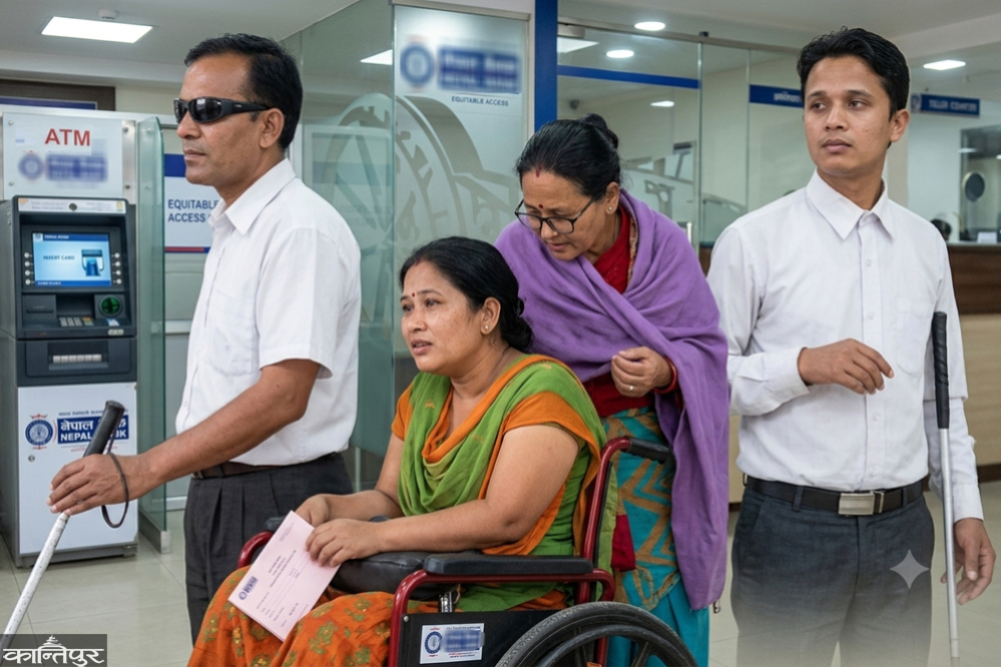
Their efforts to become customer-friendly are visible. However, in this process, the work of making transactions easier for people with disabilities is being neglected. This category especially has to face inconvenience when they have to be physically present at the bank.
We use Google Cloud Translation Services. Google requires we provide the following disclaimer relating to use of this service:
This service may contain translations powered by Google. Google disclaims all warranties related to the translations, expressed or implied, including any warranties of accuracy, reliability, and any implied warranties of merchantability, fitness for a particular purpose, and noninfringement.
Millions of people are outside the country for income, they must be connected to the banking process. The private sector is growing within the country, which has helped in increasing formal employment and economic transactions, and such transactions are usually done through the banking process. Purchasing power has increased and in turn, banking transactions have also increased. Government supervision of financial transactions is also increasing, policies and regulations have been made accordingly, due to which the banking process has become mandatory for financial transactions.
In addition, banking transactions are becoming easier for people with financial awareness. Amidst all these needs, the banking sector in Nepal is also becoming competitive. Their efforts to become customer-friendly are visible. However, in this process, the work of making transactions easier for people with disabilities is being left out. This category especially has to face inconvenience when they have to be physically present in the bank. Therefore, it is necessary for banks to take seriously the issue of making their physical and digital services disability-friendly and improve them.
A character who helps people with disabilities understand how difficult it is to deal with banks is Sita Gyawali, a teacher at Laboratory Secondary School in Kirtipur. Completely blind by birth, she can do all her work herself. She uses her mobile phone and uses digital materials. But when she has to work at the bank, she needs help. Especially, she needs another person to put on her lapel and fill out forms. Similarly, Prajwal Subedi, who is hearing impaired, faced communication problems when he reached the bank because his mobile banking was 'locked'.
It is difficult for people with physical disabilities to reach a bank on the top floor of a large building. People with different types of disabilities face difficulties in different ways. People with physical disabilities often find it difficult to reach a bank when it is set up on the top floor of a large building. People with hearing impairments find it difficult to communicate easily with bank officials. People with visual impairments have to be wary of privacy since they have to obtain banking details in the presence of a third party. The problems of people with other or multiple disabilities have also been expanding accordingly.
According to the National Census 2078, the population of people with disabilities is 2.2 percent. Many of them are involved in various professions or businesses. That is, they are involved in financial transactions. Since they are connected from education to employment, their financial access has also increased and their interactions with banks have also increased. It is certain that this will become or will have to become a universal means of income and expenditure in the coming days. At present, bank buildings, ATM booths, digital services and service delivery systems have not been fully disability-friendly.
As a result, visually impaired, hearing impaired and wheelchair users have to face various obstacles in accessing banking services. Therefore, it is imperative to ensure easy banking access for this group and increase investment in physical and digital infrastructure for that. For that, the state should make policy arrangements and ensure implementation.
Nepal Rastra Bank has recently amended the ‘Unified Directive, 2082’ and issued directives to licensed banks and financial institutions to expand senior citizen and disability-friendly services under the Simple Banking Regulation. According to the directive, banks and financial institutions should make at least one branch in each local level disability-friendly and arrange ATM booths with ramps, Braille signs, control buttons and audio support in such branches.
Such facilities will increase banking access for people with disabilities and make it easier to use it effectively. Not only should the physical and digital dimensions be made disability-friendly, but its mandatory implementation should also be ensured. Action should also be taken against banks that follow the directive. But the practical problems of banks should also be addressed.
An additional aspect that needs to be discussed in connection with this topic is that access to banks for all types of people should be increased. According to the Sixteenth Plan, the figure of families who have access to banks and financial institutions in the fiscal year 2079/80 is 63 percent. The target is to increase this to 85 percent by 2085/86. Data shows that banking access is not encouraging in a country with a population that finds traditional methods of financial transactions easier due to geographical remoteness, difficulty in expanding financial institutions, weak financial awareness, and traditional methods of financial transactions.
Therefore, in addition to facilitating access, the state also needs to increase financial awareness. It is necessary to make the banking process easier. If financial transactions can be linked to the banking process as much as possible, financial distress will also be reduced. Mainly, the policies adopted by the state and the programs made mandatory need to be disability-friendly.