The mountains were shaken not only by the earthquake, but also by the bulldozers that were driven through the mountains in the name of development. Deep wounds were created in the mountains along with the roads, which increased the problems of landslides, landslips and the risk of settlements with rain. The development that was supposed to make them safe has added to the insecurity.
We use Google Cloud Translation Services. Google requires we provide the following disclaimer relating to use of this service:
This service may contain translations powered by Google. Google disclaims all warranties related to the translations, expressed or implied, including any warranties of accuracy, reliability, and any implied warranties of merchantability, fitness for a particular purpose, and noninfringement.
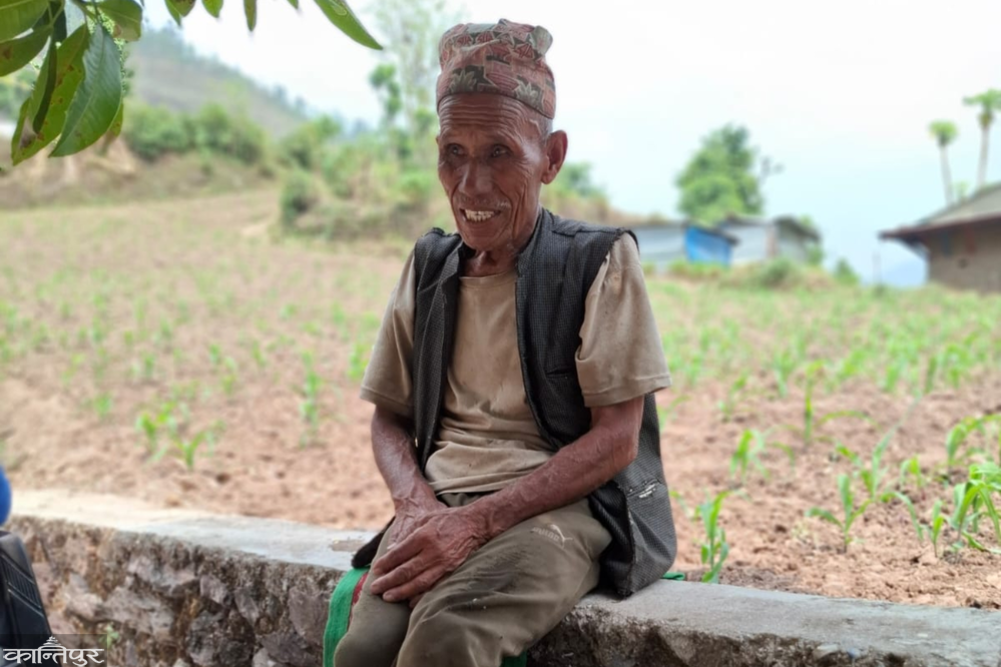
The history of a country is often written in the capital, but the real history of development is written on the feet of a person walking. Man Bahadur Rawal is 81 years old. His date of birth is written on his citizenship. However, his life history is not found in government documents. When he was found in Pipalchaur, Nalgad Municipality, Jajarkot, he named a place that is now forgotten - 'Koilavas'. When he pronounced that name, it was as if he was remembering an old relative. Koilavas is a historical southern trading post in Dang district.
There was a time when salt, clothes, medicine and sometimes even dreams came from Koilavas. A person leaving Jajarkot would take twelve days to reach there. Another twelve days to return. After a twenty-four-day journey, the salt would arrive at home. For Man Bahadur, Koilavas is not just a post, but an era. Sometimes posts are born not by the city, but by the road. And the road itself kills them. Development does not treat all posts equally. Roads lead somewhere to life, somewhere they drag away life. Development eventually brought the road to Koilavas. However, by the time that road arrived, Koilavas had lost its former importance. The state usually reaches where people are tired of waiting.
Man Bahadur Rawal was not a historian. He was not a constitutional scholar either. He did not have any statistics in his hand. However, he had his own life. He said, ‘There was great sorrow during the king’s time. Happiness came after the president came.’ Intellectuals in Kathmandu and Dang are debating the success or failure of the republic. However, this old man from Jajarkot defines republic in a different way. For him, republic is not a section of the constitution, but an experience of the days of the journey that have decreased. The common citizen does not evaluate political change the way the elite does.
This old man from Jajarkot measured the republic not from the preamble of the constitution, but from his own feet. This old man from Jajarkot measured the republic not by the preamble of the constitution, but by his feet. The path in his life has shortened. The distance has decreased, the market has become closer. Therefore, he says, ‘Happiness has come.’ This sentence should not be taken lightly. Because the final test of the great changes in history is not in the parliament, but in the experience of the common people. The republic in Kathmandu was a political event. For this old man from Jajarkot, that twenty-four days of walking were a life experience.
Constitutional scholars explain the value of systems, but the common people derive their real meaning from the calculations of their own lives. The republic should be evaluated not only from political ideals, but also from the changes in the daily lives of citizens.
Poor people do not describe political changes in the words of political science. They speak in the language of their lives. If the travel time is halved, then in their dictionary it is called 'happiness'.
I was climbing the hills of Jajarkot, towards Barekot Limsa. Evening was descending on the hill above. Somewhere, cow and goat bells were ringing. An old woman was sitting in the courtyard. I asked, ‘How many people are there in the house?’ She looked at the mountain and said, ‘Everyone is there, but no one is there.’ That answer was the story of the entire mountain. The son is in India, the grandson is in the city, the daughter-in-law is in the field. The house was standing, but the life inside the house was gradually disappearing.
The earthquake crack was still fresh in the courtyard of one house. A voice came from there, ‘The house will be rebuilt, father, where will the people come from?’ There, I felt the sorrow of the mountain more than the poverty of life becoming empty. There is only one Nepal on the map, in experience, there are still many Nepals. There are no locks on the doors of some houses, but no one is inside. There is a stove, but no smoke. There is a courtyard, but no children playing. This scene does not say anything by shouting, but its silence speaks volumes.
So when you look at the mountain, do not just look at the greenery, listen to its silence too. There are thousands of unfulfilled promises, countless postponed dreams and a hope that has been repeated for generations – one day the state will really arrive, one day it will step down from the development discourse and enter life. The market was closer when the road reached this settlement. However, the farmer's son had already reached Muglan by then. Development came, but he did not meet the person he was waiting for. The footsteps of the state are visible here. However, the time of the mountains and the time of the government are moving at different speeds. Problems arise in the lives of citizens today. The solution sometimes arrives years later.
The lack of a state here does not mean that there is no state on the map. There are administrative boundaries, government offices, or elected representatives. But what is the real meaning of the state? The state is the ability of citizens to experience rights, services, security, opportunities, and justice. If a pregnant woman has to risk losing her life without receiving treatment, if a student drops out of school because she does not have a teacher, if a citizen has to walk for days for basic services, then even if the state has a legal presence, the feeling of the state remains weak. The meaning of the state is also the feeling that citizens have found support in times of crisis. Political theorist Max Weber defined the state as an institution that exercises legitimate authority. However, in modern democracy, the legitimacy of the state does not come only from the exercise of authority. It comes only after it has a positive presence in the lives of citizens.
The earthquake of Kartik 17, 2080 destroyed homes. However, it also revealed something else – the real pace of the state. Bir Bahadur Giri, chairman of Barekot Rural Municipality, said, ‘Kathmandu is still far away.’ In government reports, it has been many years since the state reached the local government. However, the people’s representative was not talking about geography. He was talking about the state experienced by citizens in times of crisis. Eight years after the earthquake with the epicenter in Barpak (Gorkha), the earthquake with the epicenter in Barekot occurred. The lives of local victims are still difficult.
The time it took for rescue to arrive after the earthquake, the delay in relief, the speed of reconstruction, the complexity of the administrative process – all of these raised an old question again. How far has the state reached? The problem is not that the state is absent. The problem is that when a disaster tests the state’s capacity, the state’s response seems slower than the suffering of its citizens. The earthquake destroyed roads and schools. However, it also showed the limitations of the administrative structure. How quickly can a country reach its remote citizens? The answer to this question is the measure of the real strength of the state.
The distance from the federal capital is not measured in kilometers, but in the time it takes to reach the state in times of crisis. The earthquake not only shook the houses in the mountains, it also showed the distance remaining between the state and the citizens. Therefore, the sentence ‘Kathmandu is still far away’ is not a comment on geography, but a comment on governance. The Bhoomanchhe of Jajarkot shared the experience that the republic has made life easier. However, the earthquake also showed another truth – the state has come, but it has not reached all citizens at the same speed.
Another comment by Chairman Giri was also meaningful, ‘The system and trend are against federalism.’ This is not an opposition to federalism. It is a comment on the incomplete journey of federalism. There was less disappointment in his statement, more experience.
Federalism is not just a list of rights – it is a system where decisions are made where they have an impact. System i.e. rules, process, structure. Trend i.e. thinking, culture, habit of exercising power. Nepal created a federal structure. But did it also create a federal mindset? The disaster raised an old question again. If the local government is the first responder to a crisis, does it also have the right to make the first decision?
It was not only the earthquake that shook the mountains the most, but also the countless bulldozers that were driven through the mountains in the name of development. The constitution has given the municipality the right. Now the question is, ‘Has the culture of the state also accepted that right?’ The shadow of Sihandarbar still seems longer than that of local government in many places. When the power of decision remains at the top and the responsibility is transferred to the bottom, then federalism is in the structure, not in the culture.
It was not only the earthquake that shook the mountains the most, but also the countless bulldozers that were driven through the mountains in the name of development. The road came, but in some places it left such wounds in the body of the mountains that with the first heavy rain, the soil started flowing, the fields started slipping and the settlements began to be at risk. The irony is that the development that was brought to make the people of the mountains safe sometimes increased their insecurity. Earthquakes destroy houses, it is seen. However, uncontrolled dozer development weakens the womb of the mountain. It is only gradually visible. Therefore, today, in many remote settlements, the question is not just whether the road has reached or not. It is also whether the road has saved the mountain or is slowly destroying it.
The problem of the mountain is not that it is tall. Its problem is that it is often seen from afar, but the effort to understand it up close has been reduced. For the flat Terai, the mountain is a sight. It is a tourist attraction. It is the beauty of a postcard. However, people do not live inside the postcard. People live in those houses, where the stove burns in the evening and the footsteps carrying water jugs can be heard climbing up early in the morning.
The problem of Jajarkot is not that it is a mountain, but that it is not a priority for the state. I heard the words of a folk song from one house. In that song, I read the biography of the mountain. The folk song shows what the statistics do not show. There is sadness in the villages of Jajarkot, but there is no defeat. It is as if the mountain has taught its people an invisible lesson. Persistence is also resistance.
The suffering of the hills is actually more a matter of politics than nature. Nature gave it height, but policies have neglected it many times. Therefore, calling the suffering of the hills only geographical difficulties is an incomplete truth. The real question is, why hasn't the flow of development reached where the citizens had reached? Jajarkot is not poor because it is in the hills. Jajarkot is poor because development decisions are made without the voice of the people living there.
Today, when we talk about development, the hills ask a fundamental question - does development mean only roads, bridges and buildings? If roads are reached but hospitals are not reached, electricity is reached but opportunities are not reached, democracy is reached but the sensitivity of the state is not reached, can the suffering of the hills really be reduced? Ultimately, the suffering of the hills is not the suffering of height. It is not the suffering of being far away either. That suffering is not only of poverty, but of waiting for decades to see the path of development, opportunity and respect.
The river is flowing. It has seen kings, it has seen Rana, it has seen Panchayat, it has seen a republic. However, the wait for the villages on the coast is still going on. Life in the village of Man Bahadurs is like a river. Someone utters a word of sorrow, the villagers join in. Even in the midst of poverty, mothers do not stop singing ‘Magal’. Perhaps hope is the greatest asset here.
When returning from Jajarkot, I did not measure the height of the mountains, I measured the patience of the residents. And I learned that – mountains stand on the map of the nation, but the real height of the nation is seen in the lives of the people. The success of democracy should be measured not in Singha Durbar, but in the journey of Man Bahadur Rawals. Here, the road is not just a means of measuring distance, but also a measure of the presence of the state.
The Man Bahadurs of the hills and Madhesh do not demand much from the state. A pinch of happiness is enough for them – a pinch of respect, a drop of security and a drop of ease. But the irony is that the biggest test of democracy also depends on whether this small pinch can be filled or not.