In addition to financial investment, reputable brands can also enter Nepal in collaboration with local investors. This can inspire local investors and help elevate Nepal's image in the international community.
We use Google Cloud Translation Services. Google requires we provide the following disclaimer relating to use of this service:
This service may contain translations powered by Google. Google disclaims all warranties related to the translations, expressed or implied, including any warranties of accuracy, reliability, and any implied warranties of merchantability, fitness for a particular purpose, and noninfringement.
Rapid economic development and prosperity have been the long-standing desire of Nepalis. The country does not have the financial capacity to address such desires. A small amount is allocated for development in the budget of each fiscal year, but even that cannot be spent. For the same reason, employment has not been created here. Which has played a role in spreading the vicious cycle of poverty. In such a situation, small efforts by the state are meaningful, but more foreign investment is inevitable.
Which can attract investment in areas where the state itself and private investors within the country have not been able to pay attention or have not dared. In addition to financial investment, reputable brands can also enter Nepal in collaboration with local investors. Which can inspire investors here, help improve Nepal's image in the international community. All these issues are initiatives to create jobs, increase revenue and increase confidence in other investors. Such issues play a cyclical role in economic growth.
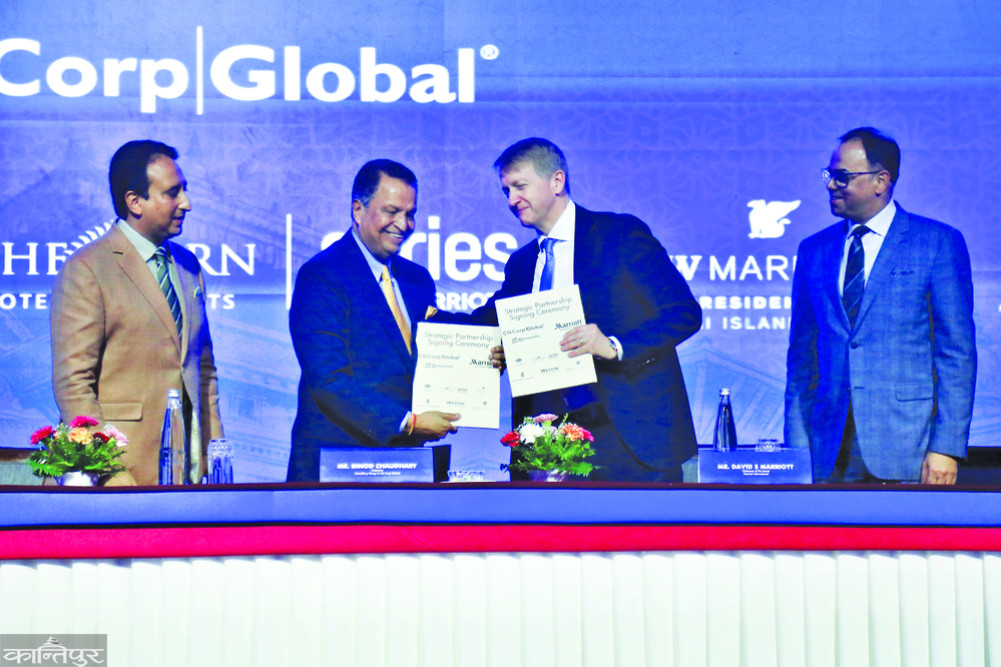
If such investments can be made in large infrastructure, the need for infrastructure will be met, and the burden of the state's obligation to spend on infrastructure will be reduced. Marriott International's luxury brands, Ritz Carlton, Westin Hotels and JW Marriott, which operate 9,900 hotels worldwide, are set to enter Nepal. Marriott International Inc. has signed an agreement with Chaudhary Group's hospitality wing 'CG Hospitality Global' to provide services under two brands. According to IEG, a Nepali investor group involved in the construction of these hotels, at least Rs 13 billion is being invested in both hotels. These hotels will employ at least 2,000 people. According to the agreement, both hotels (Westin and Ritz-Carlton) are targeted to be operational by 2028 and 2031, respectively, CG Hospitality has stated.
Similarly, Marriott International has signed an agreement with Capital Hotels and Hospitality Limited under MS Group for a luxury hotel under the JW Marriott brand. The cost of the hotel is estimated at Rs 9 billion. Although there will be no foreign investment, Nepal will benefit from the establishment of hotels of prestigious brands. For example, modern technology can be introduced in the hospitality sector. There can be a flow of world-class skills for hospitality. Establishing a hotel here means attracting high-class tourists and business guests. Of course, those who have used Marriott services in other countries are more likely to choose the same brand here as well. There is a possibility of getting employment opportunities here, and with that experience, there is a greater possibility of getting employment in this sector worldwide.
Foreign investment in Nepal is only minimal. For example, in the fiscal year 2079/80, 6.17 billion foreign investment was received. In 2080/81, it was 8.4 billion and in 2081/82, it was 7.3 billion. By April 2082/83, it has reached 11.12 billion. Although some investment has increased in the current fiscal year, it is only less than our expectations. This cannot significantly contribute to the economic growth rate we desire. Therefore, efforts to encourage foreign investment or investment are meaningful for us at this time. For example, the presence of a prestigious brand like Marriott in Nepal can motivate investors from other sectors to invest in Nepal.
Increasing foreign investment helps us meet the resources that we are lacking for investment. If such investment can be brought in for large infrastructure, the need for infrastructure will be met, and the burden of the state's obligation to spend on infrastructure will be reduced. The revenue received from foreign investors will increase the economic strength of the state. Which can be spent on welfare sectors such as education and health that benefit the citizens. In this process, from technology to skills will be imported. Efficiency will be transferred. The morale and competitiveness of domestic investors will increase. Mainly, employment opportunities will be created.
Foreign investment is also necessary. There is such a desire. But it is not being able to come in. The reasons for that have been discussed for a long time are issues such as distrustful and control-oriented policies and laws, cumbersome procedures, political instability, unstable policies, etc. Since a strong government was formed in the 21 Falgun elections, there is no problem of political instability. The government has given a message through the budget that it is trying to create some investment-friendly environment. The government has amended the Foreign Investment and Technology Transfer Act to make it unnecessary to seek approval from Nepal Rastra Bank for the return of investment and to provide sufficient information.
The budget also includes ‘convertible’ instruments, project-linked funding and other ‘hybrid’ instruments within the scope of foreign investment. Similarly, it has been said that the pre-approval system will be removed from the automatic approval process of foreign investment and the process of sending money for service fees, royalties and technology abroad will be simplified. How such policies are implemented and how investors interpret them will affect foreign investment.
There is no doubt that foreign investment is indispensable for us. However, our commitments have been superficial and ignored by investors. Therefore, it is necessary for the current strong government to implement the policies practically, and in addition, various concessions and exemptions may also be announced for encouragement. It must be ensured that investors do not face any harassment from the political and administrative sides. Only through this path can we make the country's economy dynamic, lift citizens out of poverty, reduce the state's financial burden, and increase capacity.