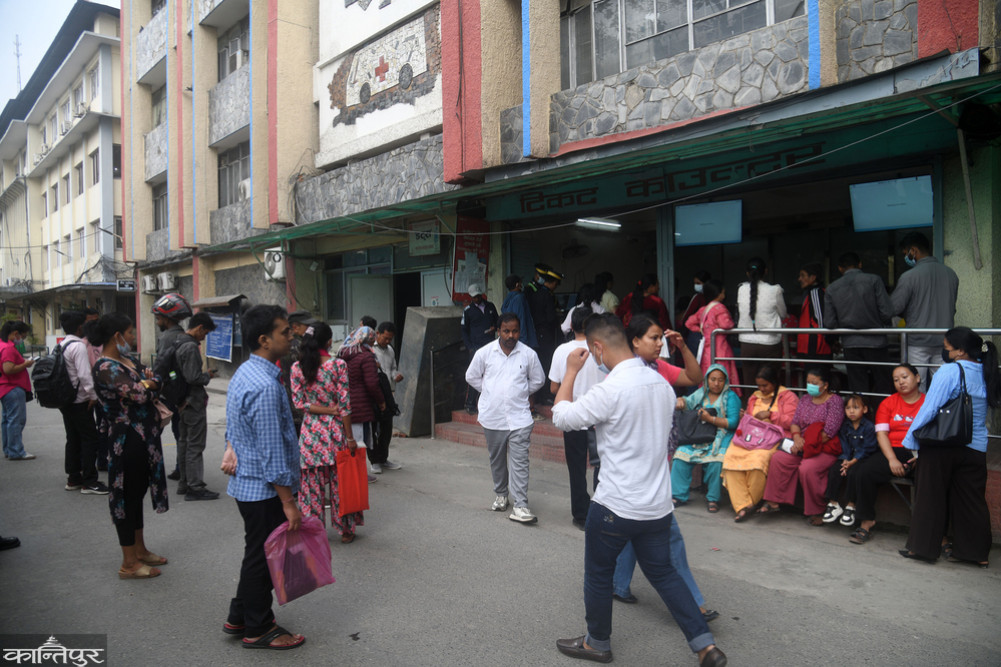
A man who had been admitted to Bir Hospital in the second week of June with unbearable chest pain needed to undergo a PTINR test, but due to a lack of reagents, the test could not be performed and he died.
We use Google Cloud Translation Services. Google requires we provide the following disclaimer relating to use of this service:
This service may contain translations powered by Google. Google disclaims all warranties related to the translations, expressed or implied, including any warranties of accuracy, reliability, and any implied warranties of merchantability, fitness for a particular purpose, and noninfringement.
100 years ago, patients from all over Nepal were forced to adopt traditional treatment methods. Doctors who adopted modern medical methods were not available, and hospitals were not built. In such a context, when Bir Hospital was established in 1947, it led the work of taking the country's treatment system towards modernity. During this period, there have been extensive changes in treatment methods, medical experience, resources, and responsible behavior towards patients.
However, Bir Hospital does not reflect that. If we ignore the general improvements that are taking place over time, this hospital does not have the status of leading the medical field. Patients who are economically and socially 'without options' and mostly from lower classes do come for treatment due to the legacy of this hospital, but they suffer more than treatment. It seems that all areas of this hospital are full of problems. Therefore, Bir Hospital needs to be made healthy at this time, and for that, it is necessary to treat this hospital.
Bir Hospital is often under pressure. The last two contexts have played a role in increasing the pressure there. First, some of the main government hospitals, including Tribhuvan University Teaching Hospital, Manmohan Cardiothoracic Vascular and Transplant Center, Shahid Gangalal National Heart Center, and others, have completely and partially stopped the treatment provided under the health insurance program.
That is why patients choose Bir Hospital. According to the Bir Hospital administration, this hospital, which used to receive 2,000 to 2,500 patients daily before Magh, has been receiving 4-5,000 patients daily since Baisakh. Second, the government has recently decided to give two days off a week. Since Saturday and Sunday are holidays, the pressure of patients in the hospital increases on the remaining days. Although the government's two-day holiday policy is impractical for the hospital, it has not been reconsidered.
Even then, the hospital has to keep its service facilities efficient. The quality needs to be improved. It needs to create an environment that motivates patients to come to it. However, Bir Hospital has failed in such aspects. To some extent, patients who have reached the emergency room for treatment have died without even undergoing the necessary tests. For example, a man who went to the emergency room of Bir Hospital after experiencing unbearable chest pain in the second week of Jestha was diagnosed with a prothrombin time/international normalized ratio (PTINR) test. However, there was a shortage of reagents in the hospital for the test.
The hospital also suffers from a shortage of medicines. After the government issued an ordinance in the third week of Baisakh, the officials of the institution were relieved of their posts, and the tender process for medicines has not been able to proceed. After the test was stopped, further treatment was affected. The patient, who was already in a bed with two other patients, died. It is a very shameful incident for a hospital with a hundred years of history that a patient who had reached the hospital died without even being able to undergo the test that the doctor had concluded. But there are other problems.
Patients have to wait a long time to get some services at Bir Hospital. One example of this is that they have to wait for a year for dental services and six months for dental bonding services. After having to wait for a long time in large government hospitals including Bir, patients are forced to go to private hospitals. There is a big difference in the ticket fees, test fees, and bed fees paid by patients between Bir Hospital and private hospitals. This increases the burden of treatment expenses for patients. Whereas, patients who reach Bir for treatment are generally from the lower class. People come to this hospital for treatment even from remote areas. When Bir's services do not improve and patients are forced to go to private hospitals, the people with weak economic status in the country are most affected in such a situation. Whereas, they are the ones who need the support of the state the most. The government and Bir Hospital administration not taking any initiative to improve the services here indirectly neglects the lower class people.
There is also a shortage of medicines in the hospital. After the ordinance brought by the government in the third week of Baisakh, the tender process for medicines has not been able to move forward. The problem of equipment breaking down in government hospitals and having to go to private hospitals for expensive tests is an old one. Of the two CT scan machines in Bir Hospital, one has been broken for seven months and the other for a month. 90 patients used to benefit from those machines daily. Patients used to get services there for 2,500 to 4,000 rupees, now they have to pay 9 to 10 thousand rupees in private hospitals. Not only the equipment, but even the elevator is broken at Bir Hospital.
After both the elevators designed for disabled patients are not working, it seems that patients are being carried up to the fourth/fifth floor by themselves or on the backs of relatives. Since the tender process has not started, the hospital has even stopped providing X-ray films in envelopes. Nurses and health workers working in the hospital are forcing the relatives of patients to buy them because the administration has not provided masks and gloves.
If the current situation continues, Bir Hospital is sure to lose trust. Its impact will be on the lower classes of society. Therefore, a comprehensive reform is needed in Bir's administrative and service system, including the initiative of the government. The lack of timely tenders for the purchase of medicines and the disruption of the patient's treatment process is not an insoluble problem.
Similarly, the lack of maintenance of equipment and elevators is not an out-of-control situation. Such problems are caused by lack of coordination and not starting the process on time. If the hospital administration takes the initiative and the government facilitates, many problems can be resolved immediately. The government should consider the impact it may have while running the administrative structure of the hospital and adopt sensitivity.
In order to minimize the increasing pressure on Bir, services should be increased in local, district and provincial level health institutions. Quality should be ensured. For that, doctors, equipment and physical facilities should be provided. If the health insurance program is also run in a proactive manner, the pressure on Bir can also be reduced.