Control of drug trafficking is not possible without international cooperation. Drug trafficking networks extend across borders. Therefore, the efforts of one country alone are not enough. For this, bilateral and multilateral cooperation, information exchange, and joint investigation mechanisms must be strengthened.
We use Google Cloud Translation Services. Google requires we provide the following disclaimer relating to use of this service:
This service may contain translations powered by Google. Google disclaims all warranties related to the translations, expressed or implied, including any warranties of accuracy, reliability, and any implied warranties of merchantability, fitness for a particular purpose, and noninfringement.
On 5 Kartik 2082, a letterhead of an organization called 'Extremist Group of Nepal' made public a statement threatening to kill 10 people, including the Chief Commissioner of the Commission for the Investigation of Abuse of Authority, Prem Kumar Rai. During the investigation, it was discovered that the then Director General of the Civil Aviation Authority, Pradeep Adhikari, had threatened Prakash Pathak, who was in the Philippines, with 100 million rupees. In addition, the police investigation revealed that Adhikari had sent Pathak 20 million rupees as a ransom to the Philippines through a hundi.
Hundi business is having a serious and multifaceted impact on Nepal's economy. It has also had a very negative impact on the state's revenue system. In the last week of Jestha 2081, it was revealed that two digital payment companies had made a hundi transaction of nearly one hundred billion rupees in the last two years. During the investigation into the gold smuggling group, the Central Investigation Bureau of Nepal Police revealed that illegal hundi transactions worth about 70 billion rupees were made through 'Pay Well Nepal' and about 24 billion rupees were made through the 'Sajilo Pay' company.
According to a study conducted by Pandikar in 2078 during his doctoral research, Nepali workers working in South Korea send about 44 billion rupees to Nepal every year through Hundi. According to the 'Employment Permit System' branch, the official body of the Nepalese government that sends people to South Korea for employment, about 35,000 workers were working in Korea as of 2075. Out of these, those who went to industrial work earned a minimum of 200,000 per month and agricultural workers earned a minimum of 150,000 per month. Assuming that such workers save at least 150,000 rupees per month on average, it seems that they would save 63 billion rupees every year. But according to Nepal Rastra Bank data, only 18.34 billion rupees entered Nepal from South Korea through remittance companies and the banking system in the fiscal year 2074/75. The difference between the amount entering Nepal through the banking system and the amount earned by the workers was 43.653 billion rupees.
More interestingly, the Korean government has deported many Nepalis for engaging in hundi transactions in South Korea. One example of this is Alok Bania, the then treasurer of the Non-Resident Nepali Association in South Korea. He was deported by the Korean government on 8 Ashad 2076 and returned to Nepal on charges of engaging in hundi transactions. These incidents show the alarming use of hundi for illegal capital flight from Nepal.
What is hundi?
In general, a hundi is a traditional informal and illegal system for transporting money. Hundi is not considered an alternative payment system but a complex mechanism for the flight of capital earned through organized crime and corruption. Hundi has some characteristics. It is based on trust and operates in a small network. It is not recognized by the official system of the state. It is not within the scope of taxation. There is no system of regulation for it.
In addition, illegal activities such as illegal capital flight and money laundering are being carried out using hundi. Its additional features are that no legal documents are required, service fees are very low, exchange rates are attractive, and services are provided at doorsteps. However, the increasing hundi in Nepal is mainly having a major impact on foreign exchange reserves.
A dangerous route for capital flight
Hundi has become the main means of illegal capital flight. Studies have shown that those who want to take property abroad illegally from Nepal pay money to Nepali hundi agents and receive the equivalent foreign currency abroad. Capital flight from Nepal through hundi is taking place at various levels and in various forms. Millions of Nepalis in foreign employment choose hundi instead of formal channels due to its speed and low cost. Businessmen and smuggling groups have been using hundi to make illegal income appear legitimate or to hide assets abroad. On the other hand, businessmen and smuggling groups have been using hundi to make illegal income appear legitimate or to hide assets abroad. In recent years, it has come to light that hundi is being operated under the guise of the banking system, abusing digital payment systems and wallets. This shows not only the weakness of the regulatory system, but also how deep the misuse of technology is.
As mentioned in the article titled ‘Wealth Laundering: Political Administrative Protection in Major Economic Crimes’ published by the Center for Investigative Journalism in 2076, a United Nations study report has shown that 550 billion rupees have been informally transferred from Nepal, among the least developed countries, abroad through the use of means such as hundi.
How is hundi growing?
The reasons behind the growth of hundi business include the state’s policy weaknesses, institutional incompetence, and socio-economic realities. Hundi increases when the formal financial system fails to serve citizens of all sectors and classes equally. In a country with high labor migration, the demand for a fast, cheap, and easy way to send money is high. Hundi flourishes when the formal system cannot meet such demand. But no body has official and detailed details of hundi transactions. According to the data of the Nepal Police, 279 people have been arrested with undisclosed cash from the fiscal year 2075/76 to 2081/82. More than 356.441 million rupees have been recovered from them. The Nepal Police considers this as hundi transactions. The data of the Nepal Police for the last seven fiscal years shows the persons arrested with undisclosed cash and the details of the cash in the table.
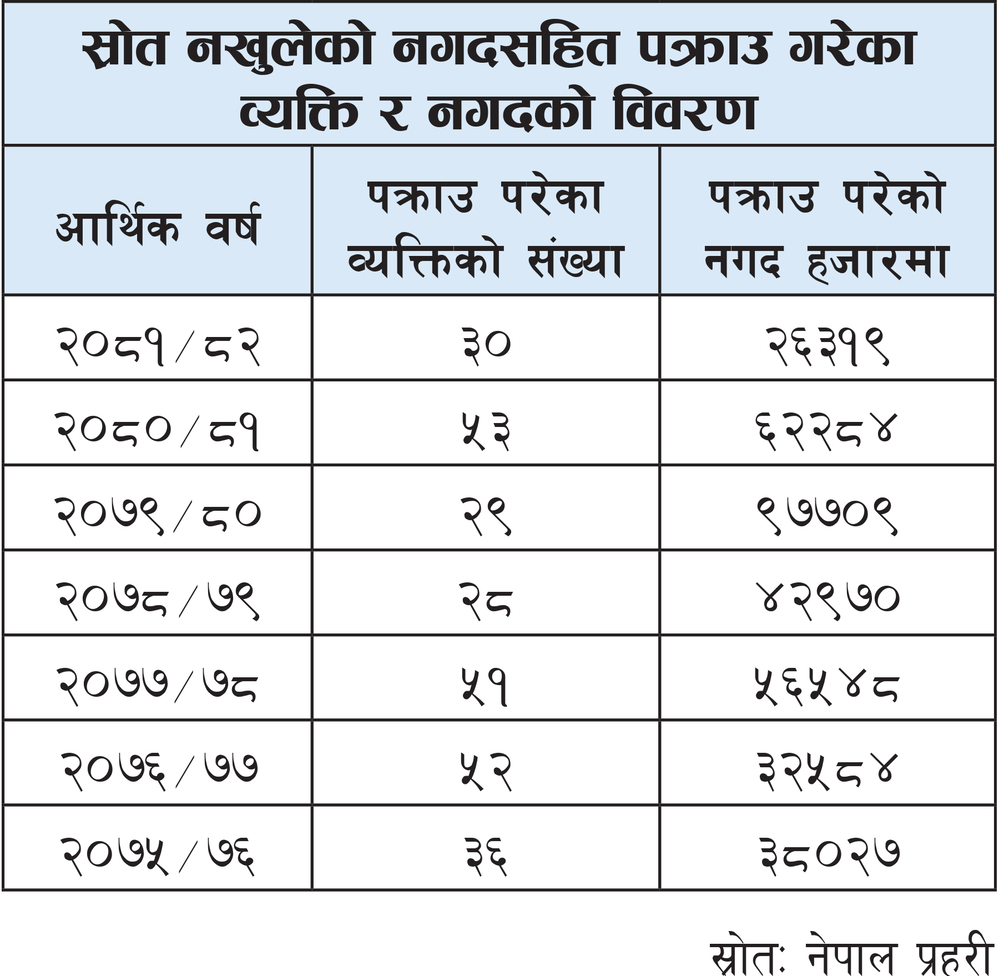
The Revenue Investigation Department also investigates and files cases regarding hundi transactions. In the fiscal year 2077/78, the Revenue Investigation Department filed 54 cases against 114 people on charges of foreign exchange embezzlement and hundi transactions. In which, a total of 4.94 billion rupees was demanded. Similarly, in 2076/77, the department filed cases against 226 people in various district courts in 147 cases of foreign exchange embezzlement and hundi. In this process, a total of 1.22 billion rupees was demanded. On 21 Falgun 2075, the department filed a case against eight people in the Dhanusha District Court for hundi transactions worth more than 4 billion rupees. A study conducted by the Nepal Rastra Bank in 2073 showed that at least 5.9 percent of remittances entering Nepal from abroad come through hundi. However, both the Nepal Police and the department do not have detailed and integrated details of hundi transactions and the cases filed regarding it.
To discourage hundi, the government has taken steps to digitize the payment system and encourage remittances to be sent through formal channels. The Nepal Rastra Bank has introduced a policy of giving one percent higher interest rate than regular for remittances sent through the formal banking system. It has also made arrangements for Nepalis living abroad to invest in the stock market with special priority. The government of Nepal has put forward a plan in the budget for the upcoming fiscal year 2083/84 to make Nepalis who send remittances from abroad, including Nepalis, a millionaire every day through lottery tickets. But despite government efforts, hundi business is booming. There are some reasons behind this.
First, the formal banking system is still not easy, accessible and user-friendly for many. For uneducated citizens in rural areas and workers living abroad, the banking process is complicated, time-consuming and expensive. They are attracted to hundi due to paperwork, hassles of identity verification, service charges and limited banking network.
Second, strict foreign exchange policies are also encouraging hundi. As the government tightens on foreign exchange transactions, it has made it difficult to send money abroad through formal channels. As a result, people are resorting to illegal channels to easily send money.
Third, the capacity of regulatory bodies and the weakness of the monitoring system are increasing the hundi business. Modern financial crimes are becoming technology-based. But regulatory mechanisms are not being updated and technology-based at the same pace. Due to extremely limited manpower, technological weaknesses and lack of coordination, the identification and control of illegal transactions have not been effective. Due to similar reasons, hundi operators have not experienced the risks.
Fourth, corruption and political patronage seem to have made hundi safe. When there is no impartiality in the implementation of the law and some individuals or groups receive political or administrative protection, illegal activities are carried out easily and conveniently. This weakens the rule of law and helps promote illegal systems such as hundi.
Fifth, the rapid expansion of digital technology has, on the one hand, facilitated economic transactions, but on the other hand, has added various challenges. Although mobile banking, digital wallets and online transfer systems are increasing, their effective regulation and monitoring have not been developed sufficiently. This has made it difficult to identify illegal transactions using digital means.
Hundi transactions are having a serious and multifaceted impact on Nepal's economy. It has also had a very negative impact on the state's revenue system. Since economic transactions outside the formal system remain outside the scope of taxation, the government is losing a large amount of tax and revenue. This has reduced the state's ability to invest in schemes including public services, infrastructure development and social security and increased the illegal flight of capital.
Similarly, hundi is facilitating organized crimes. For example, hundi was used to threaten CIAA Chief Commissioner Prem Kumar Rai and others. hundi is being used in illegal activities including gold smuggling, human trafficking, drug dealing, corruption, money laundering. On the one hand, this is expanding the scope of crime, while on the other hand, it is posing a challenge to law enforcement agencies.
The way forward
Limiting hundi control to only legal action and punishment cannot be a long-term solution. The roots of hundi are linked to the economic structure, policy arrangements, and easy and simple access to services. Therefore, the solution also seems to be sought in overall systemic reform. As long as the formal system cannot meet the needs of citizens, illegal alternatives like hundi will continue to be used. Therefore, the following work needs to be done immediately to control hundi.
First, the formal remittance system should be made fast, cheap, simple, and accessible. The process of sending money to Nepali workers working abroad should be easy, low-cost and reliable. If the formal channel starts providing cheaper and simpler services than hundi, hundi users will automatically be attracted to the legal system.
Second, there is a need for strong and effective coordination between regulatory and security agencies. In particular, an effective mechanism for information exchange, joint surveillance and technological monitoring system should be developed between Nepal Rastra Bank, Nepal Police, and the Money Laundering Control Department.
Third, effective regulation of payment service providers and digital platforms is necessary.
Fourth, the legal system should be clarified and strengthened. In the current situation, some legal provisions are unclear or implementation is weak, resulting in impunity. A legal system for strict action and effective implementation is necessary, clearly defining the individuals, networks and elements involved in hundi transactions.
Fifth, citizen awareness should be increased. Many people seem to be using hundi because they are not aware of its effects, potential risks, and long-term problems. Therefore, it is necessary to conduct awareness-raising programs targeting the general public, especially migrant workers and their families. Information should be provided about the benefits of using formal channels, including security, legal protection, and contribution to economic stability.
Sixth, hundi control is not possible without international cooperation. The hundi network extends across borders. Therefore, the efforts of one country alone are not enough. For this, bilateral and multilateral cooperation, information exchange, and joint investigation mechanisms should be strengthened.