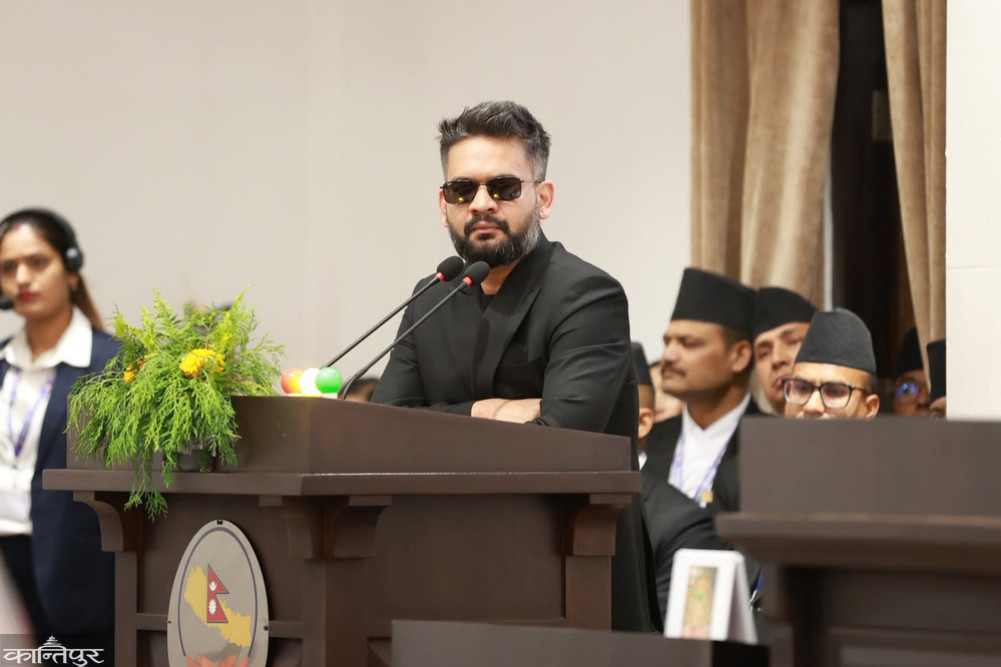
The hot air sown on September 8-9 created a political storm, on the strength of which Balendra Shah became the elected ruler. Isn't he now in the position to sow the geopolitical seeds and reap the harvest of the South Asian geopolitical whirlwind and remain in power for a long time?
We use Google Cloud Translation Services. Google requires we provide the following disclaimer relating to use of this service:
This service may contain translations powered by Google. Google disclaims all warranties related to the translations, expressed or implied, including any warranties of accuracy, reliability, and any implied warranties of merchantability, fitness for a particular purpose, and noninfringement.
Some customs of the state and society are immutable. So far, no constitution has been written using only symbols or emojis. Although words that seem meaningless in secret messages are acceptable, laws and contracts are drafted using only vocabulary with established meanings. The custom of writing news and opinions in newspapers is also born of a kind of established belief. Although this custom is weakening in the so-called 'new' media due to rapid commercialization and the spreading network of propaganda, the attempt to maintain a balance between the restrained impartiality of news and the free-wheeling partisanship of ideas has not yet been completely eradicated in traditional media. As always, even today, the articles of experts that appear on the opinion and viewpoint pages often contain unsolicited and sometimes unwanted advice. The grounds for praising or criticizing the government are not much different from the presentations of regular and 'omniscient' columnists. But the Thought Page is not called the ‘Republic of Ideas’ for nothing. One can also debate concepts other than politics there. Meaning, literature, art and the meaning of life are not rigid disciplines confined within the confines of Western philosophy or Eastern Vedic knowledge. For the vitality of the experience that every society assimilates according to its circumstances, various concepts should also be brought into public debate. In that sense, recently, educationist and poet Min Bahadur Bista, who participated in the famous ‘Sadak Kavita Kranti’ during the referendum period, has brought the issue of social philosophy into discussion by publishing a thought-provoking article ‘Nepali Self-Confidence Imprisoned in the Prison of IQ’ in this newspaper.
Bista is a scholar with a PhD, so there is no question of a lack of factual arguments in his article. The beauty of public debate is that even ordinary commentators can disagree with the conclusions. There is no need to discuss the cultural basis for disagreeing with the IQ test and the average Nepali index that is shown to be lower than normal. That is certainly a way of looking at intelligence in the light of Western prejudice. But it may seem a bit exaggerated to say that collective self-confidence is imprisoned due to the extremely low IQ shown. There are few regular participants in the ‘seminar circuit’ who have not heard the complaint or appreciation that the self-confidence seen in Nepalis, compared to other countries in South Asia, sometimes crosses the border into arrogance. Perhaps such a contradictory trend is not as inconsistent as it sounds. If a lack of self-confidence leads to a tendency to introspection, a sense of self-aggrandizement arises. In a state of inferiority, a lack of self-confidence can appear as arrogance. In such a situation, people who lack self-confidence put on a cloak of arrogance to hide their insecurities, weaknesses or imperfections.
Behavior that appears confident or superior from the outside can actually be an expression of inner insecurity. In this way, arrogance sometimes manifests itself not as a sign of strength, but as a sign of lack of confidence. In Nepalis, the fact that chauvinism, which arises from a lack of confidence, appears as a collective narcissism was included in a comprehensive study report by psychologists at Michigan State University. According to the report, narcissism manifests itself in some countries like China as a ‘hunger for admiration’ (narcissistic admiration) that shows oneself to be great, proud, and expects praise. The attitude seen in Germany or South Korea, which shows oneself to be superior by putting others down or wants to see others fail, is called ‘narcissistic rivalry’. It would probably be more appropriate to analyze the ‘achievement’ that Nepalis appear at the top of both lists of collective narcissism according to some other concept than the IQ index.
The argument that it is relatively easy to keep a society with a high level of collective narcissism in the status quo is confirmed by the inertia of the 104-year Rana regime and the 30-year Shah regime, and the strong desire for stability among democratic politicians after 2013. The September 2025 Green Belt uprising became inevitable after democratic politics lost momentum, although the violence, arson, and looting that occurred during that period can never be justified. The killing of the frontline students who attacked the parliament building by using human shields is extremely tragic, but the prison break, beating of police, and burning of ordinary people alive based on that is a crime of the highest order. There is no way but to be surprised by the stupid naivety of those who say that the simultaneous fire in the legislature, judiciary, executive, media, presidential palace, and businessmen's businesses was simply an explosion of public anger. But is Nepali society, which has been stagnant for a long time, about to fall into the trap of invisible political operators who are greedy for disruption as it moves from ‘dictatorship’ to ‘business economics’ to the era of numerical mechanisms (algorithms) and artificial intelligence? What is the common sense of democratic culture? Even uncomfortable questions should be acceptable in public debate.
Behavior that appears confident or superior from the outside can actually be an expression of inner insecurity. In this way, arrogance sometimes manifests itself not as a sign of strength, but as a sign of lack of confidence. Perhaps it is mentioned somewhere in the dialogue between BP Koirala and Ganeshraj Sharma – Nepal does not have to worry much about geopolitical risks, because the clash of interests of distant superpowers and neighboring middle powers does not allow instability to stabilize in this complex geography. One thing to add to that is that due to lack of resources, limited markets and underdeveloped technology, the geopolitical weight of this country has not been significant to date. It is natural for a country sandwiched between two huge neighbors to always be in a challenging situation. In geo-strategic matters, which must be conducted by combining all such limitations, the need to be extremely cautious is being covered up by the collective self-absorption prevalent in the leadership. With the prevalence of communication technology, its impact is immediately visible. Prime Minister Balendra Shah's first address to the parliament, pointing out the issue of Nepal and India encroaching on each other's land and expecting the involvement of a third country to solve the problem, can be called a mirror image of Khadga Prasad Sharma Oli's foreign policy - in which even though the direction of the ears changes due to the game of mirrors, the 'nose' in the middle of the face remains where it is. But it is not considered wise to keep repeating unsuccessful experiments without changing any of the components. Such actions are done either by a fool or by a very clever person.
A politician who has managed to seize power within a few months by controlling narrative, dominating the government and killing the party leadership on the strength of two days of turmoil must have a very high level of practical ability and emotional intelligence. Even if one's thinking is not mature, one needs sufficient intellectual ability to implement the plans of the operators. Is the shaky India policy of the Shah government, formed with a nearly two-thirds majority based on expressions that change from soft to hot in an instant, immaturity or a well-thought-out geopolitical disruption? Since there is no clear evidence yet, it would be more appropriate to analyze the existing uncertainty based on conceptual analysis rather than factual analysis.
No matter how much RSP President Ravi Lamichhane and Shah government Foreign Minister Shishir Khanal have rambled after reaching New Delhi a few days ago, there is no ambiguity or ambiguity in the Prime Minister's well-thought-out parliamentary speech. In his presentation, he has presented the issue of border encroachment as multilateral rather than bilateral. There is no room for doubt in his claim that the UK should participate in the verification of the revised map by the Nepalese parliament along with Nepal, India and China. The hot air sown on September 8-9, 2025, had created a political storm, on the strength of which the Shah became the elected ruler. Is he not now in a position to sow geopolitical seeds and reap the harvest of the South Asian geopolitical whirlwind and remain in power for a long time? Since the essence of citizen surveillance is not to always give the government the benefit of the doubt, but to always keep it under suspicion, it would perhaps be appropriate to observe the ‘continuous disorganization’ of the Shah government’s foreign policy through the lens of the concept of an ‘independent but dependent state’ (client state).
The Bond of the Treaty
The Gorkhali conqueror Prithvi Narayan Shah, with bravery and cunning, began to draw the map of modern Nepal to expand his dominion with the tip of his hoe, khukuri, and sword. At a time when the Mughal Empire in India was on the decline and the Qing rulers of China were reluctant to spread their influence beyond the Himalayas, it was not difficult for Bahadur Shah's Gorkhali to expand their kingdom in the lower Himalayan region, where the Bhure-Takures were in trouble. After the East India Company established its dominance from Bengal to Awadh, the Gorkhali khukuri had to be dedicated to the service of the largest multinational corporation in history. The Sugauli Treaty was possible only after the defeated side accepted the terms of the victor. By entrusting the strong thighs and strong arms of the youth of the martial race to the government, Mukhtiyar Bhimsen Thapa had taken back the ownership of eastern Madhes and saved the prosperity of the Gorkhali elite, although such an 'achievement' did not save his life. It is not unreasonable to speculate that some Gorkhali elite families who wanted to get closer to the East India Company may have been involved in the downfall of Mukhtiyar Thapa.
There is no authentic history of the Gorkhali army going to war to expand or defend Nepal's borders after Mukhtiyar Thapa, who met an ignominious death. Therefore, compared to the question of the national poet Madhav Prasad Ghimire, 'To which power, when did we bow?', poet Bhupi Sherchan's 'I think the history of my country seems more factual, although depressing.' However, no matter how wrong it may be, written history will continue to stir the mood for generations. Although the wound of the Sugauli Treaty has been there for more than two centuries, it has not yet been allowed to heal. The East India Company, which succeeded in establishing dominance in external relations while recognizing Nepal's internal independence, found a loyal military vassal in Jung Bahadur Kunwar. Jung Bahadur, who helped the company government to suppress the Sepoy Mutiny of 1857 to the best of his ability, became rich from the subsequent looting of Lucknow and also collected a huge amount of protection money from Nana Saheb and Begum Hazrat Mahal. The discussion that still goes on in Uttar Pradesh does not seem baseless. Until much later, except for the British, the Rajputs and Thakurs of the Ganga Plain who participated in India's first freedom struggle were hesitant to establish marriage relations with the Ranas of Nepal. That hesitation was not only due to suspicion of the Khas origin of the Ranas but also due to their loyalty to the 'Firangis'. Only after Chandra Shumsher opened the treasury and served the Pandits of Kashi did the Ranas, other than the Marathas and tribals, accept the Ranas.
Due to their commitment to remain loyal not only to the past but also to the future, the descendants of Jung Bahadur, who had given the 'new country' to the company government in exchange for their services, did not enjoy power. In the First World War, the ruler Chandra Shumsher, who succeeded in achieving the Anglo-Nepal Treaty of 1923, which respected each other's internal and external independence, did not allow any lapse in showing loyalty to the British Empire. In the Second World War, the support of the West made it easier for Juddha Shumsher to maintain internal control. स्वतन्त्र भारतसँग सम्पन्न सन् १९५० को सन्धिले भने औपनिवेशिक कालखण्डमा कायम रहेको नेपालसँगको सम्बन्धमा बेलायतको भूमिकालाई धारा ८ मार्फत स्पष्टसँग खारेज गरेको छ— ‘यस सन्धिले समेटेका विषयहरूको हदसम्म नेपाल सरकार र भारतको तर्फबाट बेलायती सरकारबीच यसअघि सम्पन्न भएका सबै सन्धि, सम्झौता तथा प्रतिबद्धताहरूलाई यो सन्धिले खारेज गर्छ ।’ त्यसैले सामान्य अवस्थामा सुस्ता, कालापानी र लिम्पियाधुराको साँधसिमाना छुट्याउन बेलायती प्रतिनिधि साक्षी बस्न आउने सम्भावना छैन भन्ने विषय प्रधानमन्त्री शाहका परिचालकहरूलाई थाहा नभएको होइन ।
द्विपक्षीय विवादमा तेस्रो पक्षको भूमिका खोज्नु सायद कुनै भूरणनीतिक योजना पनि हुन सक्छ । त्यतातिर ध्यान नदिई नेपालका नृजातीय राष्ट्रवादीहरू प्रधानमन्त्री शाहको थरमा रहेको मोटो ‘श’लाई पातलो तुल्याएर उनको मधेसी मूलको हुर्मत लिन लागिपरेका छन् । सायद ‘नव–खस’ राष्ट्रवादी शाहलाई पनि कहिलेकाहीँ लाग्दो हो, जति गरे पनि व्यक्तिको सामुदायिक पहिचानले कोक्रोदेखि कात्रोसम्म कहिल्यै साथ नछोड्ने रहेछ— मध्याह्नमा बरू आफ्नै छाया हराउला, नृजातीयता भने त्यस्तो बखत पनि रहिरहन्छ । मधेशले उनको दललाई एकमुष्ट मत दिएको थियो, तिनै मधेशीलाई नीतिगतरूपमा ‘ठेंगा’ देखाउन उनलाई कति पनि अप्ठ्यारो लागेको देखिदैँन । रफ्फुकारहरूले जेसुकै भने पनि शाह भने आफ्नो अडानबाट पछाडि हटेको प्रमाण सार्वजनिक वृत्तमा उपलब्ध छैन । त्यसपछि प्रश्न उठ्छ—उनले द्विपक्षीय विवादमा तेस्रो पक्षलाई निम्त्याउने हताशपूर्ण कदम किन उठाउनु परेको होला ? त्यस अहम् प्रश्नका सम्भाव्य उत्तरहरू खोज्नुअघि लिपुलेक र लिम्पियाधुराको हालको स्थिति बुझ्न जरुरी हुन जान्छ ।
नेपालले आफ्नो पश्चिम–उत्तर सीमानामा दाबी गरेको सामरिक रूपले महत्त्वपूर्ण त्रिदेशीय मिलनबिन्दु क्षेत्र लामो कालदेखि भारतीय नियन्त्रणमा छ । त्यो नियन्त्रण सन् १९५० को सन्धिअघि देखिको हो वा पछि कायम भएको हो, स्पष्ट छैन । सुगौली सन्धिको आधार बनाएर भारतीय नियन्त्रणबाट त्यस क्षेत्रलाई ‘मुक्त’ गर्ने बहस वस्तुपरक छैन । भारतसँग युद्ध लडेर त्यो भूभाग फिर्ता लिन सकिँदैन र नयाँ दिल्लीसँग बकस थाप्ने वफादारी काठमाडौंले देखाउन सक्दैन । सर्वसम्मतबाट संसदीय अनुमोदन प्राप्त नक्सा संशोधन द्विपक्षीय सहमतिमा यथास्थितिमा फिर्ता हुने बाटो नेपाल सरकारले बन्द गरिसकेको छ । त्यसपछि नेपाल–भारत सम्बन्धलाई अरू धेरै बिग्रिन नदिन थप तीन–चारवटा विकल्प मात्रै उपलब्ध छन् । पहिलो, सीमानाका मुद्दामा यथास्थिति कायम राखेर सम्बन्ध सामान्यीकरणका अन्य उपलब्ध उपायहरू अवलम्बन गर्न सकिन्छ । परराष्ट्रमन्त्री शिशिर खनाल त्यस नीतिका समर्थक देखिन्छन् । दोस्रो, सबैखाले अन्तर्राष्ट्रिय मञ्च प्रयोग गर्दै मुद्दालाई अझै चर्काउने । नृजातीय मुख्तियार शर्मा ओलीको त्यस्तो नीतिका समर्थकहरूको जमात काठमाडौंको सार्वजनिक वृत्तमा सानो छैन । तेस्रो, बंगलादेश–भारत सीमा पुनर्निधारण प्रारूपअनुसार अर्को क्षेत्रसँग भूमी साटफेर गर्ने सम्भावनाको खोजी । अध्यक्ष रवि लामिछानेले सर्वदलीय सहमतिमार्फत जति नै प्रयत्न गरे पनि त्यस्तो विकल्प स्वीकार्य ठहरिने सम्भावना साह्रै कम छ । शर्मा ओलीले पुस्तौंपुस्तासम्म निस्कन नसकिने कुटनीतिक धरापमा नेपाललाई फँसाएर निस्किएका छन् । यस परिस्थितिमा सायद शाहका परिचालकहरूलाई लाग्यो— दोष आफ्नो थाप्लोमा लिने कुनै मध्यस्थलाई निम्त्याउन सकियो भने दुवै पक्षलाई अपाच्य बन्दोबस्त पनि सामान्यजनलाई सहजै बेच्न सकिन्छ । चीन र भारतलाई जानकारी गराएर पूर्वतयारीका साथ त्यस्तो प्रस्ताव आएको हो भने त केही भन्न सकिएन, नभए तेस्रो पक्षको सहभागिता समस्याको समाधान भन्दा पनि ठूलो घाँडो ठहरिन सक्छ । केवल क्षेत्रीय सीमितताले मात्र यस्तो जटिल भू–राजनीतिक दाउपेचको व्याख्या गर्न सक्दैन । मुद्दाको जटिलता पहिल्याउन सायद यसका दक्षिण एसियामा चलिरहेको महाशक्तिहरूको शक्ति सन्तुलन र त्यसभित्र नेपालको अवस्थितिलाई बृहत्तर परिप्रेक्ष्यमा पनि हेर्नैपर्ने हुन्छ होला ।
प्रभाव प्रतिस्पर्धा
सन् २०२० को मई महिनातिर होला, भारतीय सेनाका प्रमुख जनरल एम. एम. नरवणेले लिपुलेक, कालापानी र लिम्पियाधुरा क्षेत्रमा भारतले निर्माण गरिरहेको सडकप्रति नेपालले जनाएको आपत्ति ‘कसैको इसारामा’ उठाइएको हुन सक्ने बताएका थिए । अप्रत्यक्ष रूपमा त्यस आरोपले चीनको प्रभावतर्फ संकेत गरेको थियो । स्वाभाविक रूपमा उनको त्यस्तो अभिव्यक्तिले नेपालमा तीव्र विरोध र व्यापक आलोचना निम्त्यायो र नेपालीको स्वाभिमानको हुंकार सगरमाथाको टुप्पोसम्म पुग्ने गरी घन्कियो । औपनिवेशिक शिक्षा पद्धतिको उत्पादन भएकाले होला, विद्वान भारतीय रणनीतिकारहरूले समेत के बुझ्दैनन् भने चीन पुरानो साम्राज्य हो र उसले आफ्ना परिधिय देशका शासकहरूबाट वफादारीको माग होइन, स्वेच्छिक प्रदर्शनको अपेक्षा राख्छ । स्पष्टसँग मागिएको वा परोक्ष संकेतद्वारा सुझाइएको कुरा ठम्याउन सहज हुन्छ, अपेक्षाको आकलन भने गलत ठहरिन सक्छ । बेइजिङको सत्ता सायद शर्मा ओलीको आन्तरिक राजनीतिक लाभका लागि भारतसँगको आफ्नो द्विपक्षीय सम्बन्धलाई अनावश्यक विवादमा फसाउन अनिच्छुक भयो । सन् २०१८ पछि झन्डै आजिवन राष्ट्रपति रहन सक्ने अवस्थामा पुगेका चिनियाँ राजनायक सी जिनपिङ अब आफ्नो साम्राज्यलाई स–साना मुद्दामा अल्झाउन चाहँदैनन् । उनी अब पश्चिमाहरूको गठजोड भत्काउने वैश्विक दक्षिण (ग्लोबल साउथ) ऐक्यबद्धता निर्माणमा ध्यान केन्द्रित गरिरहेका छन् । त्यस्तो दीर्घकालीन योजनामा नेपालको भूमिका अपेक्षाकृत सीमित किन छ भने चिनियाँ छाता फाल्ने जोखिम नेपालको कुनै पनि सरकारले उठाउन सक्दैन ।
सन् १९५० को दशकदेखि काठमाडौंको राज्य र समाजमा व्यापक पकड कायम राख्न सफल संयुक्त राज्य अमेरिका भने चीन जत्तिको आश्वस्त छैन । सन् १९७१ देखि अमेरिकी–चिनियाँ नेपाल नीतिको समन्वयले गर्दा भारतीय प्रधानमन्त्री इन्दिरा गान्धीले आफ्नो राजदूतलाई ‘नेपाल हाम्रो मित्र होइन’ भन्ने निर्देशन दिनुपरेको थियो । नेपाललाई सन् १९५० को सन्धिको बन्देजहरूबाट मुक्त गर्न प्रस्तुत गरिएको शान्ति क्षेत्र प्रस्तावबारे वासिङ्टन र बेइजिङका बीच कुनै मतभेद थिएन । शाह राजाको प्रत्यक्ष शासन एवं वैकल्पिक शक्ति नेपाली कांग्रेस समानरूपले अमेरिकी समर्थनका आकांक्षी थिए भने चिनियाँहरूको प्रोत्साहनमा चलेका सबैजसो कम्युनिस्ट दलहरूलाई बेइजिङले ‘प्रधान शत्रु’ भन्दा ‘भारतीय विस्तारवाद’ तिर ध्यान केन्द्रित गर्न सुझाउँथ्यो । त्यो परिस्थिति अब रहेन । दक्षिण एसियामा अमेरिकीहरूको वर्चस्व क्षयोन्मुख छ । अन्तर्राष्ट्रिय मुद्दाहरूमा भारतको कुटनीतिक वजन निकै कमजोर भइसकेको छ ।
चीन परिधिय देशहरूबाट वफादारीको अपेक्षा त राख्दछ, तर त्यसका लागि अर्थराजनीतिक सहयोग एवं भू–सामरिक समर्थन उपलब्ध गराउने जोखिम उठाउन चाहँदैन । लामो कालसम्म दक्षिण एसियामा चीन र भारतबीच प्रभाव विस्तारका लागि भइरहेको प्रतिस्पर्धामा अमेरिकालाई सन्तुलनकारी शक्तिका रूपमा हेर्ने यस क्षेत्रका सबै सत्ताहरू राष्ट्रपति डोनाल्ड ट्रम्पको दोस्रो कार्यकालमा आएर पूरै अलमलिएका छन् । विवाद युक्रेनमाथि रसियाली आक्रमणको होस् वा इजरायलद्वारा गाजामा गरिएको मानवसंहारको, चिनियाँहरू आफ्ना कूटनीतिक पत्ता राष्ट्रपति ट्रम्प जसरी टेबुलमा ओछ्याउँदैनन् । भेनेजुएलाका पदासीन राष्ट्रपतिको अपहरण होस् वा इरानमाथि गरिएको आक्रमण, चिनियाँहरू खुलेर आफ्ना सहयोगी देशहरूको पक्षमा खडा हुनबाट जोगिन खोज्छन् । प्रतिस्पर्धी एकपछि अर्को गल्ती गर्दै गएपछि त्यसको लाभ स्वतः लिन सकिन्छ भन्ने बेइजिङका रणनीतिकारहरूको आकलन गलत पनि होइन । व्यापारिक विवादमा चीनलाई घुँडा टेकाउन चाहेका राष्ट्रपति ट्रम्पलाई अन्ततः आफैं घुँडा टेक्नुपर्ने अवस्थामा पुग्नुपर्ने भूराजनीतिमा अमेरिकाको सन्तुलनकारी भूमिकालाई भरोसा गर्न सकिँदैन । सायद त्यस अर्थमा नेपाल–भारत विवादमा तेस्रो पक्षको खोजी आकाशको फलतिर आँखा तर्ने उपक्रम मात्रै हो ।
नेपालले पनि भारतको भूमि अतिक्रमण गरेको हुन सक्ने स्वीकारोक्तिले गर्दा अन्धराष्ट्रवादीहरूको मनग्गे गाली खाएका शाह सीमा मुद्दाको अन्तर्राष्ट्रियकरण गर्ने चालमा हालका लागि असफल ठहरिएका छन् । अतिक्रमण एकतर्फी हो भने जतिसुकै गुनासो गरे पनि यथास्थिति कायम राख्नेभन्दा पर त्यो मुद्दा जान सक्दैन । द्वितर्फी देखाउन सकियो भने विज्ञ बोलाएर विवाद सल्ट्याउने आधार खडा हुन्छ र त्यस्तो व्यवस्थाले तीनतिर मात्र नभई चौथो सिमानालाई पनि जाँचको परिधिमा ल्याउन सक्छ । आखिरमा त्यो एउटा लहडी र अव्यावहारिक योजना ठहरियो— भारत दृढ, चीन अनिच्छुक र पश्चिमाहरू आशंकित रहेको परिवेशमा सीमाको सबभन्दा जटिल मुद्दा सल्ट्याएर इतिहासमा नाम लेखाउने प्रधानमन्त्री शाहको चाहना गर्भमै तुहिने परिस्थिति बन्न गएको छ । आफ्नो असफलताबाट ध्यान अन्यत्र मोड्ने उनको ‘वैग द डग’ संख्यात्मक यन्त्रविधि चालबाजी— ‘मलाई पनि एम्बासडर (राजदूत) बन्न मन छ, पीएम (प्रधानमन्त्री) को नम्बर छ भने यसो दिनुस् न’— उल्टो प्रभावका साथ उनैतिर फर्किएको छ ।
स्तम्भको सुरुवात बुद्धिलब्धि सूचकांकको विवादबाट सुरु गरिएको थियो । कम हुन सक्ने आकलनले गर्दा होला, नूनमा आयोडिन मिसाएर बिक्री–वितरण गर्ने भारतीय सहयोगको कार्यक्रम चालू छ । ओखर र बदाम ‘ब्रेन–बुस्टिङ’ फूड हुन् । चीजमा प्रशस्त प्रोटिन हुन्छ । मस्तिष्कमा रक्तप्रवाह बढाएर अंगुरले पनि स्मरणशक्ति बलियो बनाउँछ । अधिशासक शाहलाई मनपर्ने त्यस्ता सभ्रान्त चमेना सामान्यजनको पहुँचबाहिर रहे पनि उनका सल्लाहकारहरू नियमित रूपमा सेवन गर्न सक्छन् । त्यसो नभए कुनै पश्चिमा अनुदानको योजनामा सामेल गरेर भए पनि सिंहदरबार र भद्रकालीको क्यान्टिनतिर च्यूरा–चनासँगै त्यस्ता चमेना उपलब्ध गराउनु नेपालको दीर्घकालीन हितमा रहेको ठहरिन सक्छ ।