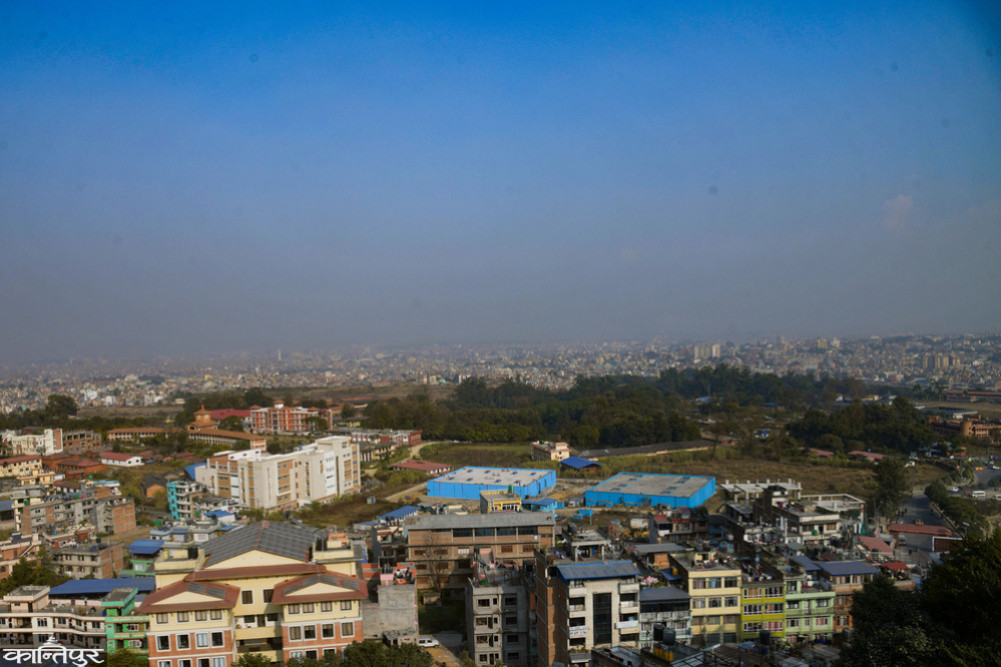
Will our universities find leadership that is far removed from political interests, understands the Nepali soil and the university, and has the drive to ”do something in higher education”?
We use Google Cloud Translation Services. Google requires we provide the following disclaimer relating to use of this service:
This service may contain translations powered by Google. Google disclaims all warranties related to the translations, expressed or implied, including any warranties of accuracy, reliability, and any implied warranties of merchantability, fitness for a particular purpose, and noninfringement.
For the past three decades, Nepal's public institutions and higher education have been made a platform for political power balance. And, the tendency for us to get opportunities more than the better ones in these fields has been increasing. In this way, the quality of every public institution and higher education has gradually deteriorated.
It is against this backdrop that the Gen-G movement took place. And, this movement was against corruption, mismanagement and nepotism. One of the 100 commitments made by the National Independent Party, which emerged on the basis of the Gen-G movement, in its election manifesto was to free all public institutions of the state from political influence and operate them on the basis of merit, ability and performance.
With this objective, the government abolished political appointments in various government bodies, including universities, through an ordinance. This step of reform has raised hope among the common citizen, students and academicians. It is the need of the day for all Nepalis to support and cooperate with this step of the government. The government's intentions seem good in this. There is definitely a rush to ‘do something’ to the government elected by the majority of the people and the cabinet filled with youthful enthusiasm.
Looking at the criteria for selecting the Vice-Chancellor for university reform, one wonders if it could have been made more scientific and relevant to the times. There is plenty of room to question the formulation of these criteria. Are the criteria for selecting the Vice-Chancellor relevant to the times and truly scientific? Who would have formulated such a procedure at this time when the debate on transformation is going on? Was such a procedure formulated knowingly or unknowingly? That criterion has been formulated within a narrow circle. Was it formulated for anyone’s benefit? However, the government elected on the basis of the Gen-G movement and the party government that has made decades of suffering, corruption, and misrule its main election agenda should not be given room to raise such questions.
In which country of the world, research articles published in international peer-reviewed journals and international patents are considered as an important basis for criteria, and books that are not available in the market and have not been cited by other researchers in their research work are used as an important basis for criteria ? It may sound ridiculous to hear, but in the past, many Nepali professors used to publish books only for the purpose of promotion . Many of those books are neither available in the market, nor have other researchers cited them in their research work . Were such aspects taken into account while evaluating the books ? The selection committee does not seem to have evaluated the quality of the published books at all .
In which country in the world, instead of research articles published in international peer-reviewed journals and international patents, books that are not available in the market and have not been cited by other researchers in their research work are made an important basis for criteria? Do you know that, with a few exceptions, no one can complete the research work alone ? The contribution of students, researchers or guides (supervisors) is necessary in research . If ethics are fully followed in the research, research articles published by a single author are extremely rare . In this context, and again leaving out some exceptions, which professor is the one whose name is at the first position in a published research article? In most places, professors have worked together with master's and doctoral students or other researchers. It is downright unethical for a professor involved in such work to be named at the first position in a research article. It is currently customary to name researchers who are directly involved in research first, second or third based on their work. It is customary for professors to only guide.
The Vice-Chancellor Selection Guidelines seem to have given high priority to such single-author publications, which may raise questions about research ethics. When examining the Google Scholar of the shortlisted candidates, it seems that the selection committee has technically recognized the single-authored articles published in very low-level journals of some candidates. Due to this, qualified and capable candidates have been eliminated from the competition.
Similarly, is it enough to have research articles in just 5 journals for a position like the Vice-Chancellor of a university? For a position like the Vice-Chancellor, shouldn't it be a criterion to have as many research articles of international standard, including as many H-index numbers (a criterion based on the number of citations in research work) as possible?
There was an error in the initial criteria. Now there is a widespread error in the selection process. It does not seem that human knowledge has been used at all. To date, the list of top 10 candidates from 8 universities has been released. Looking at the list, most of the faces have been vice-chancellors, deans, department heads in the past, and some have even been permanent professors who have been 'source-forced'.
Every Nepali living in a corner of a foreign country has an important role in the development of the country. In this way, leadership like a university is not just a matter of academic qualifications or positional experience. For that, the history, structure, culture, challenges, and deep relationships with stakeholders of the institution are also necessary. How practical is it to expect university reform from someone who has been away from the university and the country's educational environment for a long time? There are skilled human resources within the university who have left the comforts of abroad and made Nepal their workplace, have led academics, have collaborated with more and more internationally, and understand the country and environment and the institution. Therefore, the system of allowing candidates who have lived abroad for a long time and made their workplace there to reach the final stage of the selection process is a significant flaw in the guidelines themselves.
In the Nepali context, a candidate who has previously been appointed to an executive position should generally have been a member of a political party or have demonstrated loyalty to it, with a few exceptions. However, the selection criteria do not seem to address this issue. And, with a few exceptions, many candidates on the list have been affiliated with some political party or related professional organization in the past. In such a situation, what is the probability that a candidate with independent thinking and perspective will be selected?
Has the candidate's past performance been evaluated? Or is only the period of experience counted? The Vice-Chancellor Selection Guidelines seem to count only the years of experience, not performance. For example, if a candidate has held an executive position for four years, he or she would get four points. How much did he or she contribute to raising the standard of the respective institution? That issue is meaningless, which is one of the most serious weaknesses of the guidelines.
Will our university get a leadership that is far from political interests, understands the soil, understands Nepali universities, and has the courage to say, 'I will do something in higher education'?