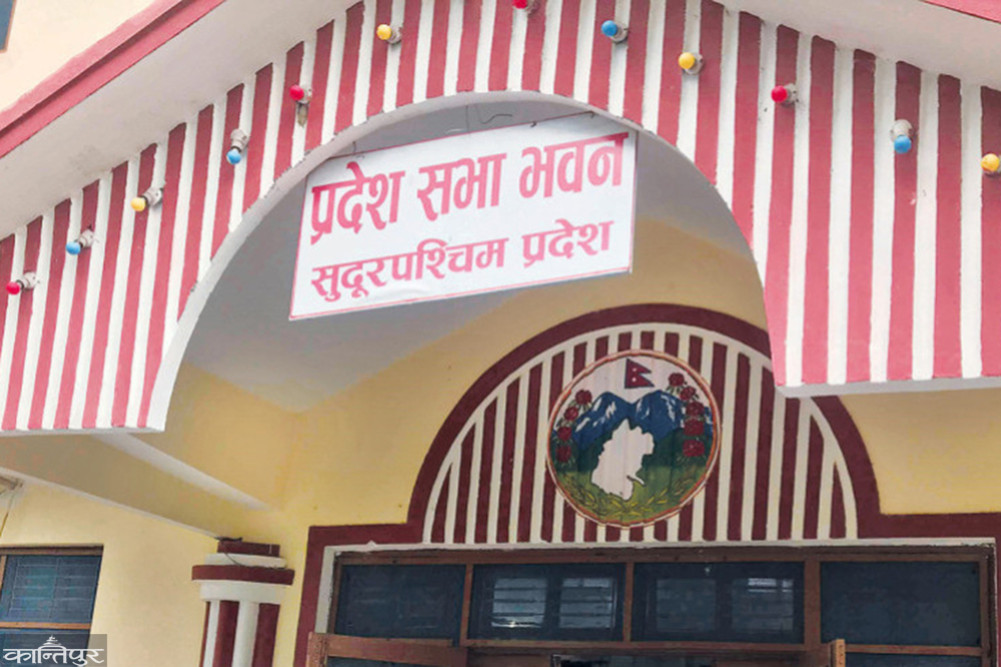
The narrative is being created that the province is not only not managing its powers but also not being able to do anything. This is like saying that a person with bound feet cannot run.
We use Google Cloud Translation Services. Google requires we provide the following disclaimer relating to use of this service:
This service may contain translations powered by Google. Google disclaims all warranties related to the translations, expressed or implied, including any warranties of accuracy, reliability, and any implied warranties of merchantability, fitness for a particular purpose, and noninfringement.
A few weeks ago, the 'Far West Court' held in Dhangadhi, the temporary capital of the Far West Province, drew widespread criticism for failing to make the province's capital permanent. The provincial parliament had already settled the name and capital issue eight years ago. However, since land-related issues are federal matters, the capital remains temporary to this day.
What kind of federalism have we brought, according to which the capital cannot be built even after the provincial parliamentarians have finalized it? The issue has become very complicated due to the non-cooperation of the federal government. The provincial government has repeatedly come to the federal government to make requests. The requests are ongoing, but the capital has not been moved. The land-related complications should either be resolved by amending the constitution, or the union should facilitate. But both have not been possible. The provincial government has become a target of criticism for not being able to build the capital. The common citizen is not even aware of all these complications. Therefore, the criticism is natural. Nevertheless, the union does not feel embarrassed - because the issue has become complicated due to its own reasons. The union government is a facilitator of the provincial government, not a ruler. But the central government has become a victim of arrogance, the Far West. Not only the Far West, but the entire federalism is under the yoke of the union's arrogance.
Conflict between regional issues and development models
Nine airports have been built in the Far West. The construction process is ongoing. However, only two airports are currently operational - Dhangadhi and Bajura airports. Sometimes planes land at Chainpur, Dipayal and Sanfebagar in Bajhang. Planes have not flown at Tikapur, Darchula and Kamalbazar. Out of the nine, only two are operational, the expenditure on other airports has been wasted. The same is true of the humidity centers. More than half of the humidity centers are not operational. Because the production to be kept in the humidity centers is not in the Far West. Due to various profits, humidity centers have been built before production. On the other hand, this year, the results of the Far West in the SEE were the weakest. The Far West is also at the bottom of the poverty index. The Far West is second from the bottom in economic growth and per capita income. There is no intensive debate on these and other issues. Such issues have not been able to fit into the definition of development. Instead, there are airports and moisture centers.
The provincial economy is not thriving
There are many dimensions of the province in federalism. It is the province that makes federalism work. One of the most important tasks is the development of the provincial economy. But in Nepal, the provinces have not been able to work in the provincial economy. The Far West is a province rich in natural resources. It is the province with the largest forest area. It is the province with the most hydropower potential. From the agricultural point of view, it is a region where all three geographies, including the Himalayas, the hills and the Madhesh, are produced. But surprisingly, this province is at the bottom of the poverty index. In terms of herbs, the Far West is the richest province. Where herbs from three different geographies are found . The Far West Province is the only province where 502 types of herbs with medicinal properties have been discovered . There have been some efforts to collect and process herbs, but now the processing centers are closing down in droves - due to lack of state protection . The Far West Province has not been able to advance state-protected industrialization . The main reason for this is that the provinces have very few resources .
Approximately 9 percent of the amount goes from the union to the seven provinces . Half of that amount is spent on employees, the rest cannot do much . The remaining amount is spent on physical infrastructure when the union does not take responsibility for physical infrastructure . Second, there is a huge lack of an employee mechanism to work systematically . The employees who have left the center are not accountable and responsible to the province . The provincial government cannot make the employees accountable and responsible . Overall, there is no money and there are no people to work . And how will the results come? The complexity lies here.
But it is also true that the provincial government has not been able to debate with the union. The union's arhankhatan and walking in the guise of a ji-hajuri is a major weakness of the province. The provinces should have been able to debate with the union constructively but could not. There is another side. The province has made the development of the current trends its own development framework. The provinces could not connect the issues of production, industrialization and employment based on regional characteristics. They also brought in imported issues of development, due to which there is no regional flavor.
The regional development should have had the flavor based on local knowledge, skills, technology, originality and its own climate and soil. But the union is stinking everywhere in the province. The province does not have the flavor of its own sweat. The Tharu community is a native tribal community of Kailali and Kanchanpur. What kind of development is needed for them? Can't we promote a production system based on Tharu culture? Can't we discourage noodles by promoting the dhikri made by the Tharu community? So the problem is not only in the union, but also in the provincial perspective. They are not interested in protecting and promoting a production system based on culture and nature. The province has failed here. There has been no systematic research on provincial characteristics.
A province like a shadow of the union
A unique practice of federalism is underway in Nepal. It is a shameful situation. When the party alliance in the union changes and a government is formed, the province also changes immediately. The provincial MPs were not able to do the work of changing and forming their own government. The shadow of the union falls on the province. The provincial parliament is supposed to exercise the sovereignty of the province. But they could not do such a practice. Instead, they walked like a shadow of the federation. The federation imitated development, the federation imitated institutional development, and the federation imitated the skills of forming and dismantling governments. This is why the provinces did not have a regional flavor. The federation is considering itself too big. From the perspective of the constitution, the three levels of government are equal. But the federation is not interested in practicing this according to its essence, and the provinces cannot even struggle.
There is a global consensus that regional parties based on identity emerge in federalism. But this consensus also failed in Nepal. The regional parties that emerged have also died. Now there is a complex question of how the provinces will be strong. If the federation and the provinces form a single-party government, a situation has been created where the provinces cannot debate. There is little chance that the federation will change its own methods to overcome this complexity. If the provinces engage in constructive debates with a provincial psychology, this is possible, otherwise there is a danger that the provincial autonomy of the essence of federalism envisioned by the Constitution will be weakened. There is a danger that federalism, which appears to have all the elements of federalism but lacks life, will remain in practice. This is a big problem. But in any case, the path to strengthening the provinces is fruitful for us. Therefore, if federalism can be filled with life, its taste will also reach the community. It will reach it organically.
Path to provincial restructuring
The issue of police and employees, which is number one on the list of single rights of the province, has not been resolved to this day. Therefore, the first task is to organize the list of single rights. We should not delay in defining the list of common rights. Especially in federalism, the term "sharing of rights" has been used a lot. Now it seems that the rights need to be shared once and for all - between the three levels of government.
The other aspect is financial management. No matter how much the boundaries of the provinces are adjusted, equality in the economic situation cannot be maintained. It takes some time for the provinces to manage their resources themselves. But right now, the provinces do not have much space to collect revenue. There are no provincial forests either. All the resources of parks, reserves and protected areas reach the union. Space should also be given to collect resources, in terms of rights. Even if they get rights, all provinces will not be equal immediately. Until then, the amount distributed by the union government should be more for the weakest province. The Far West is currently the weakest. In this sense, it should receive the most resources.
If social justice and personnel management in financial transfers can be made responsible and accountable to the province, the province will produce results faster. Because it stands in the middle of local characteristics. It is close to the people. It can take care of its context. Currently, some leaders of the Far West are campaigning for a 'special province'. In fact, if the union can assimilate social justice without calling it a 'special province', it can achieve a lot. Because this province is in a cycle of poverty. Therefore, the Far West needs human resources and financial resources to alleviate poverty. It is weak in education, so federal investment in education should be increased. The province should formulate policies, programs and strategies based on its own characteristics and on the basis of studies and research. If we can make Nepal's federalism run in such a way, the province will not take long to give positive results. The province is being criticized for not managing its rights, but it has not been able to do anything. This is like saying that a person with tied legs did not run. The province has not been able to do much work because it has not been given rights. But the unpopularity of the province has increased in the eyes of the general public. It can also be said that the union government also has a big role in increasing the unpopularity of the province. However, it is necessary for the provinces to be restructured in terms of knowledge.
Regional knowledge creation
Federalism is not a concept of giving the federal government and taking the provincial government. Both have their own autonomy and characteristics. It is important to take care of those autonomy and characteristics. When considering regional development, production and employment, utilization of natural resources, and regional and rural industrialization, the provinces should be given consideration. They should be allowed to debate in the provinces. The knowledge that comes out of the soil, rivers, and streams there opens the door to regional development.
The federation does not export knowledge, it imports it. When imported knowledge is exported, many aspects are disrupted. Therefore, the federation should do what it has to do. It should not interfere, manipulate, or give instructions to the provinces. The provinces can and should do their own work. The federation should facilitate that. In terms of regional knowledge creation, the ‘Far West Court’ has made an alternative effort. Making it more systematic and creating a larger platform for regional knowledge production should be the goal of the coming days. There should be more centers for knowledge production. Only that can address diversity.