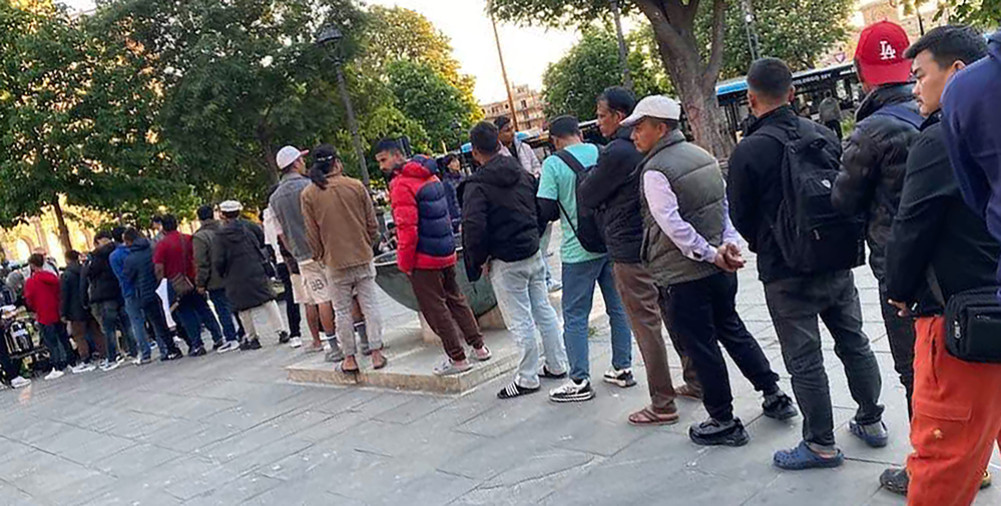
In the hope of a good income, some have fallen into the clutches of middlemen, spent millions of rupees, and completed months of arduous journeys to reach Europe and America.
We use Google Cloud Translation Services. Google requires we provide the following disclaimer relating to use of this service:
This service may contain translations powered by Google. Google disclaims all warranties related to the translations, expressed or implied, including any warranties of accuracy, reliability, and any implied warranties of merchantability, fitness for a particular purpose, and noninfringement.
Just as Nepalis are scattered in every corner of the world, so are their stories. There are stories of success, unity, and hope of Nepalis abroad, as well as stories of failure, separation, and confusion. Although many Nepalis choose to emigrate abroad, driven by the desire to make economic progress and make their lives and those of their families easier, success is not in everyone's hands, and even if it is, it may not be immediately. Rather, they may have to endure many hardships in the process. A similar scene is currently being seen in Italy.
Nepalis who entered Italy without a visa after overcoming many hurdles have to wait in Italy to obtain refugee status. In the process, they have to spend months in the dilapidated buildings, parks, and streets of the old port. However, many Nepalis are not succeeding in their plans. This account of Italy shows that there is a big gap between the expectations that Nepalis have of the labor markets of various countries and continents and the reality they have to face. Such hardships can only be minimized by having correct information about foreign employment and a sense of responsibility to follow the legal path.
In 2025 alone, 1,060 Nepalis who entered Italy via the Balkan route without a visa are trying to obtain refugee status. In the process, they have to live a difficult daily life. For example, many migrants arrive at a park near the central train station in the northeastern Italian city of Trieste. From there, they seek help from the Linia Dombra ODV association, a local NGO that provides basic health checks, food and clothing to Nepalis and other migrants living on the streets. They then apply for asylum.
Once they receive the ‘official registration certificate (white paper)’ of their refugee application, they are allowed to live in temporary accommodation centers (camps). But the process of applying and receiving the certificate can take months. In the meantime, they have to spend the night on the cold floors of streets, parks and dilapidated buildings in the old port. Such accommodation is more difficult and risky for women than for men. They also have to queue to eat food served in plastic packets. All these efforts have the same objective, to do ordinary work in the camp and get refugee status. Then to get the facilities according to the refugee status.
Although many people think that they can easily get refugee or temporary residence permits after going to Europe, the reality is not like that. Employment opportunities within the country are very few. Therefore, foreign employment is a compulsion for many. In the hope of good income, some have fallen into the clutches of middlemen, spent millions of rupees, and completed months of arduous journeys to reach Europe and America. Those who are earning a decent income in various countries have also reached Europe with assurances, additional ambitions, and the hope of additional income. However, the Gulf and Malaysia are our traditional and important labor markets.
About 75 percent of those who have gone for foreign employment are working here. Due to the lack of adequate monitoring of the labor market by the government there, the rights of workers have not been fully ensured. However, the labor market is still operating with its own characteristics. On the other hand, the public has a perception that the European labor market is dynamic, social security is ensured, there are sufficient opportunities to choose jobs, and the labor market is relatively decent. Due to this, people who are working decently in the Gulf and Malaysia are also going to Europe as an alternative or to seek additional opportunities.
Although many people think that they can easily get refugee or temporary residence permits after going to Europe, the reality is not like that. This has also been seen in Italy. On the one hand, Nepalis who have reached there are living a difficult daily life that they regret. On the other hand, the number of Nepalis who become undocumented using the Balkan route is increasing day by day. The Balkan route is the illegal route used mainly by refugees and immigrants who want to enter the European Union from Asia, the Middle East, and Africa.
However, if only positive perceptions continue to circulate in society about the European labor market, the process of reaching different places using such multiple routes will continue. This can only be minimized with correct information and knowledge. Therefore, the government should tell the people about the real labor market in Europe. The public should be informed about what kind of manpower the market is looking for, what are the positive and negative aspects, and what are the challenges of living without documents. Currently, living as refugees should be discouraged. Instead, alternatives should be encouraged. Overall, traveling without documents should be discouraged. The traveler should also be informed about his or her journey. He or she should be aware of its easy and difficult aspects. He or she should be informed about the laws and procedures of Nepal and the country he or she is going to.
Foreign employment is not a matter of ending completely. Anyone can travel abroad if they can find employment according to their qualifications, have a good financial income, and have the potential for personal development. The government's focus should be on minimizing forced travel. Forced foreign employment cannot end until sufficient employment opportunities are available in Nepal. Therefore, the government should prioritize increasing employment opportunities in the country.
The government should prioritize such employment opportunities that ensure high wages, continuity, a decent workplace, and social security. For that, we need to encourage private investment, attract foreign investment, prioritize development work, and encourage new income-generating and business endeavors.