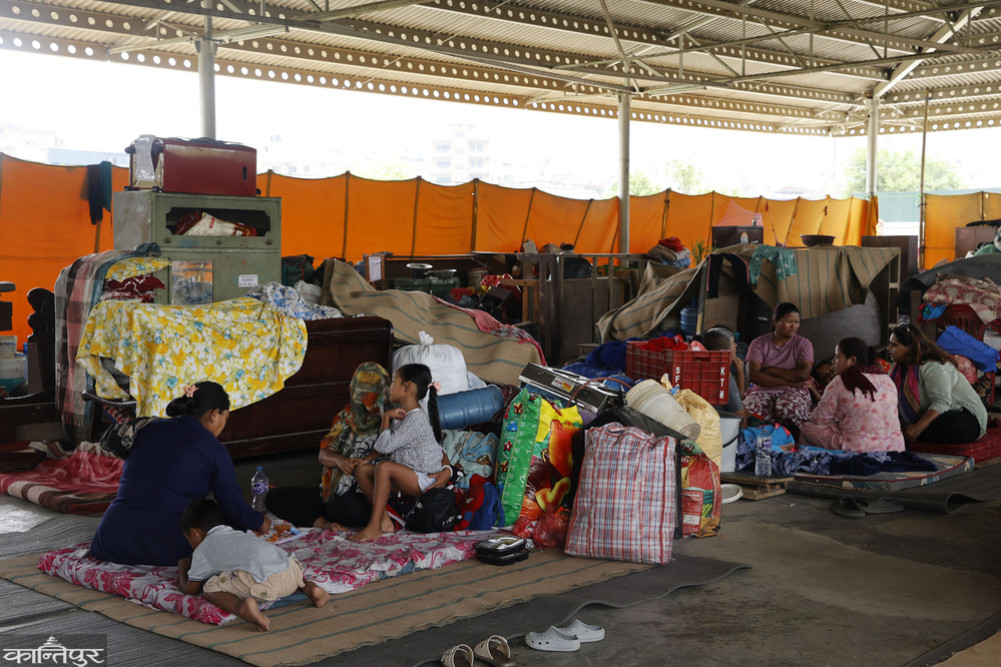
Holding centers are only temporary management. It is like putting the squatter settlements under the control of the government. Therefore, the government should take extra care of the people living there.
We use Google Cloud Translation Services. Google requires we provide the following disclaimer relating to use of this service:
This service may contain translations powered by Google. Google disclaims all warranties related to the translations, expressed or implied, including any warranties of accuracy, reliability, and any implied warranties of merchantability, fitness for a particular purpose, and noninfringement.
There is a saying in Nepali society – easy to demolish, hard to build. The government’s style in the context of squatter settlements is similar. Due to the concern, direction and initiative of Prime Minister Balendra Shah, the management of the displaced has not been carried out with the same speed with which the squatter settlements were removed. As a result, hundreds of squatters still have to live in holding centers.
The possibility of such a stay, which should be for a very short time, being prolonged has increased the anxiety among the squatters. Whatever the case, the trauma of being forcibly separated from the ‘home’ they have been living in for years, neighbors, pets, employment or livelihood arrangements, and the overall environment has been etched in their minds. On the other hand, the precarious stay of the holding center and the uncertainty of the future have also troubled them. Therefore, the government should accelerate the work of long-term management to immediately end the stay of the holding center. The same urgency that was shown in lifting the settlements should be given to their management.
After the resignation of the then Home Minister Sudhan Gurung on 9th Baisakh, Prime Minister Shah, who also held the responsibility of the ministry, met with the heads of the security agencies on the same day. In that process, he had directed the evacuation of the squatter settlements on 12th and 13th Baisakh. The District Administration Office, Kathmandu, had issued a six-point notice on 11th Baisakh directing the evacuation of the houses and huts. From the beginning, doubts were expressed that the settlement would be easily managed if the settlements were removed through such a short process. However, after the evacuation of the settlements began amidst the heavy presence of security personnel and bulldozers, the squatter settlements surrendered to the state. Amidst the confusion of the process, uncertain future and fear, many families reached the holding center. However, after reaching there, many came to know that the accommodation arrangements there were not taking into account the categories that need extra care such as pregnant women, people with disabilities, the elderly, children, and the sick. Many were not even able to drink hot water, they were not able to prepare formula milk for their children as needed, and the food provided by the government was not sufficient and of poor quality.
Just as Prime Minister Shah had shown determination by setting a date for the settlement and implementing it, the same determination should be shown for the management. The government has designated holding centers in seven places in Kathmandu, Bhaktapur and Kavre. There are 294 people from 87 houses in Machhapokhari Lodge in Balaju, 277 people from 65 houses in Radhaswamy Ashram Kirtipur and 355 people from 99 houses in the Electricity Training Center in Kharipati, Bhaktapur. There are 115 people from 24 houses in the Agricultural Training Center in Bode, Bhaktapur, 80 people from 21 houses in the Drinking Water Training Center in Nagarkot, 195 people from 45 houses in the Red Cross in Banepa and 172 people from 47 houses in the Ichangunarayan Apartment. Although some facilities are being provided in the holding center over time, the main concern has not been addressed. That is, the issue of permanent residence has not been resolved yet. Meanwhile, Prime Minister Shah has said in the House – ‘It will take as long as it takes. It should not be rushed. Let’s not try to find something that has not been done in 35 years in 35 minutes. It will take some time.’ Such a statement has not only increased confidence among the squatters, but also increased confusion.
The day before sending the dozer to the settlement (11 Baisakh), Prime Minister Shah had said on Facebook – ‘We will complete the process for the actual squatters across the country and distribute the land as soon as possible.’ From this, it was expected that he would show interest in the management as well as the settlement. But the management that has not been implemented even after a month and a half and the statement that ‘something that has not been done in 35 years should not be done in 35 minutes’ has created further confusion. Just as Prime Minister Shah had shown determination by setting a date for the settlement and implementing it, the same determination should be shown for the management.
The holding center is only temporary management. It is as if the squatter settlement itself is under the control of the government. Therefore, the government should take extra care of the people living there. They should be responsible for aspects such as nutritious food, health care, education, and entertainment. But the government does not seem to pay attention to the small concerns of the people after they are taken from the settlements and placed in holding centers. Because, in the meantime, most of them have lost their source of income. Since they are temporary residents of the holding center, they have not been able to reconnect. The food is not of good quality, nor is it according to their preferences. Health care is not a priority for the government. For example, Pramila Rai, who lives in the holding center in Kirtipur, has complained that she does not have money to give her daughter medicine and that she has not been listened to even after pleading with many people.
Some children in the holding center have not been able to study. Parents have expressed concern that the Red Cross in Banepa, Kavre has not finalized their studies. Humans are social animals. But being separated from one place and placed in another can also affect their mental state. The government should pay attention to this aspect as well. Overall, the government should provide adequate humane facilities to the squatters while they are kept in the holding center. The need for extra care should be ensured for those in need. The government should be informed about what it is doing to remove suspicion, confusion, and fear. Most importantly, the entire process of their permanent residence and management should be finalized quickly. They should be linked to employment and income-generating programs.