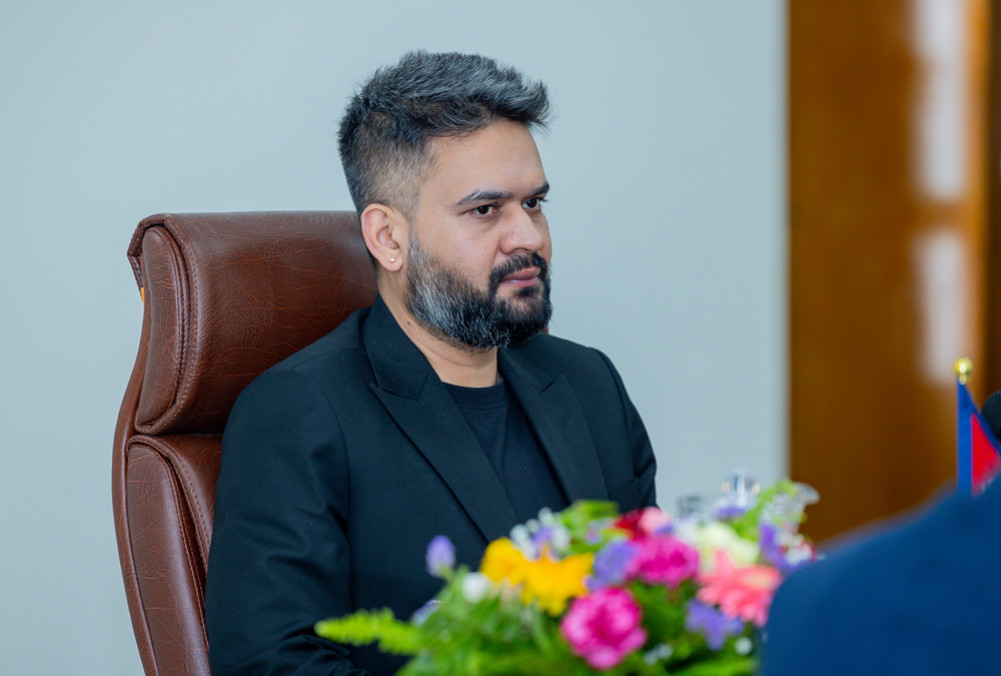
There is certainly a misconception that the simple and ordinary people consider Prime Minister Balendra Shah as their 'savior'. However, in politics, there is no definition of success and failure. Both these 'elements' are temporary.
We use Google Cloud Translation Services. Google requires we provide the following disclaimer relating to use of this service:
This service may contain translations powered by Google. Google disclaims all warranties related to the translations, expressed or implied, including any warranties of accuracy, reliability, and any implied warranties of merchantability, fitness for a particular purpose, and noninfringement.
Prime Minister Balendra Shah is in a hurry. He is in a hurry to speed up the development of the country. He is in a hurry to change the vitality and style of the people. In this hurry, he does not want to look left and right. He is a singer - a famous singer. He is famous. He is known among the big and famous personalities of the world's music industry. Has he visited his ancestral place Mahottari? It is not known. But, he has definitely hit the streets of Manhattan, the main market of New York. Chameli is one of the important characters he has used as a symbol of his songs. Does he know the real life background of that Chameli? No one has examined this.
Democracy should be active in a federal republic. The political system should be able to make every citizen self-reliant and self-reliant. The rulers of Naya Chhimal understand this much. After the elections held on 21 Falgun, Rastriya Swatantra Party President Ravi Lamichhane has become the first leader of the ruling party to visit India. Although technically he is said to have visited India at the invitation of the President of the ruling Bharatiya Janata Party, Nitin Naveen, his visit was important from a governmental perspective. The meeting with Indian Prime Minister Narendra Modi was a good opportunity for him. He was given a grand welcome in Delhi. Nepal-India relations pundits have concluded that India was 'happy' after Prime Minister Balendra said in the Nepali Parliament that India has violated Nepal's border and Nepal has also violated India's border. The same day Ravi Lamichhane returned from his visit to India, Nepal's Foreign Minister reached Delhi at the invitation of Indian Foreign Minister Jaishankar. Chairman Ravi seems very happy with the visit to Delhi. Will this happiness be productive or will it remain at the level of happiness? Only time will tell.
Of course, it is not unusual for the chairman of the ruling party of any neighboring country to be given a grand welcome after being invited by the chairman of the ruling party there. The 'result' of that welcome will come only after the meeting of Indian Foreign Minister Jaishankar and Nepali Foreign Minister Shishir Khanal. What will be the result of the meeting of the two ministers in Nepal's internal politics? Only then will the relationship be opened.
There is certainly a misconception that the simple and common people consider Prime Minister Balendra Shah to be a 'savior'. However, there is no definition of success and failure in politics. Both these 'elements' are temporary. In the elections to the House of Representatives held on 21 Falgun, the candidates of the Rashtriya Swayamsevak Sangh (RSS) defeated the self-proclaimed candidates of the Nepali Communist Party, which includes the Congress, UML, and Maoists, and the Rastriya Prajatantra Party. In this process, the Rashtriya Swayamsevak Sangh (RSS) has seized power in Nepal by relying on the leadership of Walendra. Anyone who understands politics a little knows that if Walendra had not led the election campaign, the results would not have been so 'strong' in favor of the Rashtriya Swayamsevak Sangh (RSS). Walendra had a clear understanding of how the destruction of Bhadra 23 and 24 was structured. It has been revealed that he has deep sympathy and sympathy with the villains who play illegal games while appearing as legitimate forces.
As a senior leader of the Rashtriya Swayamsevak Sangh (RSS), Walendra defeated KP Oli, a strong leader of the Nepali communist movement and UML chairman, in his own constituency. Amresh Kumar Singh, who contested from Sarlahi-4 under Walendra's election leadership, defeated his opponent Gagan Kumar Thapa by a strong margin. Thapa, who became the president of the Nepali Congress by taking the wrong path of the special convention, had raised the slogan - Let's change the Congress, let's change the country . However, he could not change the Congress, he could not . Balen also seized the path of taking responsibility for changing the country . Among the leaders at the top of the political party in the election, only Nepali Communist Party leader Pushpa Kamal Dahal 'Prachanda' won from Rukum East . The defeat of some important leaders from the Madhesh and hill constituencies was unbelievable .
The election results clearly came in favor of the Rashtriya Swayamsevak Sangh (RSS) formed by Ravi Lamichhane and led by him . As per the previous agreement, Balendra became the 'powerful' Prime Minister of the Nepal government . As soon as he took office, he accelerated his pace . First of all, he kept the constitution in his bedroom. He put the piles of laws and customs in the storage room . First of all, his eyes fell on the squatters living along the 'sacred' rivers of the Kathmandu Valley. He 'addressed' those squatters. He had not been able to do this when he was the mayor of Kathmandu Metropolitan City.
He called a session of parliament with the aim of swearing in the elected members of parliament. After the swearing-in, the parliament was adjourned. Then a wave of various ordinances began. The desire to rule through ordinances while keeping the sovereign parliament in deep sleep is not democratic in itself. However, there was not the slightest opposition from the judicial and legal community. Prime Minister Balen also interfered in the appointment of the Chief Justice of the Supreme Court. It was reported that he had formed his own task force to 'reform' the country's current constitution. So far, it has not been put into executive practice and administrative practice and what kind of reform will he bring to the constitution by trying to amend the constitution without discussion in the sovereign parliament? No one knows this .
The parliament, which was closed after the oath-taking of the MPs, reopened a few days later . The first program of the parliament was the presentation of the government's 'policies and programs' by President Ram Chandra Poudel to the members of both houses of parliament .
The honorable president started the reading of the policies and programs . While he was narrating the policies and programs, the prime minister left the house . Was he bored while listening to the policies and programs of the government he led or for some other reason ? It is not known . However, this is probably the first time that such an unprecedented incident has happened in the sessions of the parliament of Nepal .
Today's digital media is popular not only in the urban market, but also in the villages . The number of people consuming news from radio, newspapers and television has decreased . Its place has been taken by digital media like TikTok and Facebook . People's trust in traditional news media has declined. The current time for truth is not 'open'. Most editors and publishers in the media world prefer to 'live' their specific views and reactions through 'TikTok', 'Facebook' and podcasts rather than through newspapers, radio or television. This benefits both editors and publishers.
Perhaps seeing this impact of digital media, the Wallendra-led government is creating its own 'messaging app' like 'WhatsApp' owned by Facebook owner Mark Zuckerberg. Government leaders believe that after the creation of this app, Nepal will make a big leap in the field of information. With this, rumors have started circulating that the government will give the Nepali people the constitutional right to information.
According to another information received on social media, from now on, the government will collect value-added tax from consumers who consume more than 50 units of electricity. Will fifty units of electricity per month meet the needs of an average consumer? Can economic planners and officials, including ministers who make decisions sitting in air-conditioned rooms, answer this question?
It has been two decades since the people of Nepal, an independent and sovereign nation that respects all religions despite the majority of people being Hindus, overthrew the monarchy and established Nepal as a 'federal republic'. In these two decades, the direct results of democratic politics have not been seen. In Nepal, a country that is naturally picturesque, traditional in terms of customs, laws, and religious rituals, many incidents have occurred in the meantime that should and should not have happened. Economically, the people are in a painful situation. It is not possible to sustain themselves with traditional sources of income alone. Our ancestors used to go to 'Lahore' even then in search of a path to economic progress. Now, the descendants of Nepalis are going abroad in search of prosperity. This trend is increasing. Because, our rulers have neither been able to utilize our natural splendor for the normal livelihood of the people, nor have they been able to create opportunities for agricultural development. The phrase 'the country is poor' has become a byword for our new and old rulers and people's representatives. The leaders have not been able to see the dream of making the poor people of the country rich. The country is becoming poorer day by day. There is a growing fear that the original character of the country will be destroyed due to the terrible dependence on foreign employment. If this situation is not changed, the existence of the country is certain to be in danger.
Even though the country has been transformed into a 'federal republic', its style of operation and management remains the same. The citizens of the country have not yet been able to perceive any fundamental difference between the current republican system of governance, the previous multi-party democratic system with constitutional monarchy, and the independent system led by the king before that. The main goal of changing the political-social system is to make the people economically strong, happy, and prosperous. The kings and Rana rulers of Nepal could not fulfill that responsibility. Political leaders tried many experiments in the name of change. However, the fact that none of those experiments proved favorable for the common people cannot be forgotten. Democracy must be active in a federal republic. The political system must be able to make every citizen self-reliant and self-reliant. The rulers of the new Chhimal understand this much.