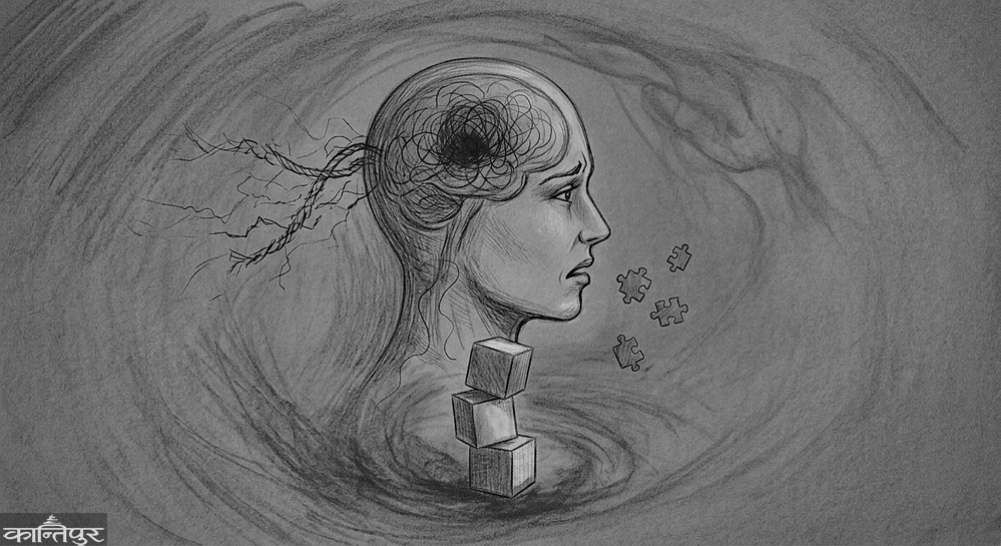
The 'memes' and satire being made on social media saying, 'We are citizens of a country with an IQ of 42' are not just jokes, they are slowly eroding the collective confidence of Nepalis.
We use Google Cloud Translation Services. Google requires we provide the following disclaimer relating to use of this service:
This service may contain translations powered by Google. Google disclaims all warranties related to the translations, expressed or implied, including any warranties of accuracy, reliability, and any implied warranties of merchantability, fitness for a particular purpose, and noninfringement.
In recent years, a serious and depressing comment has been repeated repeatedly on Nepali social media and public circles. When discussing the country's political instability, economic stagnation, or lack of good governance, many ordinary users, from responsible intellectuals, policymakers, and political leaders, cite controversial statistics as irrefutable truths: 'The average IQ of Nepalis is the lowest in the world (42.9).'
At first glance, such a comment may seem motivated by an emotional desire to improve the country's educational situation or spread awareness in society. However, the problem begins when the upper consciousness of society begins to accept uncritically examined indices that are scientifically completely wrong, methodologically flawed, and universally criticized. When an influential person in any society or the mass media repeatedly repeats an illusion, it gradually begins to transform into 'social truth.' In Nepal, this commentary is not just a propaganda of incorrect statistics, but a serious psychological crisis that is gradually turning into a national self-image. When the intellectual consciousness of a society falls prey to pseudoscience, it pushes the entire nation into a pit of collective depression and self-loathing. The concept of ‘national IQ’ and its underlying logic What may confuse the common man is that this data comes from the United Nations, UNESCO, the World Health Organization (WHO) or any established international psychological organization. However, the reality is completely different. Its original source is ‘IQ and the Wealth of Nations’ (2002) and its extended version ‘IQ and Global Inequality’ (2006) written by British psychologist Richard Lynn and Finnish political scientist Tatu Vanhanen. Later, Lynn and Vanhanen revised this series and published ‘Intelligence: A Unifying Construct for the Social Sciences’ in 2012. The latest version of the same link, co-authored by Lin and David Baker, was published in 2019 in a book called ‘The Intelligence of Nations’, where Nepal’s score is stated to be 42.79.
The main argument of the authors who put forward this concept was that the economic development, social prosperity, health level and stability of democratic institutions of any country are directly determined by the ‘average national IQ’ (National IQ) of that country’s population. According to them, countries with high IQ can easily build complex technology, efficient administration and strong economic policies, while countries with low IQ naturally lag behind in this. The ability of the top 5 percent of the intellectual class of society (cognitive capitalism) determines the pace of the country’s overall prosperity and institutional development.
Richard Lin and his colleagues tried to place the entire blame on ‘biological intelligence’ through this theory, ignoring the effects of poverty, backwardness and colonial history in the world. Their argument that West or East Asians are intellectually superior to native blacks or South Asians is in fact a modern continuation of the imperialist and racist mindset of the 19th century, which today's mainstream academia has declared 'scientific racism'.
Initially developed to measure the cognitive ability of an individual, Richard Lynn and his colleagues narrowly distorted the psychological instrument (IQ) into a way to measure the 'collective biological destiny' of an entire nation, which modern science does not accept.
Historical breakdown and challenge of the national IQ theory
IQ tests gained worldwide legitimacy in the early decades of the twentieth century, especially after their use for military classification during World War I. However, after the 1970s, with modern research in education, the human rights movement and psychology, their legitimacy as a measure of the ability of an entire nation completely disappeared. In recent decades, Richard Lin and his colleagues have attempted to revive IQ as a national measure, breaking this established scientific consensus.
However, the main reasons why mainstream modern psychologists, sociologists, and economists have dismissed the theory of ‘national IQ’ as completely unscientific and meaningless are as follows:
The reverse interpretation of causality: Lin and Vanhanen’s biggest mistake is that they fail to distinguish between ‘correlation’ and ‘cause’. They say, ‘The country is poor because IQ is low.’ However, modern science says that the country is poor, and that there is no good education, health, and nutrition, and that the IQ test scores are low. That is, children who receive good schools and nutritious food naturally score high on IQ tests.
The statement that ‘Nepalese IQ is at the bottom of the world’ is not just a harmless internet joke or a light social media comment, it is an ideological weapon of pseudo-science and racism that makes society distrust its own potential.
Unrepresentative sample and statistical manipulation (from 78 to 42.79): The way the authors dramatically changed the IQ of Nepal in different books published over a period of a few years clearly exposes their statistical manipulation. In fact, Lin did not conduct any comprehensive or reliable national survey to measure the IQ of many countries. In the case of Nepal itself, the results they produced in different books and the fluctuations in the data prove how shaky and controversial this methodology is.
However, in the 2019 edition, co-author David Baker removed the statistical ‘floor’ and applied a new mathematical formula. And, he started searching for any ‘direct data’ on Nepal available on the internet. He found not data that represented Nepal’s multilingual and geographical diversity, but data from a very limited clinical study conducted in the mid-1990s (1994–1997) on the nutrition and health of pregnant women and their children in a rural area of Nepal. They directly considered the raw score of the ‘Color Progressive Matrices’ (CPM) of the small group selected for the study of the serious crisis of malnutrition and maternal health as the ‘national IQ’ of the entire Nepal. In the book published by Lin and Vanhanen in 2012, Nepal’s national IQ was 78. Interestingly, since there was no official or large database of IQ tests available at the time, they used ‘geographical substitution’ to estimate Nepal’s score based on the scores of Nepal’s neighboring countries (specifically India and the South Asian regional average). Also, to maintain statistical balance, they did not allow any country’s score to fall below a certain ‘floor’ (minimum point).
The fact that the collective intelligence of the entire country fell from 78 to 42 without any concrete historical or biological change, just by changing the researcher’s mathematical formula and a small local medical sample, is a statistical mockery in itself. And, it completely destroys the credibility of this database.
The famous intelligence researcher James Flynn has proven that the average IQ score of a society is not static. It increases continuously every decade as education, health and nutrition improve. Extreme malnutrition, iodine deficiency or infectious diseases in childhood have a temporary negative impact on the cognitive development of children in developing countries, which can be corrected with the right environment and education. However, Lin's model considered IQ to be an 'unchangeable biological destiny', which has been proven wrong by modern science.
A score of 42.9: An objective analysis
According to established standards of clinical psychology, an IQ score of less than 70 is classified as intellectual disability or mental retardation. An IQ of less than 50 means that the person cannot perform even the most basic activities of daily life (such as taking care of themselves, dressing themselves, or communicating) without constant help from others.
If the average IQ of Nepal were really 42.9, the complex social, political, economic, and cultural structures that we have built would not have been possible. Although Nepal is still a developing country, its multi-party democracy, complex legal and administrative system, banking sector, universities, original literature, architecture, and the technical and practical skills demonstrated by Nepalese in the foreign labor market itself make this claim of 42.9 meaningless. The leadership work that Nepalis are doing as scientists, professors and researchers in the world's best technology companies, hospitals and universities is a vivid example of this.
Cultural bias and Westernization of intelligence
Most IQ tests have been developed in Western industrial society, urban literacy, abstract problem-solving frameworks and English or Western linguistic environments. These tests are not culturally neutral. According to the famous psychologist Howard Gardner's 'Theory of Multiple Intelligences', human intelligence has many forms.
The spatial intelligence of a local guide navigating the difficult terrain of the Himalayas, the natural intelligence of a farmer cultivating in harmony with nature, multilingual ability and the mutual solidarity and resilience shown by Nepali society in times of crisis - all these are unique forms of human intelligence. However, Lin's racist model completely ignores these practical and indigenous dimensions of life and considers only the written test of Western standards as the only measure of intelligence.
The political economy and national psychology of low IQ
Why did such a flawed and insulting claim become so easily established in Nepal's intellectual and social media circles? Nepal's contemporary socio-political despair and the surrenderist psychology it has generated are responsible for this. For Nepalis facing a serious and complex structural question of 'Why has this country not been formed?', this pseudo-scientific data provides a very easy 'shortcut' answer - our intelligence is low, that is why we have not been able to form a country.'
Such a commentary teaches us to blame our own biological abilities or hereditary qualities instead of blaming the system for bad governance, weak policies, discriminatory education and political culture. This has become a path of self-loathing and irresponsibility for both the ruling class and the frustrated citizenry. It diverts attention from policy failures and places the blame squarely on nature.
However, using such scores without examination has a long-term and fatal impact on the national psyche. First, it is institutionalizing self-loathing and inferiority complex. The ‘memes’ and satires made on social media saying, ‘We are citizens of a country with an IQ of 42’ are not just jokes, but are gradually eroding the collective self-confidence of Nepalis. Because a society filled with self-loathing can never envision and build a glorious future.
Second, this commentary fuels the rise of a new elite and internal divisions, giving rise to a new kind of intellectual arrogance in society, where the supposedly Western-educated class begins to see the marginalized and rural communities of the country as ‘naturally incapable’. And, it weakens social harmony from the very beginning.
Third, it is creating extreme despair and an escapist mentality in the young generation. If the country's teenagers keep hearing from their top leaders, media and intellectuals that 'our intellectual level is at the bottom of the world', the door to their aspirations and creativity will automatically close. This will instill a deadly pessimistic mindset in them and accelerate the pace of emigration.
The existence of intellectual or learning challenges in Nepal is not a biological destiny, but a reflection of complete managerial, policy and structural failures. There are certainly serious crises in our overall educational system, which is why we urgently need to comprehensively strengthen literacy, education standards and the overall quality of human capital. Clearly, this crisis is not a hereditary limitation of ours but is only the result of the policy weaknesses of the state. यसलाई वैज्ञानिक सुधार, सही लगानी र दृढ राजनीतिक इच्छाशक्तिमार्फत समाधान गर्न सम्भव छ ।
‘नेपालीहरूको आईक्यू विश्वकै पुछारमा’ भन्ने भाष्य एउटा हानिकारक इन्टरनेट जोक वा हल्का सामाजिक सञ्जालको टिप्पणी मात्रै होइन, यो छद्म–विज्ञान र नश्लवादको यस्तो वैचारिक अस्त्र हो, जसले समाजलाई आफ्नै सम्भावनाप्रति अविश्वासी बनाउँछ ।
हाम्रा सार्वजनिक बौद्धिक, राजनीतिज्ञ र नागरिक समाजले के बुझ्नु जरुरी छ भने विज्ञानको आवरणमा आउने हरेक संख्या सत्य हुँदैनन् । सूचनाको यो युगमा कुनै पनि अन्तर्राष्ट्रिय दाबीको आलोचनात्मक र विधिगत परीक्षण गर्नु बौद्धिकहरूको प्राथमिक कर्तव्य हो । नेपाललाई आज आफ्नै क्षमतामाथि शंका गर्ने आत्मनिन्दाको होइन, बरु हाम्रा कमजोरीको निर्मम आत्मसमीक्षा गर्दै वैज्ञानिक चेतना र दृढ आत्मविश्वासका साथ अघि बढ्ने ऊर्जाको आवश्यकता छ । छद्म–विज्ञानको यो मानसिक दासत्व र आत्महीनताको चक्रबाट मुक्त नभई हामीले समृद्ध र आत्मनिर्भर नेपालको जग बसाल्न सक्ने छैनौं ।