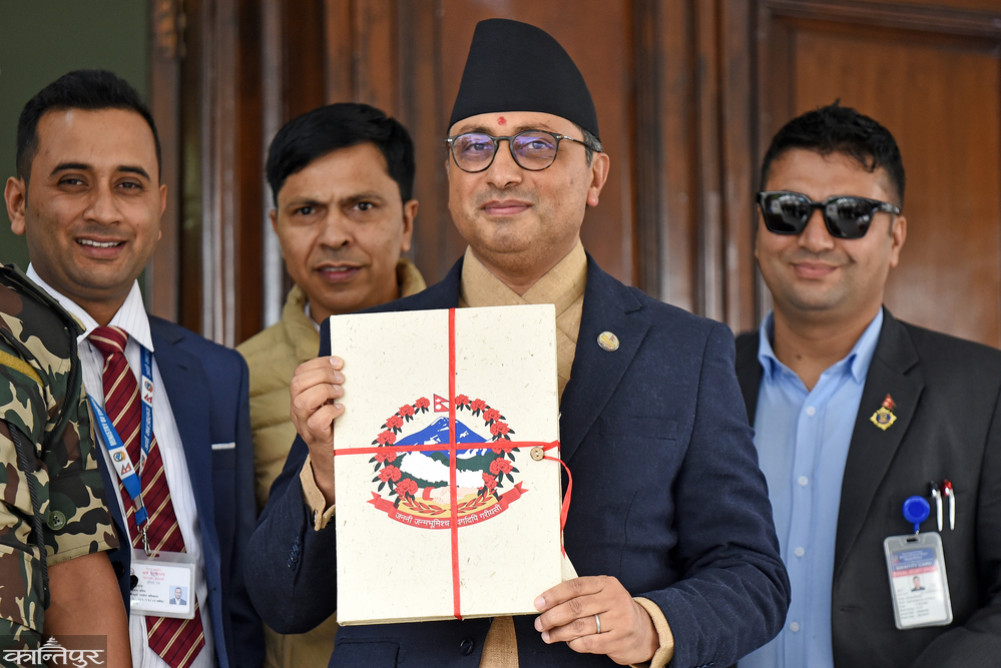
The Rashtriya Swayamsevak Sangh (RSS) has confirmed its belief that the economy is strong when the wealthy middle class prospers, and that if a few people become rich, the benefits will trickle down to the common people.
We use Google Cloud Translation Services. Google requires we provide the following disclaimer relating to use of this service:
This service may contain translations powered by Google. Google disclaims all warranties related to the translations, expressed or implied, including any warranties of accuracy, reliability, and any implied warranties of merchantability, fitness for a particular purpose, and noninfringement.
Since 1992, the Nepali economy has been systematically introduced into the neoliberal market framework. Our policy makers did not consider it necessary to pay attention to whether our environment was ready to withstand liberalization, privatization, and globalization at once, or to endure the ‘shock therapy’ with the ‘austerity package’, in the language of today. Everyone knows where we have come to due to indiscriminate economic liberalization and privatization. However, previous governments did not see any alternative to neoliberalism.
The budget is not a company's balance sheet, it is an economic and political document. The economic survey presents the main trends of the economy of the current fiscal year and the obstacles and difficulties it has faced in detail. The budget is prepared with the intention of correcting them. But even the facts that have been revealed by the economic survey for a long time have not been taken into account while preparing the budget. The Rashtriya Swayamsevak Sangh (RSS) government, which received a large public vote, and its Finance Minister had announced that a new revolution had been completed and that a 'paradigm shift' would be introduced in the economy, along with a new policy-program and budget. However, many had hoped that Finance Minister Swarnim Wagle, who carries the legacy of neoliberalism, would manage some sophisticated, modified budget in the current crisis.
The existing economic and social problems
The annual budget is not a long-term plan. However, a government that has been making revolutionary changes advances its programs through the budget according to the needs of the time. However, this columnist did not estimate that such a radical change would occur from the current government as claimed. Because, it was impossible to imagine the possibility of radical reform from a Finance Minister who has come to the forefront of the economic and theoretical trends of the international triad financial institutions (IMF, World Bank and Asian Development Bank), which have become the most dominant in Nepal's periodic planning and budgetary system. However, the Nepali voters have grossly ignored the hope that the short-term and periodic plans would be reviewed through the budget, even if it was to provide immediate relief to the problems that Nepal is currently facing.
The fundamental problems that ordinary Nepalis are facing at the moment can be presented as follows:
(1) Rural migration is accelerating and agriculture, which is considered the backbone of employment, is collapsing.
(2) The labor force that has emerged from agriculture to earn a living has not been able to be retained in the country. In other words, industrialization could not take place due to the lack of policy thinking. Workers who are frustrated and disappointed with agriculture are dependent on cheap foreign employment.
(3) The impact of the ‘Dutch Disease’ on the country’s economy has increased due to the collapse of agriculture and the lack of employment-oriented industrialization. In other words, the dependence on the production of all goods has increased.
(4) Schools and health centers in villages/cities affected by rapid migration are becoming overwhelmed due to lack of students and diseases. It seems that their management is becoming difficult without a credible plan and institutional management for integrated rural development.
(5) Foreign employment has become the mainstay of the Nepali economy. But due to the attacks on Iran by the US and Israel for the past three months, this sector has not only been in dilemma, but has also been disrupted in many ways. This is sure to have a major impact on the changing lifestyle and economic livelihood of the common Nepali.
(6) The impact of the disruption of the Hormuz water basin region has added great pain to our daily lives, more than the impact of the Ukraine-Russia war. Especially, there has been a sharp increase in prices in public transportation and transportation. The price of transportation services, clothing, food, and other consumer goods and services has increased by more than 35 percent.
(7) Not only war, but also the risk of a great war is increasing . Especially in the Middle East, which is also called the Gulf countries, more than two million of our people are employed . They are at great risk .
There does not seem to be a single point in the budget of the learned Finance Minister that a reliable solution has been found to address these fundamental risks .
The theoretical and ideological foundation of the RSVP
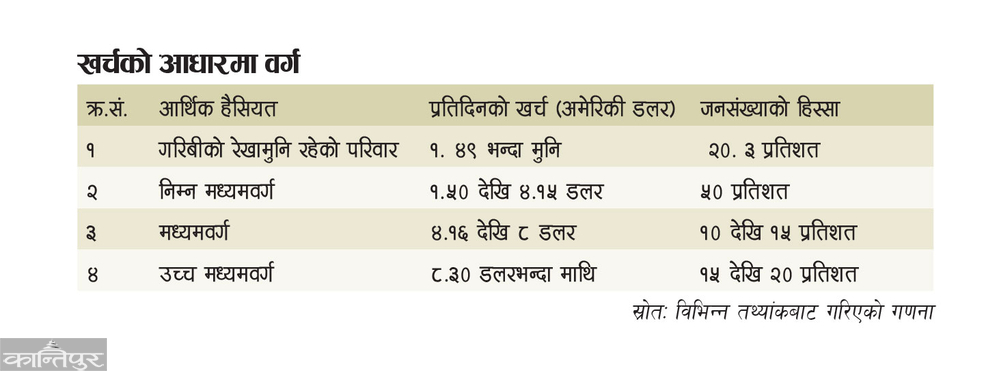
In Nepal, 80 percent of families do not fall into the middle class by international standards and 20.3 percent of families are still in extreme poverty. The Finance Minister, who moved to defend the government's policy program, made it clear that 'RSVP is neither neoliberal nor communist' and tried to demonstrate the ideology of the RSVP in the parliament by saying that 'RSVP is a pluralist force that believes in a liberal economy with social justice'. This statement would have an ambiguous meaning . The first sentence says that the 'mixed economy', i.e., the welfare state based on John Maynard Keynes, stands on the theoretical foundation of capitalism . The second sentence gives a glimpse of Milton Friedman. Moreover, the main intention of the policy-programme, ‘borderless economy, weightless development’, proved that the talk of social justice was just ‘cocktail party talk’. 35 years of experience have confirmed this.
In the second point of the budget, the Finance Minister has said that he has taken responsibility as a responsibility to change the character of the state, the culture of governance and the shape of the economy. And, in the next point, he has expressed a historic commitment to ‘establish standards of good governance in policies, laws, institutions, systems and leadership by embracing the goal of change’. This means that his party wants to prioritize information and communication, artificial intelligence, finance and trade, which generate fewer jobs, rather than expanding the country's active labor force, whether it is agriculture, which has the majority of the country's active labor force, or industry and infrastructure construction that can accommodate millions of workers. This basically means that the RSP believes that the economy is strong in the economic prosperity of the wealthy middle class, and if a few people become rich, the benefits will trickle down to the common people. That is why the Finance Minister has put forward entrepreneurs as the driving force of the future economy in the budget. In addition, in order to expand the middle class, he has put forward a program of liberalization, privatization and financialization in a new language in the budget. Although the Finance Minister does not explicitly mention privatization in the budget, it is clear that he is trying to privatize most public institutions, including telecom. Similarly, news has emerged that he has changed the tax policy and tax rates he has put forward.
Why do right-wing 'populists' need the middle class?
Even though the Congress and UML, which have ruled for three and a half decades, and the Maoists, which have been in power for the past two decades, call themselves centrist liberals and liberals or 'radical' leftists, they are still ashamed to include classes in the budget. However, in a language that everyone understands, they favored the 'private sector' and in the last phase, they openly cheated on tax rates in their favor. But this time, the Finance Minister did not just openly favor classes in the literal sense, as mentioned above, he made policy arrangements for the upliftment and encouragement of the three. It is important to understand who the middle class is that needs to be uplifted in this way, and why the current right-wing populists especially encourage the middle class.
In economics and sociology, class division is done on three bases. One, economic capital. Such as property, income and professional status. Two, cultural capital. Such as educational status, lifestyle and belief system. Three, political capital. Such as social status, influence and power of the community in society. By integrating these three issues, society is divided into five classes in the current world order – poor, low-income, middle-income, upper-middle-income and high-income (Pew Center, A Global Middle Class Is More Promise Than Reality, Report, Pew Research.org (July 8, 2015)).
The Finance Minister called the Rashtriya Swayamsevak Sangh (RSS) 'neither neoliberal nor communist', but the slogan and policy of 'borderless economy, weightless development' show the continuity of neoliberalism. Yesterday and today the international poverty line is considered to be the ability to spend 3 US dollars per person per day. A family that does not have the ability to spend is considered poor. 1 in 10 people in the world live in extreme poverty. The next class is considered to be those who can spend 4 US dollars 20 cents per person, which is considered a low-middle-income family. In today's world, 1 in 5 people fall below this poverty line. A middle-class family is one that can spend up to $8.30 per person per day. This number is estimated to be about half the world's population. A family that can spend more than that is called the upper middle class. This international poverty line policy began in 1990. At that time, 9 out of 10 people in poor countries were below the poverty line. It is estimated that 3/4 of the world's families are now lower-middle class families (World Bank Fact Sheet, June 5, 2025).
Now let's talk about the context of Nepal. Out of the total number of families in Nepal, 5 million 50 thousand families, or 80 percent of the total number of families, cannot spend US$ 8.30 per day. This means that 80 percent of Nepali families do not belong to the middle class. 20.3 percent of families spend only US$ 1.49 per day. While according to the World Bank, those who cannot spend US$ 2.15 are considered extremely poor. Being able to spend US$ 8.80 per person per day means having the ability to spend 5.5 times more than the poorest in the country. According to the recently published economic survey of Nepal, the average gross domestic product is US$ 1,513 per year, or $ 4.15 per person per day. The current average family size in Nepal is 4.37 people. To reach the above-mentioned middle class, or $ 8.30 per day, the total family expenditure per person is US$ 36.27, or $ 1,088 (Nepalese rupees 145,000). Currently, a middle-class family living in the capital city is estimated to spend an average of US$270 per month. Data for smaller headquarters and regional markets are not available.
Looking at the available Nepali data, the average expenditure and share of the population by category of families with the Nepali standard spending capacity can be seen in the table.
Once a party reaches government, it is no longer a government of just one class, community, and supporters. The political value and belief that the state should treat all citizens equally within the country is sought. But when right-wing populists do not stop at any slogan to gain state power.
After gaining state power, right-wing forces work in the interests of the middle and upper middle classes. Because, they can influence the lower middle class voters more than their own class. Lower middle class families are more affected by the economic and social influence of the middle class and upper middle class (which is a network of economic pressure and exploitation). In the context of Nepal, the economic and social institutional implementation of the neoliberal market economy in 1992 has put more pressure on lower middle class and poor families. This has happened due to the fact that a large part of the national budget is spent on ordinary expenses, the development budget is allocated less and the allocated budget is not spent on the rights and interests of the common people and employment, and banks and financial institutions are focused on hoarding and speculative profit-making.
The main reason why the right-wing protects and favors the middle and upper middle class is that most of the populist leadership class is its product. The leadership is well known for its greed, greed, tendency to be happy and sad suddenly, opportunism, and dedication and sacrifice. Therefore, changes in tax rates and increases in income tax slabs are the result of this. The upper middle class or middle class in the Nepali context is an opportunistic class that wants to strengthen its position in the education and health sectors. It wants to exercise a small government over other classes by increasing access to technology. It wants to control banks and financial institutions. It wants to control the production and export of raw materials such as electricity. The current government of Nepal needs the middle class for this reason.
In the context of Nepal, the class that the government favors is the above-mentioned upper middle class. Its number is estimated to be 15 to 20 percent of the total population. But it is important for government policymakers to understand that approximately 82 to 84 percent of workers work in the informal sector. Within that informal sector, approximately one lakh Nepali youth are employed in today's famous IT sector. Out of which, 83.5 percent (20 to 29 years of age) are self-employed, in other words, active in the informal sector. About 13 percent of Nepalis use AI (The Kathmandu Post, February 25, 2026). The remaining 80 percent of the sector relies on agriculture.
Overall, the cultivation of fandom (blind fans) by neglecting the majority of the labor force (engaged in agriculture and various enterprises) may promote the politics of passion for a while, but it is not sustainable. It will happen if the rulers understand in time – the nature of the middle class is like Lakshmi, no one is a stable partisan.