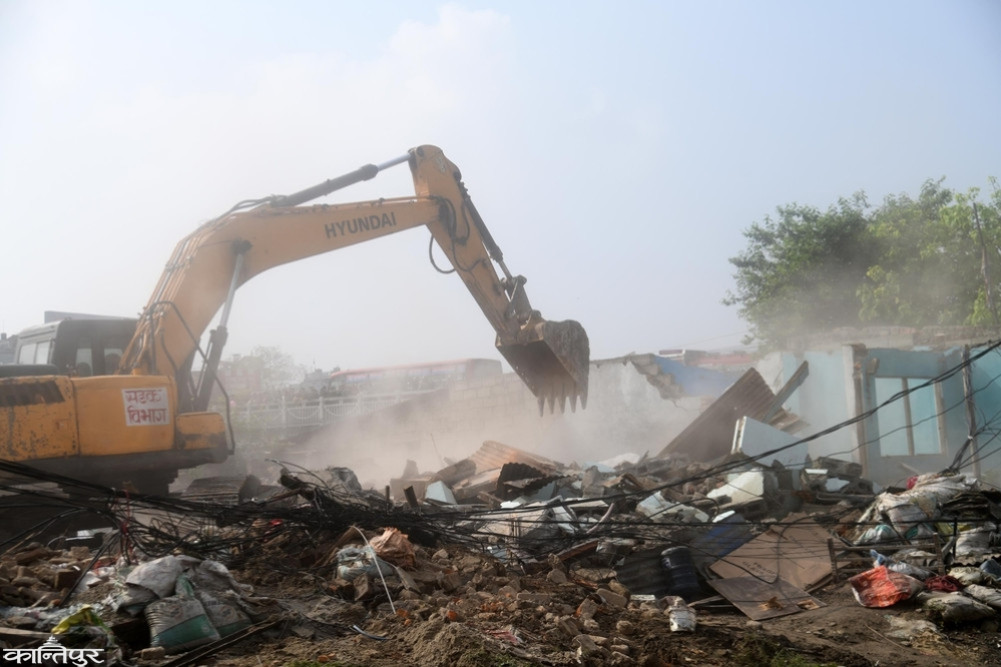
Is it justice or violence for the state to bulldoze citizens' homes without dialogue, acceptance, alternative housing, employment, and dignified and respectful rehabilitation?
We use Google Cloud Translation Services. Google requires we provide the following disclaimer relating to use of this service:
This service may contain translations powered by Google. Google disclaims all warranties related to the translations, expressed or implied, including any warranties of accuracy, reliability, and any implied warranties of merchantability, fitness for a particular purpose, and noninfringement.
Landlessness is not a personal weakness. Landlessness is the result of the state's unequal land distribution, historical discrimination, poverty, caste oppression, displacement, and deprivation of opportunity. On the one hand, some are born and become owners of hundreds of bighas of land - on the other hand, some are farmers who have been born in the soil for generations, struggling with the soil, and feeding the world by producing. Why and how does this happen?
This is structural injustice and exploitation by the state. In the past, rulers distributed land to certain classes and communities close to power on the basis of land grants, jobs, donations, and service. When the land ownership system came, whoever could get the land registered. However, the weaker sections of society continued to be deprived of land. The Dalit community was legally deprived of land. Today's landlessness is not due to a limited or momentary accident as is said on the surface, but is the result of the state's policy and implementation system.
I had reached the protest rally called by the landless in Thapathali after the government's 24-hour order to vacate the landless squatter settlement in Kathmandu. Many people were near trees, sheltering under houses, far from the place where they were chanting slogans. There was a lot of pain on their faces but they did not have the courage to chant slogans. They were also reluctant to speak to the media.
An elderly mother standing a little further away said, 'We heard that the new government has come, we will get the documents.' But instead of the documents, we got news that the house will be demolished.' Another woman added, 'We voted because they said that no one's house will be demolished in the elections, but they cheated us badly.' A pregnant woman was found washing clothes in one part of the settlement. She said, 'They will demolish the house tomorrow. I don't know where to go. But if I survive, I am washing clothes because I need two or four pairs of clothes.'
The statement broke my heart. Whose roof is going to fall off tomorrow. Where will they go now? I don't know. But, they have to be prepared to live as normal. Despite so much pain, fear, injustice and uncertainty, they are doing something for tomorrow, saving something. They are still keeping hope and patience alive. As soon as she saw the
mobile, she added, 'Don't take my photo or video. We had an arranged marriage. My husband's family is not aware that he is a squatter. If they knew that this too was collapsing, their parents would be very sad. My mother has a heart condition, what should I do if something happens?' Seeing this pain, constraint, dilemma and compulsion of a pregnant woman, she lost her words.
The bulldozer not only destroys tin roofs, mud or cement walls and windows, it also takes away children's safe places, schools, friends and memories of childhood. The demolition not only destroys houses but also destroys people's intimacy, feelings, memories, security, identity, dignity and respect. The bulldozer not only destroys tin roofs, mud or cement walls and windows, it also takes away children's safe places, schools, friends and memories of childhood. It takes away the shelter of the elderly and disabled. It makes women unsafe. It loses the place to rest in the evening after working all day. It pushes the entire family into fear and mental anguish.
However, the state is calling it development, management and law enforcement. Is it justice or violence for the state to use a bulldozer on citizens' homes without dialogue, acceptance, alternative housing, employment, and dignified and respectful rehabilitation? Now, thousands of squatters are staring at the state from holding centers, with hopeless eyes. Now the debate should continue - is this development or destruction?
After the uprising, we also reached the holding centers where squatters from Thapathali, Gairigaun, and others were kept. The situation was not normal. They barely got food and shelter. However, everyone had a terrifying mountain of worries. A person is not an object or a dependent creature (animal), to whom food given by someone gives happiness and satisfaction. How much happiness will justice give after so much pain, humiliation, and injustice? Will this be compensation for injustice?
The Constitution has guaranteed every citizen the right to housing and Dalits one-time housing along with land for agriculture. It is not the fault of the landless that there is no solution despite the existence of laws, regulations, procedures and necessary structures. Not keeping the settlements in risky and negative list places there does not mean indiscriminate demolition by bulldozers, but a solution with proper management, dialogue, rehabilitation and respect.
No matter how much the government tries to justify the sit-in, it is not right from any angle. The government's long-term plan and dream may be right, but the method and process were not right at all. When the state is supposed to be the guardian and protector of the weakest citizens, can it commit inhumane treatment and deliberately bring disaster upon them? Even today, the law seems to be harsh on the poor and soft on the powerful. The concept of a rule of law is definitely not like that.
The poor are landless encroachers for the state, but those who keep hundreds of ropanis of land unused, occupy public land or turn land into a means of trade never come under question . As per the government's obligation to protect public land, dozers are immediately used in the huts of the poor, but there is no discussion on the issue of ending absentee land ownership, returning land above the limit, and ending dual ownership of land in the interest of farmers, which is clearly written in the constitution.
Land is the basis of human survival, a source of hunger, a place to hide one's head . It is security, identity and respect, and also a trust connected to life and livelihood . Therefore, the question of land is not just about who has the title deed or not The landless have working hands, sweat, and skills, but no soil.
It is not about who owns the land on paper. Whose life has it sustained? Who has used and saved it? The debate should focus on this issue.