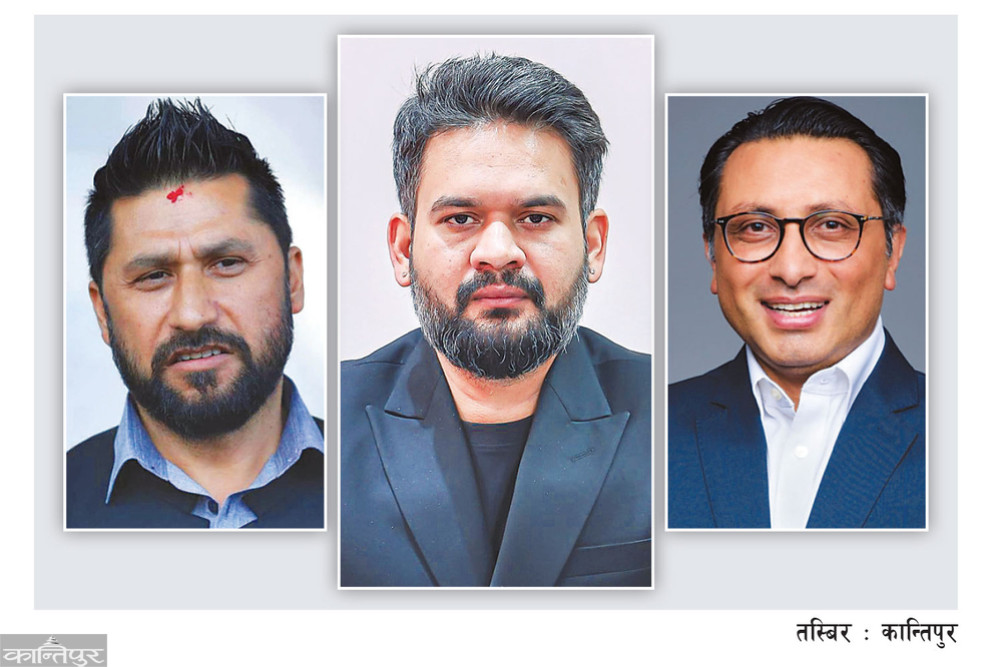
The answer to the question of where the country is heading is not in Ravi's visit and article, Balen's controversial statements, and Wagle's budget speech. The answer lies in that triangle, where the foundation of the budget is strong, the language of the leadership is responsible, and diplomatic expectations are intertwined with domestic preparations.
We use Google Cloud Translation Services. Google requires we provide the following disclaimer relating to use of this service:
This service may contain translations powered by Google. Google disclaims all warranties related to the translations, expressed or implied, including any warranties of accuracy, reliability, and any implied warranties of merchantability, fitness for a particular purpose, and noninfringement.
Finance Minister Swarnim Wagle presented the budget in Parliament . Prime Minister Balendra Shah made controversial statements in Parliament . Rashtriya Swayamsevak Sangh (RSS) Chairman Ravi Lamichhane visited India . These developments took place within a week . The budget has failed to provide clear guidelines for the country's economy . The Prime Minister's statement has lowered Nepal's historical position . There are signs that Rashtriya Swayamsevak Sangh (RSS) Chairman Ravi's visit to India will give a new shape to the relations between the two countries . He has made his views public by publishing an article in the Indian daily 'Hindustan Times' . Nepal, especially during Ravi's tenure, has tried to clarify what it wants from India . Against this backdrop, I will discuss in this article where the country is heading economically and politically .
If I have to sum it all up in one word, it should be called 'inconsistency' . The inconsistency is between policy and practice, between the dreams of the people and the ability of the leadership, and between diplomatic expectations and domestic preparations. The budget is a document that shows the path the state will take throughout the fiscal year. But because that document does not have a foundation on which to stand, it has become like the second manifesto of the Rashtriya Swayamsevak Sangh (RSS). It is not like the country's economic strategy.
Most comments on the budget are limited to ‘how much taxes have increased or decreased’ or ‘what new programs have come up’. But the problem with the current budget is deeper than that. The Prime Minister's presence in Parliament has created unnecessary tension about the country's identity, its history, and the dignity of ordinary Nepalis more than policy debate. Due to which the discussion has been decentralized from real economic issues. And at this time, Ravi Lamichhane's visit to India and his article have brought a different kind of proposal. To change the very terminology of Nepal-India relations, to focus on development diplomacy rather than geopolitical friction, and to connect not only the border but also the economy. The problem is that the budget and the existing governance and governance practices do not seem to be creating such a basis for such an ambitious proposal. As a result, there is a contradiction within the country. Two Nepals have emerged. One imagines that ‘we will rise through rail, energy, digital, and tourism to connect the economy.’ The other is a Nepal where the budget is scattered in the old format, with weak implementation and uncertain and literary language.
The attempt to ‘open a new path of relations through vocabulary’ is not new in the history of Nepal-India relations. In 1950, the then Prime Minister and Foreign Minister of the Rana regime, Mohan Shamsher Rana, visited India. And, the achievement of that visit was the Nepal-India Treaty of Peace and Friendship of 1950. Which is considered an important turning point in the history of the relationship between the two countries. The world and regional politics of that time were different. The state structure within Nepal was different. The two countries also had different perspectives on each other. But that historical context teaches a lesson. That is, when a relationship between two neighbors builds a long-term structure, it is not just a commentary on it, but institutional arrangements, economic interests, security concerns, and people-to-people relations all come together. Today, when Ravi Lamichhane proposes a development diplomacy terminology, it seems that he is basically trying to return to this structural thinking. But it is different from the treaty-centric one like in 1950. This time, he proposes to put ‘economy and opportunity’ at the center. But now the question arises – is our budget and governance capacity geared towards that?
Most comments on the budget are limited to ‘how much taxes have increased or decreased’ or ‘what new programs have come up’. But the problem with the current budget is deeper than that. Its main weakness lies in ‘the world’. Honest acknowledgement of credibility, clarity of priorities, and implementation capacity. The budget has tried to give something to everyone. But the task of boosting the economy is to give sufficient resources, sufficient attention and sufficient administrative energy to a limited number of sectors. When the budget does not prioritize, it does not choose the results either. And a budget without results ultimately does not give any big results. It flows little by little, disappears and returns next year with a new title. I had written before that such a budget can come and the same problem can repeat. That is what has happened. In such a budget, the fear of political balance is more visible than the strategic direction of the nation (by political balance, I mean the ideological and practical conflict between the Prime Minister and the Finance Minister). And, due to this fear, the Finance Minister has failed to make the budget confident.
This is where Ravi Lamichhane's proposal - 'Connecting the economy, not the border' seems meaningful. Because that proposal shows the weaknesses of the budget like a mirror. He sees a transformed India. India has become a large and rapidly growing economy by cutting old bureaucratic chains. He wants partnership in honor of that achievement. And he makes the railway the most tangible symbol of partnership. He mentions that India is running towards world leadership in metro rail expansion, laying about 15 kilometers of rail track every day, and the fact that the Raxaul-Kathmandu railway is less than 150 kilometers. He says that with the addition of that 150 kilometers of track, a revolution can come in trade, tourism, logistics and regional connectivity. This is not fantasy, it is economic logic. After transportation time and cost are reduced, the market expands, raw materials for industry become easier, agricultural products are saved from being wasted, tourism movement increases and Nepal is connected to the supply chain. But where does the budget place such 'engine projects'? Has it left the railways on paper, or has it given clarity on institutional preparation, land management, financial modalities, diplomatic roadmap and timelines? The budget is silent. This budget cannot go hand in hand with a clear development diplomatic proposal.
The same gap is seen in aviation and regional connectivity. Direct flights from Pokhara and Lumbini to hubs like Delhi, Mumbai, Bengaluru – this is not just a matter of tourism, but of the entire service economy. Direct flights reduce the cost of religious tourism, conference tourism, business trips, student movement and access to healthcare. Does the budget see airports only as ‘physical infrastructure’ or ‘gateways to the economy’? If a gateway is to be built, air route development, international standards, service quality, price competitiveness and marketing should all be combined. Such things are scattered in the budget. There is no coherent strategy. Whenever we talk about learning from India's aviation boom, the necessary reforms and preparations from our own side should have been at the center of the budget. Otherwise, 'direct flights' are also another dream.
The inconsistency is even more clear in the digital economy. Talk about the Kathmandu-Bengaluru Digital Corridor. Ravi Lamichhane urges Indian IT companies, startup ecosystems and universities to open innovation labs, incubation centers and tech hubs in Nepal. Nepal has talented youth, clean energy and a growing digital ecosystem. He argues that this can be transformed quickly with a 'small touch' of a mature ecosystem. He also argues that small entrepreneurs in both countries will be empowered through digital payments, fintech and cross-border platforms. But the budget seems to have avoided digital transformation by putting it in the general language of 'technology use' rather than as a serious economic policy. Without a concrete package and measurable targets on startup-friendly rules, data governance, cybersecurity, digital skills, tax policy clarity, and cross-border payment interoperability, the digital economy will be just a ‘number on the dashboard’.
In development diplomacy, Nepal’s strongest card is hydropower. It is no longer just a source of domestic needs. It is also an engine that can provide clean energy to India’s growing industrial corridors. The talk of moving from ‘fragmented trade’ to ‘integrated energy market’ is attractive. But its domestic foundation is weak. Generation growth, transmission line expansion, grid stability, storage capacity, regulatory trust, and transparency in pricing. If the transmission line itself is slow at home, the permitting process is confusing, and there is uncertainty in PPAs and financial closures, then even a grand energy partnership proposal abroad will be weak. The budget has written a lot under the heading of energy. But these are not tied to deadlines, project selection and institutional capacity. Therefore, energy cannot become a ‘diplomatic engine’. Although this budget claims to prioritize the energy sector, the integrated roadmap linking energy infrastructure and energy diplomacy is not clear. This ambiguity increases the gap between development diplomacy dreams and domestic reality.
The budget’s weaknesses are also reflected when looking at border management and ease of trade. Ravi Lamichhane says that the situation where ‘bureaucratic bottlenecks’ determine everything from the price of tomatoes to the movement of machinery needs to end. He emphasizes that ‘hard borders’ should be turned into ‘seamless bridges’ with modern ‘digitized incorruptible check posts’ and advanced transit corridors. This is a concrete measure to reduce Nepal’s trade costs. But the budget does not set measurable targets for ease of trade and border infrastructure. Without customs digitization, risk-based checks, a single-door system, indicators to reduce transit time, and a clear plan for coordination with the private sector, market prices will not decrease, competition will not increase . When the budget is not decisive in such reforms, then the desired 'results in daily life' of development diplomacy speeches will not come .
There is a shared civilizational opportunity in tourism . The cultural-religious circuit from Himalayas, Janakpur, Lumbini, and Bodh Gaya can show the world's tourists common heritage in a single trip . But to make it successful, administrative barriers must be reduced, services at border points must be facilitated, joint marketing must be done, and connectivity must be increased . The budget has once again put tourism in the sweet literary language of 'potential' . It has not tied it to a 'circuit-based, measurable, facilitation-focused' strategy .
'Trust' is at the core of all these issues . Disputes between neighbors cannot be hidden . Ravi has argued that countries with civilizational ties dating back thousands of years should resolve recent disputes based on historical facts and mutual understanding. He rejects ultra-nationalist rhetoric and proposes evidence-based dialogue. But within Nepal, the irresponsible language of the leadership, the short-sightedness of power-ego, and the baseless optimism of the budget make it difficult to build that trust. On the one hand, we seek a ‘development partnership’ with India, on the other hand, our own governance indicates that we have not been able to stabilize our own priorities, rules, and implementation capacity. This has put not only India, but also the Nepali private sector and the general public in doubt. If the state itself is uncertain, how can the opportunity from external partnerships be converted into institutional benefits?
Ambition itself is not wrong. But ambition without a foundation turns into empty talk. The argument that a stable and prosperous Nepal is a ‘strategic necessity’ for India is also reasonable. A prosperous Nepal is a natural guardrail on India’s northern border. An unstable Nepal is a sign of instability in the neighborhood. But the same logic is also true for Nepal in reverse. If we want a development partnership with India on an equal and respectful basis, we must first prove our own domestic state capacity, budgetary discipline, and policy stability. Diplomacy is not just about talking outside. Diplomacy is an extension of domestic management capacity.
A failed budget that has failed to lay the foundation on which to stand cannot be connected to the development diplomatic roadmap that Ravi Lamichhane expects. A budget without a foundation cannot advance big proposals for rail, energy, digital, tourism, and border management. They get stuck on paper. And the public can again conclude - 'I have spoken too much.'
Therefore, the decisive question now is not 'What does India give to Nepal?' but 'What does Nepal want to make of itself?' यदि हामी साँच्चै विकास कूटनीतिमा प्रवेश गर्न चाहन्छौं भने बजेटले प्राथमिकता छान्नैपर्छ । केही ठूला परियोजना जसले लागत घटाओस्, लगानी बढाओस् र रोजगारी देओस् । रक्सौल–काठमाडौं रेलजस्ता कनेक्टिभिटी इन्जिन, ऊर्जा बजार एकीकरणका लागि घरेलु प्रसारण लाइन र नियमन सुधार, डिजिटल पेमेन्ट/फिनटेक इन्टरअपरेबिलिटी र स्टार्टअप नीतिको प्याकेज, ट्रान्जिट करिडोरको समयबद्ध कार्ययोजना, पोखरा–लुम्बिनी उडानलाई आर्थिक रणनीतिसँग जोड्ने योजना र साझा पर्यटन सर्किटको सहजीकरणलाई पुनः नयाँ तरिकाले ल्याउनुपर्छ । त्यसका लागि सरकारले पूरक पूर्वाधार बजेट ल्याओस् ।
अन्तमा, देश कता हिँडिरहेको छ भन्ने प्रश्नको उत्तर रविको भ्रमण र लेख, बालेनको विवादास्पद अभिव्यक्ति र वाग्लेको बजेट भाषणमा छैन । उत्तर त्यो त्रिकोणमा छ, जहाँ बजेटको जग बलियो हुन्छ, नेतृत्वको भाषा जिम्मेवार हुन्छ र कूटनीतिक अपेक्षा घरेलु तयारीसँग गाँसिन्छ ।
अहिले त्यो त्रिकोणको दुई कुनो कमजोर छन् । बजेट आधारहीन छ, नेतृत्वको वाणी असावधान छ । तेस्रो कुनोमा विकास कूटनीतिक महत्त्वाकांक्षा मात्र उभिएको छ । महत्त्वाकांक्षा आफैं गलत होइन । तर जगबिना महत्त्वाकांक्षा कोरा कुरामा बदलिन्छ । यदि साँच्चै रास्वपाले भारतसँग १९५० पछिको अर्को ‘ल्यान्डमार्क’ सम्बन्ध निर्माण गर्न चाहेको हो भने त्यो सन्धिको नामबाट होइन, नागरिकको जीवनमा देखिने परिणामबाट मापन हुनुपर्छ– रेल चलेको दिन, सीमा वारपार सहज भएको दिन, डिजिटल भुक्तानी सीमा पार चल्न थालेको दिन, ऊर्जा व्यापार पारदर्शी र स्थिर बनेको दिन तथा पोखरा र लुम्बिनीबाट क्षेत्रीय हबमा उडान भरिएको दिन ।
त्यस दिनसम्म पुग्ने बाटो तय गर्ने हामीले हो । त्यसका लागि साहित्यको लेपन गरिएको भावनात्मक भाषण होइन, अर्थमन्त्रीले संसद्मा साँच्चैको बजेट प्रस्तुत गर्न सक्नुपर्छ । प्रधानमन्त्री पदमा आसीन व्यक्तित्वले मुलुकको मर्यादा बुझ्न सक्नुपर्छ ।