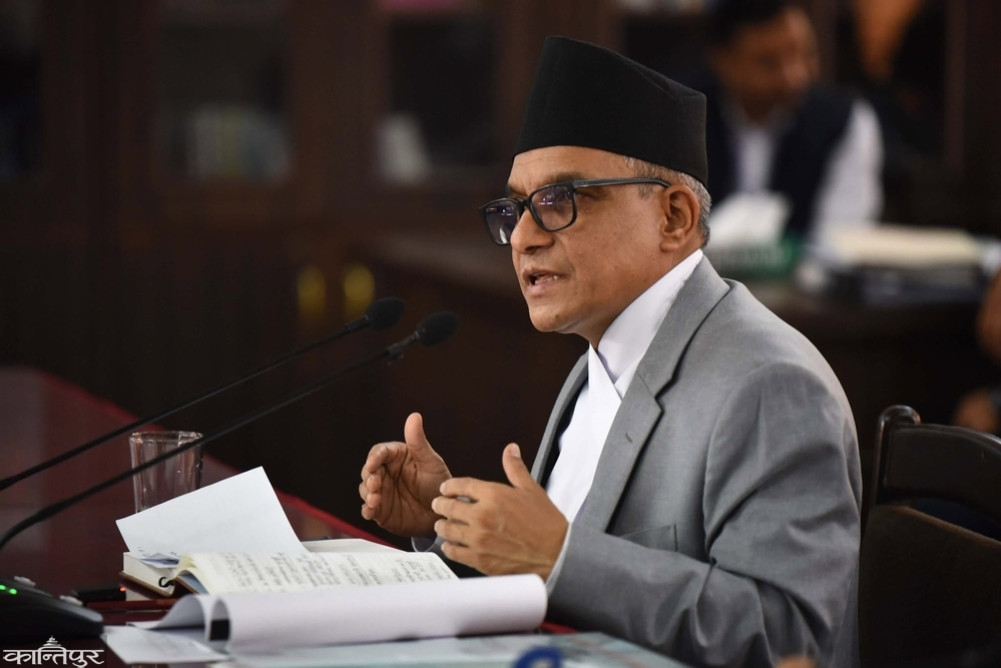
Manoj Kumar Sharma, who became a judge of the Supreme Court after receiving a 'double promotion' and then again after receiving a 'double promotion' and becoming the Chief Justice, surpassing the three justices before him, must now demonstrate the style and pace of 'double promotion' by reforming the judiciary.
We use Google Cloud Translation Services. Google requires we provide the following disclaimer relating to use of this service:
This service may contain translations powered by Google. Google disclaims all warranties related to the translations, expressed or implied, including any warranties of accuracy, reliability, and any implied warranties of merchantability, fitness for a particular purpose, and noninfringement.
Justice Manoj Kumar Sharma, the fourth seniority, became the Chief Justice after succeeding three seniors. A small group of the bar took out a symbolic lantern procession. Since the constitution does not say that the most senior person should become the Chief Justice, the society understood that the fourth seniority person becoming the Chief Justice was for reform.
After the establishment of the republic, faith and trust in the judiciary had been decreasing. Inconsistencies, inconsistencies and corruption were increasing. The leadership had not paid attention to reform. They had only given lip service saying that they would reform. Justice had become expensive, slow and cumbersome. Easy access to justice was difficult. There was a division in the appointment of judges. There were signs that an environment had been created where leaders were allowing the Chairman of the Judicial Council to 'dictate' the appointment. For this reason, when Prime Minister Balendra Shah 'picked up' a fourth-ranking judge to make him the Chief Justice, the society responded positively. 'The judges did not speak, but the Prime Minister did the right thing'.
All those who have worked in the Supreme Court for three years are candidates for the position of Chief Justice. Seeing this arrangement, the Judicial Council sent the names of all judges who have completed three years to the Constitutional Council. It is not the law but tradition that the most senior Chief Justice should be. Not following tradition does not violate the constitution. For this reason, the Prime Minister, as the Chairman of the Constitutional Council, recommended the fourth person as the 33rd Chief Justice on the basis of deciding the most cases out of the six. The parliamentary hearing unanimously approved it. The 33rd Chief Justice took the oath and started work. However, the six people were equally capable. None of them were less than the other. Evaluating judges solely on the basis of deciding more cases can lead to discord in the judiciary. This should not happen now.
The Chief Justice has a mountain of problems and reforms to face. The term has completed 6 years. He cannot say 'lack of time'. How to reform? What to do? When to complete? It is a matter of his vision. The problem has not been reformed because the powers of Article 136 were not used by those before him. If we ask ordinary citizens and parties to the case, their first suggestion is, 'Reforms should be made in the appointment of judges and only then will anomalies, irregularities, distortions, and corruption gradually be controlled. Therefore, justice becomes faster, quicker, and more accessible. Therefore, reforms should be made from the appointment of judges.'
This time, the tradition was broken for reforms in the appointment of the Chief Justice. After the country became a republic, all three organs of the state had become controversial. Even if other organs became controversial, the judiciary should not have become controversial. If the other two organs became controversial, the judiciary would reform them through judicial review. But, who would reform the judiciary itself when it was controversial? There was confusion. It seemed like there was a competition between the three organs of the state to see who would be more controversial.
The Judicial Council appoints judges. The Chief Justice is appointed by the Constitutional Council. The government has no role in the appointment of judges. The 'Founding Fathers' of the Constitution made the Judicial Council five-member. Making it five-member means that if one member tries to make his own person a judge, the other member will control it. The five members themselves were there to balance and control power against each other. However, the five members became reconciled. One member named 'my this', the other 'my this', and everyone made their own person a judge. You will know when you read Sushila Karki's interview. If any member tried to get involved, the job of the chairman and the senior-most member would have been to stop them, but they did not stop them. They also had to inject their own people. This is why the judiciary was made controversial.
The Chief Justice has mountains of problems and reforms. The term has been completed for 6 years. He cannot say 'lack of time'. How to reform? What to do? When to complete? It is a matter of his vision. The Judicial Council ran under the invisible command of leaders and political parties. The chairman and the senior-most member forgot their oath and became selfish. Due to personal interests, they did not think about the importance of the Judicial Council. The main source of the chairman and senior-most member of the council is the justice. The turban of the justice gave them the opportunity to become the chairman and senior-most member. Being a justice and a member of the Judicial Council, one should not be appointed to a sensitive position like a judge under the pressure or request of the party. If they do so, justice will die and the judiciary will become controversial. Sitting on the council does not give one the status of the Chief Justice or the senior-most judge to exercise judicial power. Appointments may be questioned. Cases may be filed in court. Appointments are not judicial work. Position and authority have forgotten oath and ethics.
The Public Service Commission, thinking that judicial authority is exempt, has been rather dignified in the appointment of judges, thinking that 'who will question the work we have done? Even if a writ is filed against the work we have done, we will be the ones to look into it', while the Judicial Council has not been dignified. The reason why Prime Minister Balendra Shah, as the Chairman of the Constitutional Council, is aware of these issues must be the reason - he appointed the fourth-ranking Chief Justice as the Chief Justice because he wanted to end the division in the appointment of judges. If the Chairman and the senior-most judge were not committed to high ethics, there could not be a better system like the Judicial Council. If the Constitution is to be amended, the Judicial Council should be abolished.
Now, if appointments are to be made from legal practitioners other than career judges, they should also appoint senior, qualified, experienced, reputable, senior-most legal practitioners who are respected. The practice of appointing judges who are not recognized by Article 129 (5) by insulting and 'humiliating' disciplined career judges who have gained experience by handling thousands of cases should be stopped. This article does not mean that 'judges should not be appointed from legal practitioners'. The attention of the Chairman and the senior-most member should be drawn to Article 129 (5). The words 'recognized as distinguished legal practitioners' are included in it.
In the same clause, there is also the phrase ‘having practiced law as an advocate for at least 15 years continuously’. Five justices of the Supreme Court can invalidate a law made by 334 MPs. Two justices can overturn an important decision of the government. The title of advocate alone is not enough for such a job. An advocate who has ‘acquired a reputation as a distinguished lawyer’ should be appointed. The chairman and the senior-most member should understand why the founding fathers of the constitution used the phrase ‘acquired a reputation as a distinguished lawyer’. What does that phrase mean, there is no need to explain it, the meaning of the word itself speaks for itself.
‘Distinguished lawyer’? ‘Reputed lawyer’? Can be seen on an objective basis. Regular Supreme Court appearance in ‘complex constitutional and administrative law cases’, argumentative skills, opinions provided to business houses, amount of tax paid, number of other lawyers working in the law firm, lawyers trained in internships, how much contribution has been made to law journals, number of cases registered in the law firm and what types of cases are there in which courts? Etc. All these things are seen on an objective basis.
What is important today is what level of debate is there? What arguments do they give while debating? What examples do domestic/foreigners use to argue? How easy has it been to administer justice? These are issues that the Chairman and senior-most member of the Judicial Council, who have the ability to interpret the articles of the Constitution and the Act, see and experience every day when they sit on the bench as judges. If a legal practitioner who has ‘gained a reputation as a distinguished jurist’ is appointed as a judge in the Supreme Court, there will be no opposition from anyone or anywhere. Therefore, if the chairman is to appoint a judge from among legal practitioners, he should appoint a person who has ‘gained a reputation as a distinguished jurist’. This will be the first important step in reform. As stated in Article 129 (5) in the High Court, only accomplished legal practitioners should be appointed. All ‘career judges’ are disappointed, their seniority has been violated. They were no less capable than those appointed from among legal practitioners. However, after the establishment of the republic, the discipline and dignity in the judiciary were destroyed.
When a ‘person who has gained a reputation as a distinguished jurist’ is appointed to the post of judge, there is no allegation of division and they are not called Congress judges, UML judges, Maoist judges, or Rashtriya Swayamsevak Sangh judges. The chairman and the most senior member of the council should remember their oath and code of conduct as sitting judges in their original form. It should be remembered that the appointment of judges also falls within the power of Article 136 to make the judiciary effective. Just as one becomes loyal when deciding a case, the same loyalty should be maintained when appointing judges as the chairman and the most senior member of the council. There may be two reasons why the chairman and the most senior member of the judicial council are not loyal. One is that the parliamentary hearing was only in name, the judicial council approved whatever was sent. Another reason is that the chairman and members of the council did not fear impeachment. If they had remembered these things, the chairman and the most senior member of the council would have become loyal in the council just as they become loyal when administering justice.
In America too, there is a dispute over the appointment of judges. There, a Republican president appoints a Republican, while a Democrat president appoints a Democrat. However, there is no deviation in the administration of justice there. In America, the ‘Roe v. Wade’ case, which is related to abortion, protected women’s right to abortion. That case was considered important in the world for women. Republican President Donald Trump wanted to reverse that. At that time, there were 6 Republicans and 3 Democrats on the Supreme Court. Needless to say, the precedent of the case was somewhat reversed. There was a rumor that ‘it was reversed because of the majority of Republican judges.’ The Chief Justice was and is ‘John Rawts’. In a speech, he had convinced the society by saying, ‘There are neither George Bush judges in the US Supreme Court, nor Barack Obama judges, nor Bill Clinton judges, we 9 judges are the judges of the US Supreme Court.’
After the introduction of the republic, we too were tagged as Congress, UML, Maoist judges. Now, if a judge is appointed who has ‘gained a reputation as a distinguished jurist’ without looking at the date of birth, horoscope, or Chinese of the judges, there will not be and will not be a Congress judge or UML judge in the Supreme Court. 21 justices will be the judges of the Supreme Court. It should be shown by filling the vacancies.
Justice Manoj Kumar Sharma became a judge of the Supreme Court after getting a 'double promotion' and then became the Chief Justice after getting a 'double promotion' again and leaving behind the three justices before him. Now it should be shown by reforming the judiciary in the style and speed of 'double promotion'.