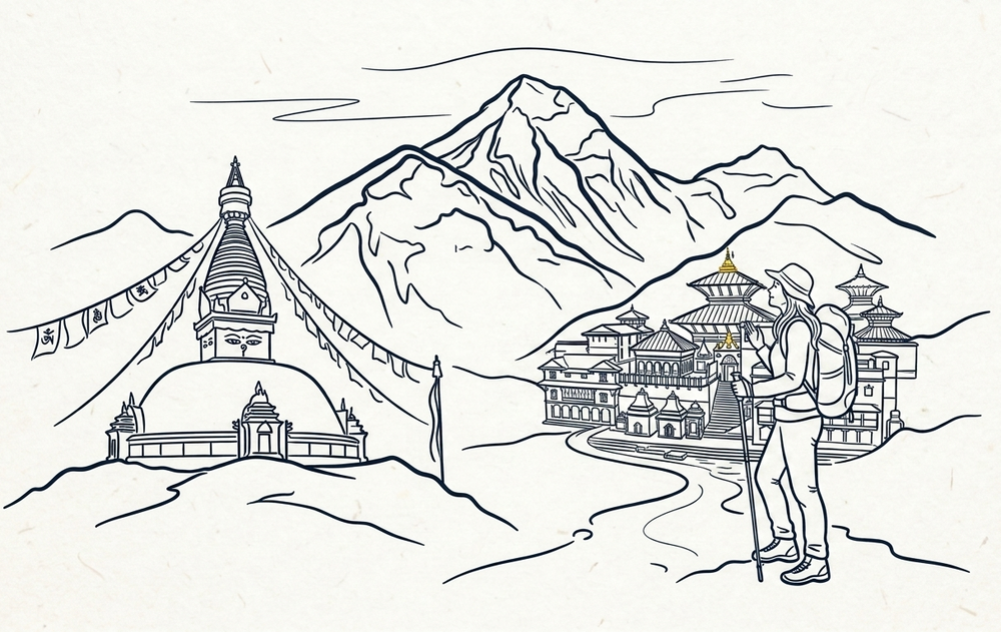
Nepal has a deep, historical, and original national identity. But the process of transforming that identity into a unified national discourse is incomplete. National identity is the root, and national discourse is its effective expression.
We use Google Cloud Translation Services. Google requires we provide the following disclaimer relating to use of this service:
This service may contain translations powered by Google. Google disclaims all warranties related to the translations, expressed or implied, including any warranties of accuracy, reliability, and any implied warranties of merchantability, fitness for a particular purpose, and noninfringement.
When some foreigners use insulting language like ‘What’s wrong with Nepal? Where is Nepal’s national identity?’ in a public event, it makes us very restless. Let’s not debate with such ignorance, we don’t have to keep answering such people who revel in intellectual poverty. But such a tendency to deny Nepal’s independent existence should not be repeated. This is not an issue of a particular party or leader, but a common issue for all Nepalis. Perhaps, in connection with Nepal’s national identity and discourse, the Rashtriya Swayamsevak Sangh (RSS) government has brought an abstract concept from ‘buffer’ to ‘dynamic bridge’ in foreign policy and relations. Nepal has never been and is not a buffer state, so it needs to be corrected. What is Nepal? And, such ideas about what it should be have been debated from the Panchayat system to federal democracy to this government after the Gen-G rebellion and destruction.
Just like former King Gyanendra also came up with the concept of developing Nepal as a 'transit point'. The conceptualizer of the dynamic bridge is Baburam Bhattarai, who has gone into political seclusion while debating. KP Oli has tried to establish it as a land of knowledge, land of penance, or the role of Eastern knowledge theory in general. Perhaps the Rashtriya Swayamsevak Sangh (RSS) must have brought this idea as a summary of everyone's thoughts. Along with that, now Foreign Minister Shishir Khanal has called for everyone's cooperation in conducting Nepal's foreign relations and has taken forward the dialogue by prioritizing the creation of that national identity and discourse. In the same vein, Lok Bahadur Poudel Chhetri, the spokesperson of the Ministry of Foreign Affairs and Head of the Public Diplomacy Division, has taken forward the debate by covering many topics through a detailed report. One of the topics is related to that national identity and discourse. This article focuses on this thought.
Let's start with the basic question. Is Nepal really a country without an identity? Or, has it not been able to establish one even though it has an identity? This is not just an intellectual exercise and luxury, it is directly linked to Nepal's diplomatic future. Therefore, when debating, we should start with the fact that there is no country without an identity, all have a unique identity. The 193 countries recognized by the United Nations all have their own unique identities. Rather, it is about how many of them have been able to establish an identity or not. Identity is not established only by power and strength, identity is also inherent in historicity and civilization, which requires diplomatic effectiveness to establish. In that sense, Nepal's identity is not a new construction. When Prithvi Narayan Shah defined Nepal as a 'yam between two rocks' with the creation of modern Nepal, he gave not only geography, but also the outline of strategic existence. This is a strong foundation of history. Nepal has never been colonized by anyone. But this is not the time for the yam analogy, in that sense it should be transformed. Perhaps that is why different prime ministers and governments have come up with different ideas. The concept of a 'dynamic bridge' is one of them. But to make the dynamic bridge practically functional, the trust of both neighbors across the bridge should be gained. It should enter the structure of trilateral cooperation, in which India and China should be positive. Similarly, Nepal has been the confluence of the Himalayan and Gangetic civilizations. Coexistence within diversity has become its social character. These are the unique historical identities of Nepal. Therefore, the question is not 'does it have an identity or not', the question is how that identity is presented to the world today. Or, whether the transformed Nepal has continued and transformed its identity or not. Because while maintaining its traditional identity, its transformation in accordance with global politics and diplomacy is also necessary.
Therefore, in conclusion, Nepal has a deep, historical and original national identity. But the process of transforming that identity into a unified national discourse is incomplete. National identity is the root, and national discourse is its effective expression. Nepal's current challenge is not to find the root, but to present its discourse to the world in a clear, confident and strategic manner. As British public diplomacy expert Simon Anholt said, 'Nation branding is not about creating something new, but about clearly expressing to the world what already exists.'
Identity: Soft Power
At first glance, a nation that is strong in economic and military power seems to rule the world. The US and China are examples of that. Donald Trump and Xi Jinping represent that power. Considering that the world is moving towards multipolarity, new powers are emerging based on those criteria. But in modern diplomacy, power is not limited to military or economic means. As the famous American political scientist and conceptualizer of soft power, Joseph Nye, said, soft power is the ability to shape the preferences of others through attraction. It is the ability to bring others to your side not through pressure or force, but through attraction and influence. It is through this attraction that nations are building their global image. For example, Japan transformed its culture, discipline, and technology into global influence. As soon as the word Japan is mentioned, the world understands it as a nation with an excellent combination of tradition and technology.
South Korea established its identity through its cultural exports. South Korea's national discourse has been its pop culture and innovation. For example, Korean pop bands like BTS and Blackpink have created a stir in the world, which have been promoted by the government there as a Korean soft power. India is a power that has made its cultural and civilizational influence known along with its military-economic capabilities. Yoga, Ayurveda and spiritual traditions are its diplomatic tools. Therefore, identity is for everyone, or rather, identity is not created, but presented strategically. Nepal does not lack soft power, it has abundant potential. Nepal's greatest soft power is its unique society built on the foundation of Hindu and Buddhist civilization. The birthplace of Gautam Buddha, the mother of Hindu civilization and a land with the authority to give a message of peace, coexistence and spirituality. The Himalayas are also a sensitive area of climate crisis and an active participant in the United Nations peacekeeping mission. These are not just symbols, they are a unified national discourse that Nepal can build. The Hindu-Buddhist worldview is a civilizational international thinking based on peace, balance and coexistence. If anyone can give the world a true message of peace, only Nepal can maintain that authority.
Such identities have been established by some countries. Mecca-Medina is not just a religious center for Islam, but a symbol of a unified global identity. Jerusalem is not only a center of faith for Jewish and Christian civilizations, but also a sacred place connected to history and existence. For Sikhs, the Golden Temple, which is considered the holiest gurudwara, is considered the sacred Himalayas for Chinese Taoism. Pashupatinath is a sacred place for Hindus around the world, who are worshipped as the lord of all beings in the world. Similarly, Lumbini can establish Nepal not only as a geography, but as a global spiritual center connected to the message of Gautam Buddha. But Nepal has not yet been able to turn its original gentle strength into a national discourse.
Fragmented vision
Nepal's weakness is not external criticism, but internal ambiguity and division. These include changes in national priorities with political change, lack of long-term diplomatic vision, and weakness of institutional coordination. Nepal has an identity, which has been accepted by its neighbors and the world, but it has not been able to become a unified national discourse. Can the 'young government' led by Balendra Shah turn Nepal's national strength and identity into an international identity and discourse? Two months after the government was formed, the previous debate has continued. The changes in world politics and changing geopolitics are forcing medium and small countries to clarify their position. The competition, rivalry and cooperation between India and China, the increased activism of the Americans by playing into it, development projects and strategic partners are all pressuring Nepal to clarify its diplomatic identity. There is a demand for leaning towards them, but Nepal should reject it outright. The strategic interests of powerful countries cannot be rejected through domestic fragmented thinking. The goal is to advance relations while maintaining strategic autonomy.
Nepal can no longer establish its national identity by just talking symbolically. The new government should take this forward as a primary diplomatic agenda. To establish Nepal's world view, the Ministry of Foreign Affairs should coordinate with other related ministries, such as Culture, Tourism, Communication and Education. There are plenty of identity materials, but the presentation has not been effective. In coordination with stakeholders, the Ministry of Foreign Affairs should formulate a common vision, discuss among political parties, and prepare a document that is passed by the parliament. The above-mentioned benign forces should be mentioned in it. For example, Lumbini can be developed as a world-class spiritual and diplomatic center through international conferences, peace dialogues and cultural diplomacy programs. Pashupatinath and Muktinath can also be branded in the same way. Nepal has already reached an understanding with India to advance the Ramayana Circuit and the Buddhist Circuit, but there is no sign of any progress in that. Most importantly, a common vision should be created among Nepali parties. The issue of formulating foreign policy and conducting diplomacy through that policy is not only the government's, but it is the state's, which includes all parties and stakeholders. Overall, the issue of building Nepal's international identity and image is not the concern of one party, it is a common issue for all. When a strong and unified Nepal is seen in the world, then the neighbors and the world will relate to that unified force, where only national interests are seen, not party and personal interests. Till today, we have failed in this. This is also an opportunity for Prime Minister Balendra as the Chief Executive Officer. It is positive to inform 17 ambassadors collectively about the government's foreign policy and relations instead of meeting the ambassadors in Kathmandu individually. But the Prime Minister should meet the ambassador in Nepal based on the need, protocol does not prevent it there. Because, any ambassador must meet the Prime Minister or Chief Executive Officer of the country that provides hospitality. Similarly, it is not that I will not meet the ambassador or secretary of a neighboring country, but that I will meet him based on the agenda. Tomorrow, will any Nepali ambassador be able to meet the Prime Minister there or not? Similarly, if there are examples of Nepali ambassadors not being able to meet the Prime Minister and Foreign Minister until the end of their term, they should not go to the level of making it an issue tomorrow. The Prime Minister is supposed to lead the Nepali identity, and on the basis of that identity, he should meet with external counterparts, foreign ministers, secretaries, and ambassadors. In that sense, the Prime Minister must have had a deep encounter with that cultural and civilizational identity. Whether it is when the Prime Minister appears in parliament or in high-level foreign meetings, it must have been portrayed. If Nepalis cannot carry the Nepali identity, foreigners will not respect it.
Therefore, let the foreign ministry's efforts to establish a national dialogue through the existing identity be successful. And, let diplomatic behavior move forward by looking at national strength.