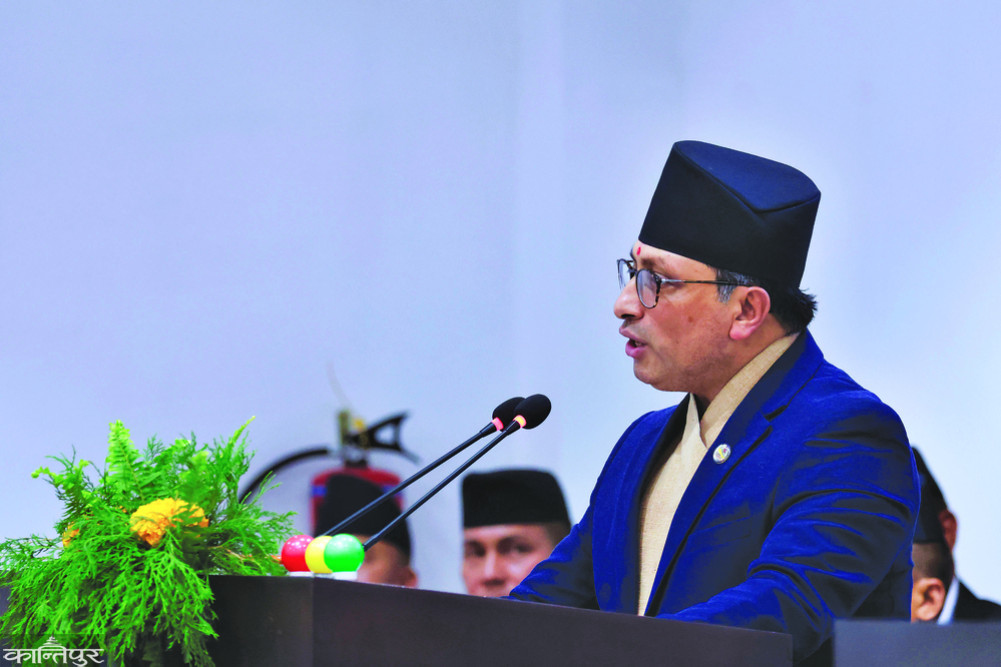
Rising public debt, debt servicing pressure, high share of current expenditure, weak implementation capacity, and inadequate addressing of the concerns of marginalized communities have challenged the effectiveness of the budget.
We use Google Cloud Translation Services. Google requires we provide the following disclaimer relating to use of this service:
This service may contain translations powered by Google. Google disclaims all warranties related to the translations, expressed or implied, including any warranties of accuracy, reliability, and any implied warranties of merchantability, fitness for a particular purpose, and noninfringement.
The Government of Nepal has presented a budget of Rs 2124.34 billion for the fiscal year 2083/084. This is about 8.2 percent more than the budget of Rs 1964.11 billion for the previous fiscal year 2082/083. This budget aims to transform the economy through productivity growth, digital transformation, administrative reforms, and private sector participation.
However, the high share of current expenditure, rising public debt, weak implementation capacity, and imbalances in social justice have raised questions about the effectiveness of the budget. About 59.8 percent of the total budget has been allocated to current expenditure, 20.3 percent to capital expenditure, and 19.9 percent to financial management. This shows that a large portion of the state's resources are still focused on salaries, allowances, administrative expenses, and debt repayment. However, the announcement of reducing the number of ministries from 22 to 18, abolishing 31 agencies, and restructuring the administrative structure are positive aspects. If these reforms are implemented effectively, they will help control government spending in the long run.
The budget for the fiscal year 2082/083 prioritized agriculture, energy, tourism, infrastructure and social sectors, while the budget for 2083/084 has expanded it and given special emphasis to the digital economy, AI, administrative reform and technology-friendly governance. This seems to indicate that the traditional expenditure-oriented approach will be oriented towards structural reforms to some extent.
Rising public debt, debt repayment pressure, high share of current expenditure, weak implementation capacity, and inadequate response to the issues of marginalized communities have challenged the effectiveness of the budget. The basis of any nation's long-term development is quality education and health services. The government has increased the budget for the education sector this year compared to the previous year. In the fiscal year 2082/083, about 203 billion rupees were allocated for the Ministry of Education, Science and Technology, while in 2083/084 this amount has been increased to about 2011 billion rupees. However, this increase seems limited in proportion to the total budget. This year's budget includes programs to expand technical and vocational education to the local level, develop digital classrooms, implement a learning achievement-based assessment system, and encourage research and innovation. Considering the growing gap between university output and the labor market, the emphasis on skill-based education is a positive aspect. It has attempted to link certificate-oriented education with productive human resource development.
The budget has also increased in the health sector. In the fiscal year 2082/083, about 86 billion rupees were allocated for the Ministry of Health and Population, and this amount increased to about 91 billion rupees in 2083/084. The restructuring of the health insurance program, the upgrading of federal and provincial hospitals, the goal of providing treatment for complex diseases domestically, and the program to expand access to basic health services can be considered positive. However, despite the increase in budgets in both the education and health sectors, there is no ambitious program of the expected level for structural reforms, improving service quality, managing teachers and health workers, expanding services in rural areas, and strengthening public institutions. The additional 3 percent tax on private schools and the provision of a health equity fee from patients seeking treatment in private hospitals and medical colleges also risk increasing the cost of education and healthcare.
The most prominent aspect of this budget is the priority given to AI and information technology. The government has announced the establishment of a ‘Sovereign AI Compute Center’ for the first time. The program to encourage startups, innovation, remote work, and digital entrepreneurship has indicated that Nepal will move towards a knowledge-based and technology-based economy. The plan to purchase thousands of AI processing units, provide them to youth at a discount, establish a tech hub by selling some shares of Nepal Telecom, and legalize remote work can be considered ambitious in the South Asian context. The concept of Digital Nepal was also there last year, but this year that policy seems to have come in a more clear and structured form.
With the aim of encouraging the private sector, the personal income tax exemption limit has been increased, the maximum tax rate has been reduced, a startup fund has been established. And, public-private partnerships have been encouraged. These provisions look positive as collaboration with the private sector is necessary for job creation and expansion of economic activity. In the agricultural sector, programs such as land banks, contract farming, production-based subsidies, and digital fertilizer distribution systems have been included. This indicates an attempt to move the agricultural sector from a subsistence-oriented state to a commercial and production-oriented direction. The budget seems to accept the reality that Nepal's rural economy cannot become strong without agricultural modernization and productivity growth. In the energy sector, the goals of hydropower generation, transmission line expansion, and energy export have been continued. Although Nepal's efforts to economically utilize its vast water resources are positive, investment security, policy stability, and implementation capacity remain challenges.
One of the weakest aspects of the budget is the lack of sufficient sensitivity towards marginalized and backward communities. Programs targeted at Dalits, indigenous peoples, Madhesis, Muslims, Tharus, citizens of backward areas, landless, marginal farmers, people with disabilities, and the underprivileged are limited. Despite the slogan of inclusive development and social justice, the budget does not include concrete and adequate programs for the education, health, employment, entrepreneurship, and economic empowerment of such communities. There is also concern that the reduction in the fiscal equalization grant going to the provincial and local levels may affect social and inclusive programs operated at the local level. Although the essence of federalism is linked to local needs and local development, a centralized approach still dominates the budget. The biggest challenge in budget implementation is financial management and public debt. Currently, Nepal's total public debt has exceeded about 29 trillion rupees. In the fiscal year 2083/084 alone, 422.64 billion rupees have been allocated under the heading of financial management, a large part of which will be spent on debt repayment.
As a large part of the revenue is being spent on debt repayment, the risk of limiting the resources available for development construction, the productive sector, and employment creation programs has increased. The salary of employees at all levels has been increased by up to 21 percent, which seems to put additional pressure on current spending. While the ability to spend the capital budget has been weak in the past, there is concern that development spending will be able to meet the target this year as well. Decisions such as the provision of VAT on electricity consumption exceeding 50 units, additional taxes in private schools, and health equity fees in private hospitals are likely to impose additional financial burden on citizens. It expands the use of clean energy. And, access to quality education and health services also contradicts government goals.
Overall, the budget 2083/084 presents ambitious goals of productivity growth, technology-friendly governance, administrative reforms, private sector participation, and building a digital economy. Some positive programs are also included in education, health, agriculture, energy, and information technology. However, rising public debt, debt service pressure, high share of current expenditure, weak implementation capacity, and inadequate addressing of marginalized communities have challenged the effectiveness of the budget. The success of the budget will depend not on its size or announcements, but on its implementation capacity, good governance, transparency, and real change in the living standards of citizens.