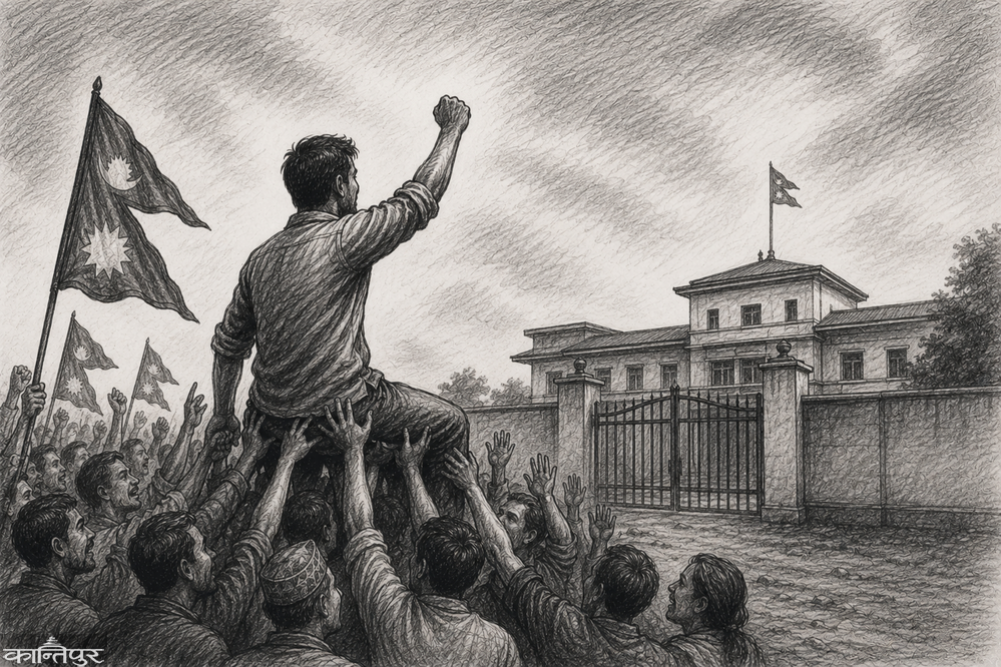
If reform-oriented energies continue to clash with institutions seeking to preserve the old balance of power, political polarization and a crisis of legitimacy are likely to increase.
We use Google Cloud Translation Services. Google requires we provide the following disclaimer relating to use of this service:
This service may contain translations powered by Google. Google disclaims all warranties related to the translations, expressed or implied, including any warranties of accuracy, reliability, and any implied warranties of merchantability, fitness for a particular purpose, and noninfringement.
Nepal is no longer just a country going through a regular democratic cycle. The country is now entering a deeper phase of political transformation, where public expectations are shifting from merely symbolic republicanism to demands for state effectiveness, institutional reform, accountability, and executive capacity. Along with this, the risk of another political instability or emergency seems to be gradually increasing. The rise of reformist political forces like the Rashtriya Swayamsevak Sangh (RSS) is not only a discontent with weak governance, but also with the political-security-diplomatic structure established after 2006. But the evolving political landscape in Nepal is now exposing a serious tension—the tension between electoral mandates and institutional continuity.
Reformist forces have gained political legitimacy through about two-thirds of the 275, or 182, seats in the House of Representatives. However, important parts of state power are still secured within the institutional structures built by the old consensual system. The National Assembly, parts of the judiciary, entrenched administrative networks, and old party structures still retain significant influence in policy formulation, implementation, interpretation, and control of political momentum. This conflict is not accidental, but a natural feature of transitional political systems around the world.
Some leaders succeeded because they were able to combine anti-system legitimacy with institutional restructuring, economic management and administrative modernization. ‘Comparative politics’ describes such institutions as ‘veto structures’. Formally, their purpose is to ensure stability, continuity and control over the sudden impulses of the majority. However, in periods of rapid social change, these same institutions gradually come to be seen as mechanisms for blocking change. In this context, the political behavior of Prime Minister Balendra Shah ‘Balen’ becomes particularly significant.
Many commentators have interpreted his unusual style as simply personal temperament or political immaturity. But such an analysis ignores the broader comparative political context. Studies in political science and political psychology show that leaders who emerge in transitional phases often use symbolism, behavioral differences and public rejection of established processes to distinguish themselves from the old political culture. Such behavior is often not accidental.
In many transitional regimes around the world, established anti-establishment leaders have sought legitimacy through ‘symbolic break’ rather than institutional conformity. This includes unusual attire, rejection of formal protocol, public confrontation with old political elites, informal executive style and a style of addressing ‘people rather than institutions’ directly. These are all political signals.
When leaders appear deliberately informal at state functions, ignore protocol or show distance from formal political culture, analysts interpret it as a reflection of institutional inertia, dissatisfaction with elite consensus politics and an attempt to build legitimacy based on direct mandates rather than traditional power structures. International examples of this abound. Narendra Modi sent a clear message of break from traditional Delhi political culture during his early term. He presented himself as a leader outside the established power circles of ‘Lutyens’ Delhi’ – a force for change, not a continuation of the old order. His message focused on combating corruption, policy inertia and coalition-based political weakness.
Boris Yeltsin symbolically represented the ‘break’ in the post-Soviet transition. His image standing on a tank during the 1991 Soviet ‘coup’ attempt became a global symbol of resistance against the old order. But rapid change also brought with it problems of institutional instability, economic chaos and centralization of power. Hugo Chávez built political legitimacy in 1992 through direct anti-establishment confrontation. He challenged the established political order through public demonstrations, symbolic politics and the narrative of ‘people versus elites’. But the over-personalization of power and institutional weakening led to a long-term crisis.
More recently, Javier Milley in 2023 used Argentina’s economic crisis, political inertia and popular resentment against the old parties to mount an aggressive anti-establishment political campaign. Through unusual public behavior, sharp speeches and a personal style, he established himself as a political ‘break’ against the old order. El Salvador’s Nayib Buk also challenged traditional political structures in 2020, creating an image of “decisive leadership” through social media, direct messaging, and a centralized executive style. But comparative political history also offers another important lesson—symbolic disruption alone is not enough. Whether transitional or transformational leadership succeeds or fails ultimately depends on institutional transformation.
Some leaders succeeded because they were able to combine anti-systemic legitimacy with institutional restructuring, economic management, and administrative modernization. Lee Kuan Yew transformed Singapore from a weak postcolonial city-state to a highly institutionalized state after 1960. Deng Xiaoping led China out of ideological inertia and restructured its economy. Franklin D. Roosevelt redefined the American state with the New Deal. Nelson Mandela saved South Africa from major instability by balancing change and institutional reconciliation. In contrast, some transitional leaders failed because symbolic politics dominated institutional governance. Hugo Chavez initially gained popular support, but institutions weakened. Boris Yeltsin dismantled the Soviet structure but failed to build stable legitimacy. Mohamed Morsi gained democratic energy after the Arab Spring, but his political downfall was due to his inability to manage institutional resistance and power struggles. This is the difference. Successful transitional leaders institutionalize change. Unsuccessful leaders make change individual-centered.
Nepal’s current transition also seems to be oriented towards this global pattern. The propaganda about the role of the Nepali Army, the conflict between the judiciary and the government, the lack of cooperation between parties in the National Assembly, and the youth forces created or re-established by various political parties are some examples of this. Now the division is not just ideological, it is becoming structural, generational and institutional.
On the one hand, there is the post-2006 consensus structure—the purpose of which was to manage the balance of power and coexistence after the conflict. On the other hand, a new populist political culture is emerging that demands rapid governance reforms, corruption control, administrative efficiency, and executive effectiveness. This is why criticism of the National Assembly is growing. Reformist currents have begun to portray it as a structure for old political networks to maintain their influence, not a democratic institution that provides stability. Similarly, when some decisions of the judiciary are seen as obstructing reform-oriented executive steps, public discontent begins to grow. The role of the judiciary in a transitional system is very sensitive. Courts must maintain a balance between constitutional control and social change. But when courts are seen as guardians of the old political system rather than impartial institutions, a crisis of legitimacy begins to deepen. This is where Nepal could potentially head in a dangerous political direction.
If, as public sentiment for reform grows, major institutions begin to be seen as forces obstructing change, Nepal could head not just into political conflict, but into a crisis of legitimacy. In such a situation, five trends often emerge – weak public trust in institutional impartiality, disillusionment with executive leadership, street-level polarization, individual-centric politics, and pressure to ‘bypass’ constitutional processes in the name of ‘national transformation’. Nepal is not there yet. But the signs are becoming clear.
If reform-oriented energy continues to clash with institutions that seek to preserve the old balance of power, political polarization and legitimacy crises are likely to increase. A large section of society is now beginning to believe that the post-conflict consensus structure is struggling to adapt to the governance, development, and outcome-oriented expectations of a new generation. If institutions continue to block change without credible alternatives, public discontent may focus not only on politicians but on the entire institutional system. From that point, political crises begin to emerge. Nepal’s risk is twofold. If the old institutions fail to accept change, anti-establishment politics will intensify. But if the reform-oriented leadership tries to completely ignore institutional controls, the executive branch will become overly centralized and the risk of democratic erosion will increase.
This is not simply a struggle for reform or resistance. It is a deeper struggle about the future shape of the Nepali state. Will Nepal continue to operate in the post-conflict consensus framework? Or should state institutions now evolve towards a mandate-responsive and transformational governance system?
Another profound aspect of Nepal’s current transition is the growing tension between ‘stagecraft’ and ‘statecraft’. Modern political leadership is no longer judged solely by administrative capacity. Symbolism, political messaging, public style and the ability to ‘project’ change have also begun to define leadership. Balen Shah’s political style can be understood from this perspective. Unusual communication style, public confrontation with old structures and distance from traditional political culture are not just personal traits, they are political signals against the established structure after 2006. But history shows one thing clearly – ‘stagecraft’ alone cannot transform the state. Long-term change ultimately depends on ‘statecraft’ – in the difficult process of institutional reform, coalition management, economic governance, administrative restructuring, legal adaptation and strategic consensus building. Nepal is currently at this juncture.
If reform-oriented energy continues to clash with institutions that seek to preserve the old balance of power, political polarization and legitimacy crises are likely to increase. But if institutions can embrace change through adjustment, adaptation, and systemic transformation, long-term stability is possible. The real challenge for Nepal is not whether change is needed or not. Because the people have almost made that decision. The real question now is—how capable are Nepal’s institutions of adapting to a rapidly changing mandate?
The 100-day objectives for the RSN are seen in three phases. The first month was a phase of expectation, which has already been seen. The second month is a phase of resistance, which is currently underway. The third month could be a phase of uncertainty—where the situation could either head toward crisis or reach a point of crowned success. This question will determine whether Nepal moves toward democratic transformation or democratic confrontation in the coming years.