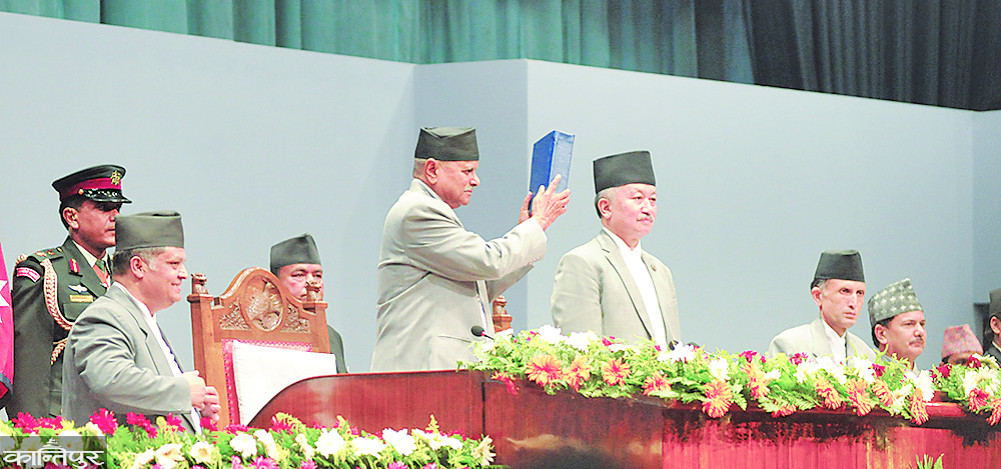
The suggestions given by the people on constitutional amendments are not just words - they are the dreams and expectations of the citizens expressed for the good governance, prosperity, and stability of the country.
We use Google Cloud Translation Services. Google requires we provide the following disclaimer relating to use of this service:
This service may contain translations powered by Google. Google disclaims all warranties related to the translations, expressed or implied, including any warranties of accuracy, reliability, and any implied warranties of merchantability, fitness for a particular purpose, and noninfringement.
The current government has sought direct suggestions from the general public for amending the constitution. The 'Constitution Amendment Suggestion Committee' has urged Nepali citizens to send their opinions, thoughts and views via email. It is a rare and historic opportunity for sovereign citizens to directly suggest what the country's basic law should be.
In a context where the practice of making or amending laws is traditionally carried out only by the parliament or legislature, where our representatives reside, going to the people's doorstep and asking 'What should we improve in the constitution?' gives a sense of direct democracy. However, looking at the history of Nepal and global experience, the more encouraging this process seems, the bigger the question marks and challenges are raised on its implementation and honesty.
If we look back at the history of Nepal, we rarely find the practice of the state taking the people's opinion in governing or making laws. Our rulers have always viewed the people or citizens as 'commanders' and not as 'partners'.
History mentions that King Prithvi Narayan Shah, who unified Nepal, consulted the people on war, tax determination, or important administrative appointments. He especially consulted with the Tharghar and Bhadrabhaladmi and his divine advice that ‘the people are fat, the court is strong’ said that people’s sentiments should be respected.
The first and biggest historical event in the history of Nepal where the people’s direct opinion was sought about a modern political system was the referendum of 2036 BS. King Birendra had asked the people to vote directly on whether to choose the ‘reformed Panchayat system’ or the ‘multi-party system’. This was a form of direct democracy that sought people’s suggestions in a policy sense, although many questions were raised about its impartiality at the time.
During the drafting of the 2047 BS constitution, a suggestion collection commission was formed to collect people’s opinions, but those suggestions were overshadowed by the interests of the power centers.
The closest and bitterest experience is during the drafting of the 2072 BS constitution. After preparing the draft of the new constitution, the Constituent Assembly had sent teams across the country and collected suggestions from millions of citizens online. The people spontaneously expressed their disagreements and areas for improvement on the draft. But ironically, those suggestions were shelved by the top leaders of the political parties. Ignoring most of the suggestions given by the people (such as on the form of government, secularism, or federalism), the constitution was promulgated based on the 'whip' and 'consent' of the top leaders. That history of citizens' suggestions ultimately becoming 'ignored' continues to create distrust among the people even today.
There are exemplary examples of direct suggestions and constitution-making in world history. Some countries have made direct suggestions and participation of citizens the main mantra while drafting or amending the constitution. This increases the acceptability and sustainability of the constitution.
Is this call by the current government a historic opportunity or just propaganda? This step taken by the government is in principle highly commendable and welcome. In the digital age, allowing every citizen to express their views through email reduces the distance between the state and the citizens. This makes Nepalis who are far away, who do not have political access but are intellectual and concerned about the country, a partner in state reconstruction. However, some serious doubts have also arisen in the civil community regarding this process, which the government should resolve in a timely manner:
1. Classification and analysis of suggestions : How does this happen? By what method are millions of emails and suggestions classified? Is the government capable of objectively studying each email collected by the suggestion collection committee? Isn't this process just a weapon to fulfill the technical formality of 'we also asked the people'?
2. Parliamentary mathematics and political consensus : A two-thirds majority in Parliament is required to amend the current Constitution of Nepal. No matter how excellent the suggestions made by the people are, if there is no consensus among the major political parties represented in Parliament, those suggestions are bound to end up in the trash. There is also a risk that this process, which the government has started without taking other parties in the parliament into confidence, will be limited to political stunts or propaganda.
3. Digital divide : When suggestions are sought through email, how can the voice of the large population of Nepal, who is still beyond the reach of technology, or who does not know how to use the internet and email, be heard? Can this email technology encompass the feelings of citizens in remote villages of Karnali or poor settlements of Madhesh?
The constitution is not a static document, but a living document. It is inevitable that it will be amended with the development of time and citizen awareness. The current government's request for citizens' suggestions for amending the constitution is an attempt to add a strong brick of direct democracy. It makes citizens feel that they are real 'citizens' and 'owners of sovereignty' from the people. However, it is important for the government and the suggestion collection committee to understand that the suggestions given by the people are not just letters, they are the dreams and expectations of citizens expressed for the good governance, prosperity and stability of this country. The bitter history of millions of suggestions being ignored during the Constituent Assembly in the past should not be repeated this time.
The government has issued a white paper on the suggestions collected and what percentage of the citizens gave which suggestions? Which of them were included in the revised draft of the constitution? This issue should be made public in a transparent manner. Only then will the time, labor and intelligence of the citizens be respected. And, the Constitution of Nepal will truly become a document ‘by the people, for the people and of the people’. May this beautiful practice of direct democracy not become another cause of political disappointment.