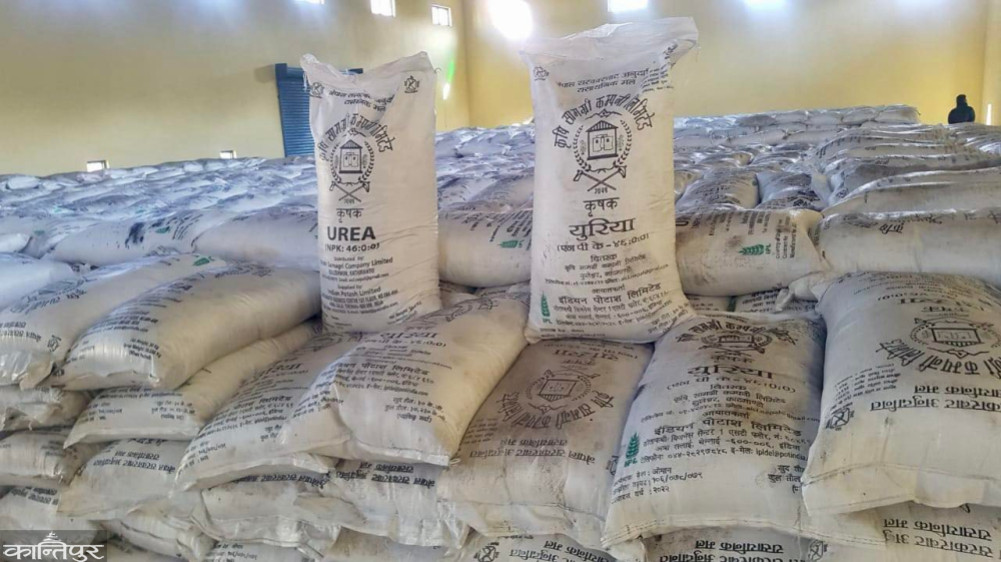
Every year, with the beginning of Jestha, farmers face the problem of chemical fertilizer shortage. The government claims to have fertilizer in stock but farmers do not receive it.
We use Google Cloud Translation Services. Google requires we provide the following disclaimer relating to use of this service:
This service may contain translations powered by Google. Google disclaims all warranties related to the translations, expressed or implied, including any warranties of accuracy, reliability, and any implied warranties of merchantability, fitness for a particular purpose, and noninfringement.
Rice is usually sown in Ashar and for that, the seeds should be planted within the first or second week of Jestha. At this time, DAP fertilizer is considered essential to increase the fertility of the soil and strengthen the plants. But every year, with the onset of Jestha, farmers face the problem of chemical fertilizer shortage. The government claims that there is a stock of fertilizer but farmers do not get it. This year too, farmers in different parts of the country have started complaining about not getting fertilizer.
Agricultural production in Nepal is closely linked to food security, the country's Gross Domestic Product (GDP), and the economic planning of the middle-lower class. Due to the shortage of fertilizer that farmers face at the time of planting the main crop, all the above aspects are disrupted. Therefore, the government should create an effective system of import and distribution to prevent shortage of fertilizer during sowing and planting of rice seeds. A strong decision is expected from a strong government so that farmers feel relief.
42-year-old Saeed Ahmed Shesh of Gularia-12 Dudha, Bardiya, has been cultivating 10 bighas with his two brothers for the past 10 years. They are also the ones who face the shortage of fertilizer even when it is time to plant rice. They have complained to Kantipur – ‘It is too late to plant rice seeds, there is neither irrigation water nor fertilizer.’ There are many farmers like them who face the shortage of fertilizer during planting.
Agriculture is already expensive. It is unattractive due to the uncertainty of returns. It is also burdensome due to reasons such as lack of fertilizer. The problem that is seen while planting seeds in Jestha may become more acute during planting rice in Ashar. Such a problem is not new for farmers, but the issue of not solving a problem that has always been there is strange. Such a situation highlights the government’s low sensitivity to the problems of farmers. At this time, a strong government with a new governance character has been formed. Therefore, it should take the initiative to prevent problems from arising in a sensible manner. If problems are seen, they should be addressed immediately. Farmers should be able to feel the government.
Fertilizer is needed. If it is not easily obtained through the government system, citizens look for alternatives. This causes losses to both the government and the farmers. Because, when farmers do not get fertilizer from the government system, farmers lose faith in the government and its system. Second, citizens try to get fertilizer from their own access. For that, they can buy it from shops that sell fertilizer. The price of such fertilizer can also be high. In addition, there is no assurance about the quality. In this way, farmers are cheated in terms of price and quality. On the other hand, in a situation where the quality is poor, it is not certain how much fertilizer should be used for which area. Such fertilizer also does not supply the crops.
In a situation where the shortage of fertilizer increases, the tendency to bring fertilizer at the border by evading customs duty increases. Aite Karki, a farmer from Bardiya, told Kantipur – ‘Even if we pay money, the government cannot provide fertilizer. Since fertilizer is not available here, it has to be brought from the border market in India, Balaigaun.’ When fertilizer is imported by evading customs duty, the state not only loses revenue, but farmers may also have to use substandard fertilizer. In some cases, the shortage of fertilizer can motivate social psychology towards negative actions. For example, in Asad 2079, the Revenue Investigation Department seized a truck carrying illegal chemical fertilizers in Dhading. The fertilizers were seized by local farmers while they were being brought to Kathmandu.
Such an act is not appropriate from the point of view of civilization. All these details make it clear that due to the lack of a strong government system, citizens are forced to adopt the wrong path and this will harm all parties. Therefore, the government should do its homework to improve the system.
There are some reasons for the shortage of fertilizers. First, since fertilizers are not produced domestically, they have to be purchased from foreign countries. When purchases have to be made, the process should be carried out in a timely manner and the system for distributing them when needed should be strengthened. However, according to the budget allocated by the government for procurement, the Agricultural Materials Company Limited and the Salt Trading Corporation Limited have been purchasing fertilizers through global tenders. In this process, 3 to 6 months pass. Sometimes due to the upheavals in the international situation, fertilizers may not arrive on time or may not arrive at all. This disrupts the storage and distribution system here. Second, the distribution system for the accumulated fertilizer is not strong. In Nepal, fertilizer is distributed to farmers through cooperatives.
Fertilizer quotas are set on a provincial basis based on the demands of local levels. There have been allegations that political influence is used in this and that more fertilizer is supplied than is required in some local levels. As soon as there is more in one place, there is a shortage in another. Therefore, the quota setting system should also be made transparent and fair. A system should also be created to transport excess fertilizer in one local level to another.
Agriculture is already expensive. It is unattractive due to the uncertainty of returns. It is also burdensome due to factors such as fertilizer shortage. Factors such as the lack of chemical fertilizers increase farmers' distaste for the profession and encourage them to migrate. But the story of fertilizer shortage is decades old. In 2049, the then Agriculture Minister Shailaja Acharya resigned due to a dispute over the supply of chemical fertilizers.
The fertilizer procurement process, delays and disputes, which had become a big issue three and a half decades ago, are still the same today. Therefore, the current government should make the distribution system efficient and transparent to avoid an immediate shortage of fertilizer. For a long-term solution to the problem, the import process itself should be made suitable for the Nepali agricultural cycle. For that, timely purchases and ample stock should be maintained.