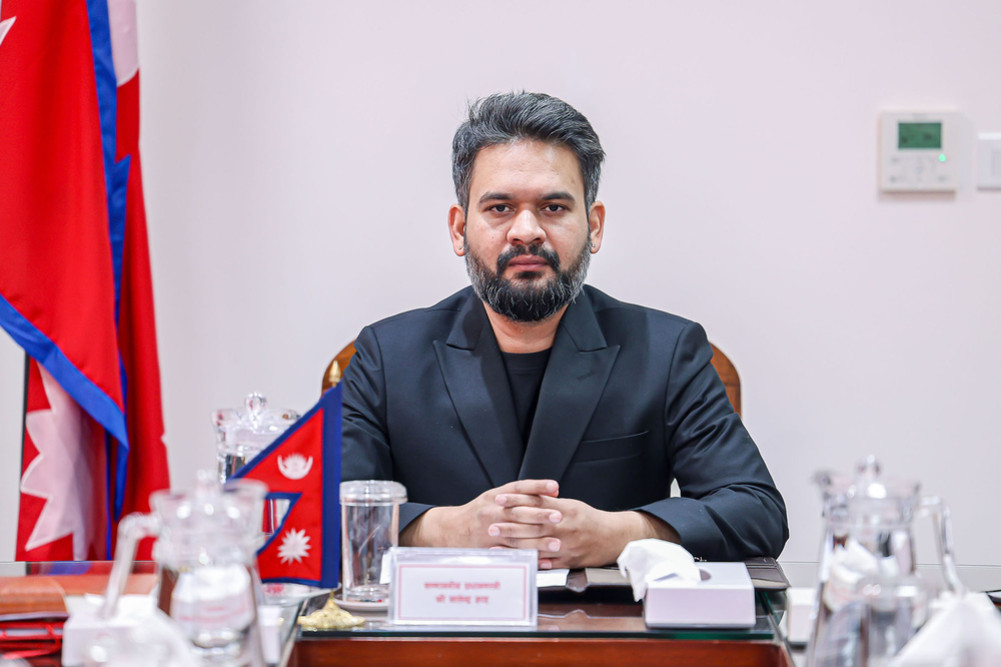
Balen Shah understands the system, but how much does he understand the people? Balen-This is the biggest unanswered question in economics. This question will not be answered by any budget, only by the coming years.
We use Google Cloud Translation Services. Google requires we provide the following disclaimer relating to use of this service:
This service may contain translations powered by Google. Google disclaims all warranties related to the translations, expressed or implied, including any warranties of accuracy, reliability, and any implied warranties of merchantability, fitness for a particular purpose, and noninfringement.
What does it mean to understand a leader? It is not about getting close to him, nor is it about lecturing him. Understanding is about patiently reading the pattern – on which problems does his hand move on its own? On which issues does he get impatient? When is he not ready to wait for the process? A leader’s economics are hidden in his nature rather than in his formal policies. That is why light-hearted nicknames like ‘Balenomics’ turn understanding into a brand and people get confused there.
There is only one way to get to the bottom of understanding – by asking different questions. Every economy ultimately stands on a belief that people are driven by what. What kind of nature do you consider a citizen to be? That is why your policy takes shape. So what is the belief held by Balen Shah’s government? What drives Nepalis?
Before entering this question, let us clarify one issue. The economic approach of this government, especially many of the issues put forward by the Finance Minister, are not new, nor should they be. The worldview of development itself has been evolving. Just look at the journey of the World Bank's development report - in 1994, the emphasis was on infrastructure, then on education and health, in 2002 on building institutions for the market, and in 2017 on good governance and law. In other words, the development debate has started from physical infrastructure, passed through people and institutions, and reached the quality of governance. Therefore, talking about revenue and institutional reform is just standing on the contemporary development consensus. However, something different is seen in Balendra Shah's nature - as if his tendency had already touched on the issue that consensus had just begun to embrace.
To find the answer to this, we must look back. Nepal ruled for a long time on the same belief - people are driven by relationships and patronage, and those who have access to the top get what they deserve. That is why our state has become a kind of transaction center. Balendra's nature questions this old belief. His request is simple – the rules should apply equally to everyone. This request did not fall from the sky, but was born from years of laxity. He cannot be said to be wrong about the fact that the country was not built on the old pattern.
However, there is a subtle issue hidden right here, which will determine the entire direction of Walendra's economics. Although the old belief and Walendra's request (protection and strictness) seem to be opposite at first glance, deep down both are rooted in the same soil. Both are economics of compliance. One makes citizens friendly by distributing facilities, the other by following the rules. However, the basic belief of both is the same – a citizen is a subject to be managed from the outside. However, prosperity is not born only from compliance, it is born from creation. And creation cannot be bought with facilities, nor can it be extracted by rules alone.
Where does this creation come from? To understand that, I found the glasses of economic geography more useful than economics. In the past, our government leaders often operated only from a macroeconomic perspective – the perspective of interest rates, revenue, balance of payments, etc. Walendra’s mind is not of that frame. He is a structural engineer, he was a mayor, both are professions linked to ‘place’. He sees the country not in numbers, but in places. What can be done, what is blocking the way? This spatial vision has its own Nepali tradition. Hark Gurung had drawn a blueprint for regional development in the sixties. Pitambar Sharma taught us to read development from market cities and their networks and pointed out a bitter truth – urbanization in Nepal was never planned, it was only a reaction. Municipalities were declared without infrastructure, and cities without the qualities of cities were born.
Our traditional budget debate revolves around the same circle every year – what changed in which tax? Whose interests changed it? However, the perspective of the global value chain asks a different question – what do we as an industry have to protect? And what can we sell in the global market? What skills, crafts, identity does the world get only from us? What cannot be copied, that is what survives.
After understanding this formula of originality, the artist-entrepreneur within Balendra becomes meaningful. Rapper and entrepreneur – both create something original, not the same. The work of an artist and an entrepreneur is deeply the same – to create with the belief that something can be made even before the evidence comes. When Balen says, ‘Nepalese can make world-class things’. That is not an emotional slogan. Perhaps he is the seed of the economics of uniqueness without fully realizing it himself. World-class is not cheap, it is original. And, because it is original, it cannot be imitated.
Here another aspect of Balendra’s nature is meaningful. Development economics now considers good governance not as a separate entity, but as a multiplier – an interaction effect that increases or decreases the returns to infrastructure, capital and education. If there is good governance, the same investment will yield more results. And, our biggest and never-calculated tax is the cost of indecision. Stuck projects, unfinished agreements, waiting capital. The cost of a road that has not been built or a project that has not been implemented for years is not reflected in any budget. The ability to make decisions is an economic resource in itself, this is the ‘good governance premium’. Balen’s decision-maker is truly an asset in this sense. However, there is a limit here: decision-making is a premium in technical problems – such as building a road, eliminating delays. In deeper problems such as changing human nature, trust and creativity, speed of decision alone is not enough.
Balen – What is economics? This is not a ready-made theory – the first year is said to focus on governance. And, so far, it is not a theory, it is a pile of hints. I see it as an open tension. His nature is drawn towards uniqueness – originality, identity, confidence. But, the tools he inherited are still of the old pattern of compliance – rules, control, management. His vision has probably reached ahead of his tools. The question is not whether he is right or wrong. The question is – will the tools ever meet the vision?
The budget of Jestha 15 will show the first glimpse of it – only the first, not the last. If that budget wanders in the traditional circle and gets confused in the calculation of what has changed in which tax, then it will be understood that the old logic continues. If it touches on the question of what Nepal can offer the world differently, then it will be a sign that nature has started to pull the tools.
But, the budget is just a signal . Let's go back to the beginning – understanding . A government can understand the system: roads, bridges, revenue, infrastructure . But, the economy is ultimately about people and understanding the system is not enough to understand people! Something else is needed there – empathy . A small entrepreneur, a youth who sees a future in their own creations – a vision that can consider them not as subjects to be managed, but as creative citizens . I have no doubt that Balen Shah understands the system . How much does he understand people ? This is the biggest unanswered question of Balen economics as I understand it . And, the answer to this question will not be given by any budget, but only by the coming years .