Good governance is not a political slogan, but the basic infrastructure of state operation. Unless adequate investment is made in promoting good governance, state investment in service improvement and the quality of development will not be result-oriented.
We use Google Cloud Translation Services. Google requires we provide the following disclaimer relating to use of this service:
This service may contain translations powered by Google. Google disclaims all warranties related to the translations, expressed or implied, including any warranties of accuracy, reliability, and any implied warranties of merchantability, fitness for a particular purpose, and noninfringement.
In the policy and program presented to the parliament on April 10, the government has set a target of upgrading Nepal to a respected middle-income country and achieving an average annual growth rate of seven percent in the coming decade. Similarly, good governance and corruption control are prerequisites for the effective implementation of the 100-point agenda issued by the government. To achieve this, the next budget should increase investment.
Nepal's good governance status
Nepal is on the list of countries with high levels of corruption in the Corruption Perceptions Index published annually by Transparency International. In 2025, Nepal had scored only 34 out of 100 points. And, it was listed on the list of countries with high levels of corruption. Transparency International lists countries with a score of less than 50 as countries with high levels of corruption. Nepal has been stuck around 34 to 35 points for a long time. Similarly, the World Bank's Global Governance Index measures the state of good governance in a country on six key indicators. A score below 2.5 indicates that the state of good governance in a country is weak, and a score above that indicates that the state of good governance in a country is strong. In 2024, Nepal scored 0.20 in accountability and freedom of expression, 0.85 in political stability and the end of violence, 0.65 in government effectiveness, 0.45 in regulatory quality, 0.60 in rule of law, and 0.75 in corruption control. This shows that the state of good governance in Nepal is very weak. The Financial Action Task Force has placed Nepal on the 'grey list' due to the ineffectiveness of Nepal's legal and institutional framework to control money laundering and terrorist financing.
This shows that despite the existence of institutions to establish good governance and control corruption in Nepal, the situation is disappointing. Despite the establishment of bodies like the Commission for the Investigation of Abuse of Authority, the Auditor General, the Department of Prevention of Money Laundering, and the National Vigilance Center, the reason behind the weak state of good governance and the increase in corruption is the very low investment in good governance. The table below presents the budget allocated for promoting good governance and controlling corruption in the fiscal year 2082/83.
The total budget for the fiscal year 2082/83 is more than 1964 billion rupees. However, a budget of around 7.22 billion rupees has been allocated for the promotion of good governance and controlling corruption. This is about 0.37 percent of the total budget. This shows that good governance and controlling corruption have not been a priority for the government. The need for digital good governance, transparency, accountability, and public service reform is increasing in the country. However, the investment made for such programs is very weak. The allocation of only Rs 2.9 million for e-governance in the fiscal year 2082/83 shows that the state is not serious about the expansion of the digital governance system, simplification of service delivery and technological reforms required to control corruption.
Looking at corruption control, Rs 1.81 billion has been allocated for the Authority in the same fiscal year. This amount is not sufficient for the monitoring, investigation, prosecution and institutional strengthening of corruption nationwide for the Commission, which is supposed to investigate more than 35,000 complaints every year. Similarly, the state has also allocated a small amount of budget for the National Vigilance Center, the Money Laundering Control Department, the Auditor General, and the Revenue Investigation Department. It seems that a large part of the allocated amount is for salaries, allowances and general expenses. Even though the state is spending a large amount on physical infrastructure and development projects, the bodies that enhance transparency, accountability and responsibility of the investments made are unable to work due to lack of budget. This leads to recurring problems such as leakage in development expenditure, institutionalization of corruption, decline in public trust in public works and services, and failure to reach the target groups and communities.
Why invest in good governance?
Good governance is not a luxury or a political slogan. Good governance is the basic infrastructure of state operation. Unless the state prioritizes the promotion of good governance and makes sufficient investments, state investments in service improvement, quality of development construction, and other areas cannot be as effective and result-oriented as expected. Weak good governance limits state policies, plans, budgets, and programs to paper. In addition, the risk of their implementation being weak and the available resources being spent on the interests of a limited group increases. Therefore, investment in good governance should not be considered as unnecessary expenditure, but as a strategic investment that makes overall development quality and result-oriented. 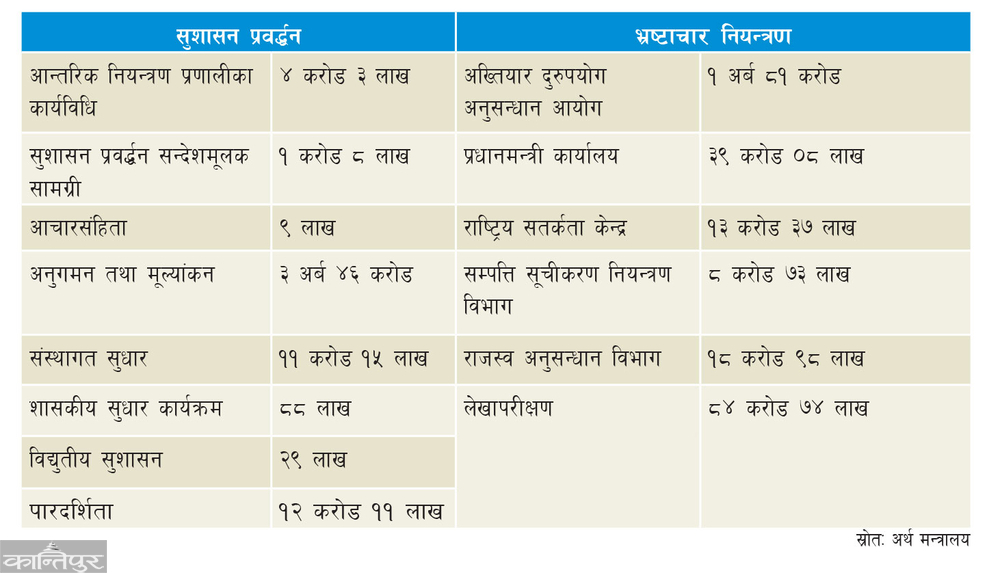
In the context of Nepal, a large amount of money is allocated every year in the fields of education, health, infrastructure, agriculture, employment, social security, etc. However, the expected quality, effectiveness and public satisfaction have not been achieved. Even though school buildings are built, the quality of education is poor. Even though equipment and health workers have reached health institutions, the service is not effective. Even though roads and bridges are built, there is a problem of collapse and deterioration in a short time. The main reason for this is not only the weakness of the plan. Rather, it is the corruption at the implementation level, weak monitoring and evaluation system, political interference, lack of accountability and institutional inefficiency. Therefore, to achieve real results of development, it is inevitable to invest equally in good governance as well as planning. There are some reasons to invest in good governance.
First, investment in good governance is necessary to prevent leakage of resources and budget. A large portion of the budget allocated by the state for development is misused due to various types of irregularities, commissions, corruption, double spending, and weak implementation. This weakens the effectiveness of government investment. If the necessary investment is made to make the public procurement system transparent, a strong digital monitoring system, a strong audit and monitoring mechanism, and a competent corruption control body, budget leakage can be reduced. Development investment without good governance is like pouring water on sand. Therefore, investment in good governance should be made to prevent misuse and exploitation of resources in development activities and to hold the concerned officials accountable. Investment in good governance protects public resources and also makes them productive and result-oriented. This helps in getting maximum returns from limited resources.
Second, investment in good governance is also necessary to make public service delivery easy, fast, and of high quality. Even today, many citizens are forced to stand in line for hours to receive basic government services. Some have to complete unnecessary paperwork, resort to intermediaries, and in some cases, bear additional financial burdens. Such a situation weakens the trust of citizens in the state. If the government invests in digital service systems, e-governance, employee capacity development, service standard development, and citizen-friendly administrative systems, service delivery can become faster, simpler, more transparent, and more effective. For example, online service systems, digital payments, and one-stop service systems reduce the possibility of corruption. This saves both time and cost for citizens and also helps make the relationship between the state and citizens more trustworthy and accountable.
Priority areas Third, investment in good governance is also indispensable to attract foreign investment and accelerate economic development. Before investing, any international investor seriously evaluates the legal stability, transparency, policy continuity, administrative efficiency, good governance, and corruption situation of the country concerned. Complex administrative processes, unstable policies, and high-level corruption increase investment risks. This prevents direct foreign investment from coming to such countries. Democracy is only strengthened when citizens feel that the state is fair, transparent and accountable. Investment in good governance lays the foundation for building a prosperous, just and sustainable nation. Therefore, it is not possible to attract investment without investing in the structural reforms necessary to enhance good governance. Transparent administration, an effective justice system, clarity of the tax system and a corruption-free governance system are necessary to create an investment-friendly environment. Therefore, investment in good governance does not only lead to administrative reform - it also lays the foundation for overall economic growth, job creation and long-term prosperity. Investment in good governance is also a prerequisite for strengthening the democratic system, promoting social justice, increasing citizen participation and restoring public trust in state institutions. Democracy is only strengthened when citizens feel that the state is fair, transparent and accountable. Therefore, investment in good governance lays the foundation for building a prosperous, just and sustainable nation.
The Nepal government is currently in the process of preparing the budget. In the budget to be made public on 15th of Jestha, the Nepal government needs to allocate budget with priority in some strategic areas of good governance. First, investment should be increased in the digitalization of public services and making them technology-friendly. Direct human contact in the government service system is the main cause of corruption. A completely digital system is necessary to reduce it. For this, investment should be made in software development, cyber security, data management and inter-agency system integration. Second, investment should be made in the field of employee capacity development and continuous training. Administrative efficiency does not come only by passing the civil service examination - employees should also be provided with continuous training in modern management, public ethics, use of technology and policy analysis. No good governance reform is sustainable without a competent bureaucracy. Therefore, the government needs to increase investment in this sector.
Third, regulatory bodies should be strengthened and strengthened. Bodies like the Authority, the Auditor General, the Department of Money Laundering Investigation, and the National Vigilance Center are the backbone of good governance. Therefore, such bodies should be provided with adequate budget, technical capacity, and institutional independence. It is necessary to free them from political interference and increase investment in investigation and monitoring capacity. Fourth, judicial reform. Delayed justice is an obstacle to good governance. The justice system cannot become effective without the use of technology in the court, expansion of human resources, and improvement of the case management system. Delayed justice is considered to be injustice. Therefore, investment in judicial reform is directly linked to good governance.
Therefore, the Government of Nepal should keep good governance and corruption control as a 'priority area' in the upcoming budget. Some policy transformations are necessary for this. First, a result-oriented budget system should be set. For that, the budget should be linked to clear indicators of good governance improvements such as reducing service delivery time and expanding digital services. Second, the budget should accept the imperative of e-governance. A policy is needed for each ministry to spend a certain portion of its total budget on digital system development and service automation. Similarly, the necessary budget should be allocated for a complete digital service system that reduces direct contact between citizens and employees, open data and transparency, strong rule of law and an independent audit system, protection of whistleblowers, technology and AI-based surveillance systems. It is also necessary to create a separate budget code for good governance.
The government should consider investment in good governance not as an expense but as long-term savings for the future. If the state does not invest the necessary amount in good governance, the common citizen will not be able to get the return on the large amount of investment made in infrastructure and development.
Therefore, the prosperity of the country does not come from investing in building infrastructure alone. Rather, investment in an efficient, transparent, and accountable governance system that operates such structures brings prosperity. Therefore, it is imperative that the government increases investment in promoting good governance in the upcoming budget.