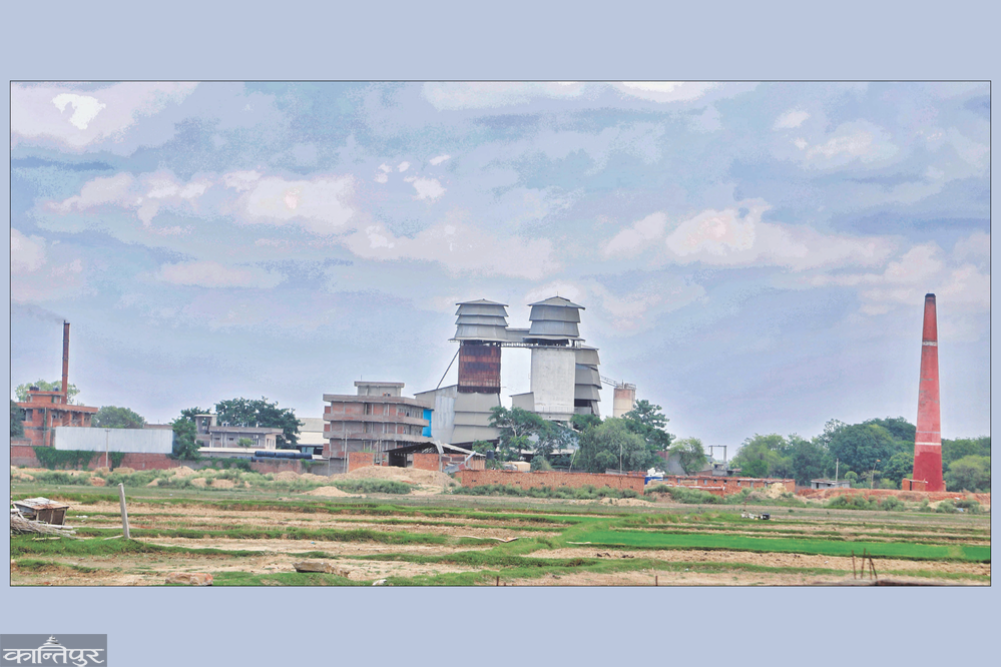
The state neither creates an investment environment nor adopts a policy of encouraging and protecting industrialists who invest at risk.
We use Google Cloud Translation Services. Google requires we provide the following disclaimer relating to use of this service:
This service may contain translations powered by Google. Google disclaims all warranties related to the translations, expressed or implied, including any warranties of accuracy, reliability, and any implied warranties of merchantability, fitness for a particular purpose, and noninfringement.
Any state in the world that is determined to make the country prosperous encourages industry. Protects it as much as possible. In Nepal, industrialists are experiencing almost the opposite situation. The state neither creates an investment environment, nor adopts a policy of encouraging and protecting industrialists who have invested by taking risks. Haribhakta Sharma, Executive Director of Deurali Janata Pharmaceuticals and former President of the Confederation of Nepalese Industries, has pointed out this situation and said – ‘We have committed great sins in our previous birth and have opened industries in this birth.’ As long as the collective mindset of industrialists is such a disappointment, there is no possibility of industrial development in that country. There is no possibility of development. This is the root of the underdevelopment and poverty that Nepal is facing. If we want to escape from this, we must adopt a policy of encouraging and protecting industrialists.
The contribution of industry to Nepal’s Gross Domestic Product (GDP) is decreasing. For example, in the fiscal year 2072/73, the contribution of the overall industry sector was 14.1%. It has shrunk to 12.8 percent in 2081/82. However, if we look at the manufacturing industry alone, its share has decreased from 10 to less than 6 percent in the last 30 years, while the manufacturing industry has contributed 17 percent to the GDP in neighboring India. In the period after the economic liberalization of 2048, while the overall economy expanded by an average of 4.2 percent, the expansion of the manufacturing industry has averaged only 2.9 percent. The weak state of the overall industry or the manufacturing industry continues, on the other hand, the political and administrative leadership is not sensitive to its causes and effects. The country and its citizens are suffering the ill effects of such a situation. Underdevelopment is rampant in the country, youth migration is increasing, and investors are becoming reluctant to take risks.
Even now, five lakh people enter the labor market in Nepal annually. Half of them go abroad for employment. If private sector investment in the country were high, if enough industries were opened, many people who came to the labor market would get employment in the country. At least forced foreign employment could be reduced. But now there are no employment opportunities. Unemployed citizens do not have purchasing power. Demand has not been created. Industrialists are not enthusiastic about further investment when demand is not created. At that time, the cycle of the economy slows down. On the other hand, since the number of industries is low, the income they pay from taxes is also not sufficient. Due to which the state has weak financial capacity. As a result, the ability to spend for development is also weak. Therefore, citizens are also being deprived of the benefits of development.
If private sector investment in the country was high, if enough industries were opened, many people who came to the labor market would find employment in the country. Due to the lack of sufficient industries in the country, sufficient goods have not been produced here. Due to which we have to rely on imports for all small and large goods. A large part of the income received from foreign employment has again gone abroad for the purchase of goods and services. There is a situation where domestic resources are not utilized properly, youth have to go abroad for employment, and imports are high, and the country also has to suffer a trade deficit. If this cycle continues to strengthen, the country will become more dependent and underdeveloped. And, as soon as risks arise in other countries, the country itself will be plunged into crisis.
If we want to get out of the quagmire of underdevelopment and dependence, the number of industries in the country must be increased. For that, industrialists must be encouraged and facilitated. They should not be suspected, but trusted. They should not be insecure, but should be made to feel secure. But in Nepal, there is a high level of unnecessary suspicion and accusations against industrialists and businessmen, from the state to the citizens. If someone has done something wrong, action should be taken. But it should be possible to establish that the person concerned has been taken action for doing something wrong. The tendency to defame, demoralize, and discourage the entire sector must be ended. The policy of shutting down and listening to the industry risks damaging the reputation of the industrialists and causing them to flee. Where domestic investors are discouraged, the prospects for foreign investment also remain weak. At that time, foreign employment becomes an additional compulsion.
The Nepali industry sector is facing problems such as lack of capital, high dependence on imported raw materials, low adoption of innovation and advanced technology, and high production costs. Due to which the competitiveness is weak. On the other hand, there is also a policy problem created by political instability. As a result, the courage to take risks for additional investment is becoming weak. But no government has been able to adopt a strong policy for industrial promotion. At this time, the strongest government in history has been formed. The budget is also being made public in a few days. Through this, the government should announce an industry-friendly policy. Priority should also be given to issues that need to be improved in the laws. Similarly, the tendency to view industrialists and businessmen from the same perspective, and instead emphasize business-friendly policies, should also be ended. Industry should be a priority from every perspective.
Industry is the backbone of economic development. It simultaneously plays a role in increasing production in the country, replacing imports, creating jobs, and making economic activities dynamic. Ultimately, that is the way to increase the economic strength of the country and its citizens, fulfill the expectations of citizens for development, and help expand its influence around the world. Therefore, if the state protects industry and creates an environment for industries to flourish, over time, industry will also protect the state and contribute to expanding the state's strength.