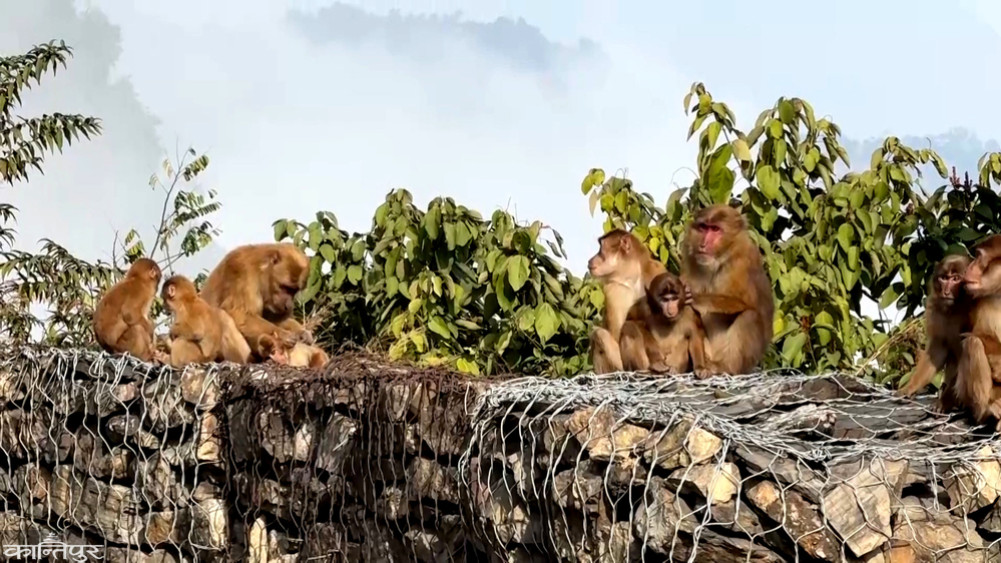
Farmers and pilgrims are the most affected by the Ranto monkeys that are causing trouble throughout Nepal. However, there is no proper and infallible science for 100% monkey management.
We use Google Cloud Translation Services. Google requires we provide the following disclaimer relating to use of this service:
This service may contain translations powered by Google. Google disclaims all warranties related to the translations, expressed or implied, including any warranties of accuracy, reliability, and any implied warranties of merchantability, fitness for a particular purpose, and noninfringement.
From the village to the parliament, the issue of monkey management has once again come up in the national debate. Those who have been affected by monkeys have been raising their voices for a long time. In the previous parliament, honorable members had already suggested to the government for conflict management of monkeys and other wildlife. Researchers conducting research and state agencies and departments working at the implementation level have also submitted written and verbal suggestions to the government on the topic of monkey management. However, efforts to manage monkeys are not succeeding.
Recently, on April 26, 2081, the Ministry of Forests and Environment had formed a technical committee with representatives from the Ministries of Agriculture and Home Affairs to reduce the damage caused by monkeys in the agricultural sector. Before that, the National Concerns and Coordination Committee, including members of the Federal Parliament and the National Assembly, had prepared a study report on the situation of human-wildlife conflict in 2080 BS. The conclusions given by most of the studies are almost of the same nature. The study of short-term and long-term conditions has been the main priority in monkey management efforts.
Last week, in a meeting of the House of Representatives, former Minister and House of Representatives member Mahavir Pun asserted that it is impossible to reduce monkey conflict. He claimed that all efforts to reduce monkey nuisance had failed, saying, “It is easy to make a rocket, but the technology to chase away monkeys is not easy.”
Even after repeated attempts, some measures have not been taken. But, how can we help each municipality to solve this problem? Have we not been able to? Or where are our efforts failing? These questions remain unanswered. The incident of monkeys eating corn in the mountains dates back to the time of our grandfathers. The problem of monkeys has been going on in the central hilly region for a long time. The incidents have only increased now.
In 2009, a report by the World Conservation Union (IUCN) concluded that ‘there is no definitive solution to the conflict between great apes’. The same conclusion may apply in Nepal, but in some cases it is no different. Our main weakness in monkey management is the lack of coordination.
Capturing a group of monkeys from one place and moving them to another does not solve the problem. A few years ago, monkeys from the jute mills in Biratnagar, the capital of Koshi Province, were released in the Kanepokhari forest area under the East-West Highway road section under the pretext of management. Now, a group of monkeys has created panic on that road section. In this way, in the name of solving the problem, a new problem has been created in another place. The practice of Morang has already shown that capturing and releasing monkeys elsewhere will only relocate the problem instead of solving it. Where to relocate? In what place and when? It is important to study these issues first before drawing conclusions.
There are 3 species of monkeys in Nepal: the red monkey, the Assamese watch monkey, and the langur species. There are four subspecies of langurs. The IUCN Red List lists the red monkey as a species of Least Concern, while the Assamese watch monkey as a Near Threatened species. The langur species are both in the List Concern and Near Threatened categories. The Assamese monkey is also included in the list of protected wildlife in Nepal.
The species that is seen everywhere and causes the most problems is the red monkey. This monkey nuisance is everywhere in Nepal. Generally, farmers are the most affected by monkeys. However, not only farmers in Nepal, but also pilgrims are affected by monkeys. It is likely that hundreds of pilgrims daily loot offerings, worship materials, and amulets from religious monasteries and shrines in the Kathmandu Valley by groups of monkeys.
The main reasons for the increase in human-monkey conflict
are the destruction of natural habitats, expansion of agricultural land by clearing forests, an increase in the number of monkeys at the local level, and an increase in the food supply of monkeys through farmland.
The main reason why monkeys are attracted to places inhabited by humans is the easily available food. In some places, this is not only due to the lack of food in the forest, but also because nutritious food is available around humans without causing any harm. On the other hand, leopards, which eat monkeys in the forest, used to control their numbers. Now, due to the lack of leopards, the number of monkeys is becoming uncontrolled. Despite the lack of proper management of waste dumped in urban areas, monkeys are getting enough food.
Area-specific identification and management strategies
There is no clear-cut way to manage monkeys. To solve this problem, it is necessary to be ‘site specific’. Monkey control efforts in one area may not be successful elsewhere. Before managing, first of all, how and in what form are monkeys coming to human settlements? It should be classified. Monkeys have come to humans in three ways. Such as: monkeys that enter villages in search of food by destroying crops, monkeys that are easily fed by humans at religious and tourist sites, and monkeys that are accustomed to the garbage and modern lifestyle of urban villages or markets.
Only after identifying the geographical conditions and situation of all three areas can the available methods be adopted to give results. For this, the concept of monkey management areas can be applied to the improvement of available technology, coexistence, and habitat. Coordination and partnership between intergovernmental bodies are important. When there is a central, provincial and local government, who will do what at the ward level? This issue should be clarified. In addition, a mechanism should be created to communicate information about the movement and damage of monkeys in a timely manner.
Short-term and long-term strategy
It is necessary to identify areas where there is human-monkey conflict and create short-term and long-term management strategies together. In short-term strategies, you can use tin cans, scare them with dolls, use repellents, bring langurs to drive away monkeys, or record loud sounds made by red monkeys. Plants or fruits that monkeys do not like can also be planted around the farmland. In particular, the use of odors can be used to drive away monkeys for some time. For example, lemon, sour, thyme, turmeric, and chili peppers are not liked by monkeys. Solar electric fences can also be used in certain areas to protect crops. This technology has also been successful in elephant management. The habit of feeding monkeys indiscriminately should be completely stopped.
Sterilization method may be suitable for permanent management of monkeys in religious places in Kathmandu. This method was also successful in Himachal Pradesh, India. Although it does not give immediate results, it helps reduce the number of monkeys in the long term. It is more useful for places with high density. Vaccines like PZP can be used. This method is suitable for both health and management. This vaccine can be given through food.
Export, calling, coexistence and diplomacy
A topic that has recently come up again in Nepal for monkey management is exporting monkeys abroad. As easy as it sounds, it is extremely difficult in practical, legal and diplomatic terms. India and Bangladesh also used to export monkeys at one time. India exported about 120,000 monkeys to the US for research between 1956 and 1978. However, it was completely banned in 1979 after wildlife rights concerns were raised. Bangladesh has also banned similar exports.
Another method of wildlife management is also used in the world, which is called culling. This is the process of killing a certain number of wild animals. However, a country as rich in religion, culture and spirituality as Nepal cannot imagine killing this wild animal that is associated with religious beliefs.
As Mahavir Pun said, there is no proper and infallible science for 100% management of monkeys, and the IUCN report also says the same. Therefore, the best option is to identify regional problems, formulate specific strategies according to the place, and use available successful practices.