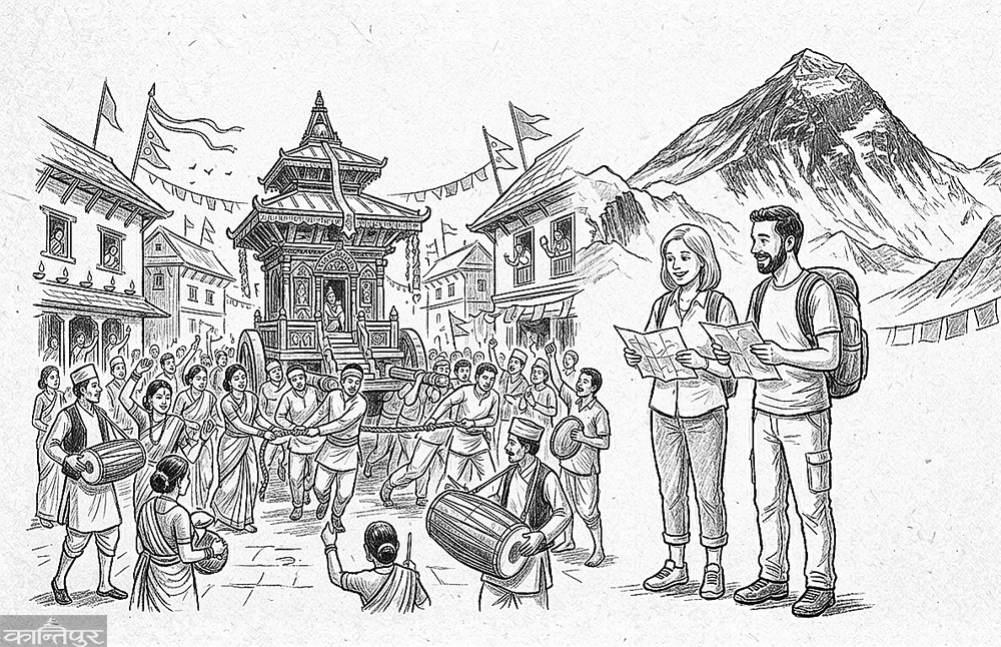
Economic prosperity and diversification of foreign relations should be the two fundamental pillars of our soft power. Certainly, the professionalism of the identity between them will be the key to the success of our soft power.
We use Google Cloud Translation Services. Google requires we provide the following disclaimer relating to use of this service:
This service may contain translations powered by Google. Google disclaims all warranties related to the translations, expressed or implied, including any warranties of accuracy, reliability, and any implied warranties of merchantability, fitness for a particular purpose, and noninfringement.
In the principles and priorities of the budget for the upcoming fiscal year 2083-84 (point 11) and the policies and programs for the same fiscal year (point 87), the government has announced that it will give high priority to the effective mobilization of soft power. This is certainly a welcome issue. If we can work in a small way, we will be able to fill a new void in Nepali diplomacy, which is trapped in the 'big power trap', i.e. the trap of powerful nations due to our own weaknesses. In addition, it can also be the starting point of a beautiful journey on a new path of rapid economic growth, which is the long-desired goal of the Nepali people. In such a big expectation, comprehensive thinking, analysis and cooperation of all of us are equally necessary. The greater the importance, the greater the preparation is the essential condition for success.
The government's announcement is good. But we should not forget that such announcements have been made many times in history. For example, the language used in the concept of mobilizing gentle power mentioned in the current government's policy is very similar to the objective (point 7) mentioned in the foreign policy announced in 2077 BS. Now is not a declaration, but the time to make the citizens feel the difference between implementation and results. Let us emphasize once again, we must be serious about this important issue. A new politics begins with a break with the old politics that makes every good policy look like a mess.
Gentle Power: Origin and Use
The most important vocabulary of the entire political science and an integral discipline within it, 'International Relations', is - power. The discussion of power is as long as the history of mankind. The discussion of power in international relations has been based on two different perspectives. As political scientist Robert Dahl explained, the ability of one nation, head of state, or institution to compel another nation, head of state, or institution to do something that it would not normally do, i.e., character-centered power, and the national power and its influence created by the military, economy, population, natural resources, leadership, good governance, etc. of the entire country, was/is .
Soft power is the ability to win the hearts of the concerned country and bring results in its favor. With the academic discussion of soft power gaining ground since the late twentieth century and the word ‘smart’ becoming more and more popular in the twenty-first century, the practice of classifying power began. Harvard University professor Joseph S. Nye Jr., who served as Assistant Secretary of Defense for International Security Affairs in the Department of Defense from 1994 to 1995 under the administration of US President Bill Clinton, first used soft power in his 1990 book ‘Bound to Lead: The Changing Nature of American Power’. After that, it has been discussed around the world with him at the center. Today, it has become a major and most popular topic in foreign affairs studies.
An interesting incident is that the same American professor who worked in the Clinton administration was specially requested by the Beijing-based think tank 'Center for China and Globalization' to write a book called 'Soft Power and Great Power Competition' in 2023, and in which Nai has also criticized China's soft power. Yes, today's China has been built by such soft power.
To understand soft power, it is first necessary to understand the hard power at its other pole, i.e. 'hard power'. The power that Robert Dahl mentioned is largely 'hard power'. The ability to persuade or persuade another party to act in one's favor by using military or economic benefits (payments), greed, or enticement. Soft power is the ability to win the hearts of the country concerned and bring about results in one's favor. It is the ability of countries to attract or persuade other countries based on certain qualities or characteristics. That is, the ability of countries to bring other countries to their side by establishing the legitimacy that the country concerned has the right to raise issues in that region, advocate for it, or make certain requests to other countries is called soft power. Such countries have raised their love and respect for themselves to a high level based on certain characteristics. Many other countries are also trying to imitate the management models of the region that the country concerned is trying to brand itself. Countries that are good at soft power conduct international exchanges and interactions by focusing on such successful regions, which have a positive impact on other regions as well.
Essential questions for success
We are discussing here the announcement by the Nepalese state to mobilize one of its powers in a strong manner. Any power has its own process of formation. When, to whom, and how such power is used, it also has its own method of achieving high results. When we use power, the reaction of the other side is also decisive in the results of power. It is a national responsibility to have a detailed and intensive discussion about all these basic dimensions and identify the problems that may arise in the future and move forward. Some of the questions below may be helpful in facilitating this great campaign.
First, why is the high priority given to the mobilization of soft power at this time? If we start the discussion by focusing on the irresponsible answer that Nepal can do nothing about ‘hard power’ because our neighbors are very strong, so soft power is the only option, then it is not only a manifestation of ignorance, but also a dangerous expression for the future of the country. As world history has proven, soft power is ultimately a means of acquiring ‘hard power’. It should be clear how we are also on the path to strengthening ‘hard power’ through the effective mobilization of soft power strategically. That is, the relationship between these two powers is like that of nails and flesh, we need to clarify our understanding.
The government, while refining its language of policies and programs, has clearly declared ‘soft power for economic progress’ in the principles and priorities of the budget (11th point). This may be a major dimension. But defining any power from an economic perspective alone is not enough. A political definition of power is indispensable. What is the impact we are trying to have on the political relations we have with other countries while mobilizing the soft power we are trying to develop? Let us make this matter easier by comparing it to a river. Right now, our relations are flowing in one direction. We are going to mobilize one more power there. Now, will the relations flow in the same direction at a high speed or will the flow change? We should reflect on this issue nationally, considering our immature climate diplomacy as a mirror.
The results of the two political relationships that Nepal is seeking through the judicious mobilization of soft power are clear. On the one hand, we need a quantitative and qualitative increase in the elite and elite groups within the major power countries, including our two neighbors, who will advocate for Nepal, the Nepali people, and the national interests of Nepal. On the other hand, an end to the bitter reality of being pushed further and further away from middle power countries and into the clutches of power countries over the past two decades is also inevitable. Our soft power should focus on such political course corrections. That is, economic prosperity and diversification of foreign relations should be the two fundamental pillars of our soft power. Certainly, the professionalism of the identity between them will be the key to the success of our soft power.
Second, what are the dimensions of soft power for economic prosperity that the government has announced? In March 2026, the world's most famous Korean pop band BTS held a public concert at Gwanghwamun Square in Seoul, the capital of South Korea. Several reports have been made public that estimate its economic impact to be around 27.25 billion Nepalese rupees. Are we supposed to develop our festivals and festivals as a living culture of the world that citizens from all over the world can come to see?
The complex problem of discussing many issues at once and not prioritizing them has been identified in the discussions of our gentle powers. Point 87 of the policy and program for the upcoming fiscal year 2083-84 is a vivid example of this. Where it is said - 'Nepali's original identity, language, art and heritage will be established on the world stage and gentle powers will be expanded.' But, what can we do immediately? What are its immediate interests and long-term interests? There is a lack of dialogue and reflection to draw concrete conclusions on such issues.
There is a competition all over the world to make soft power the new engine of economic growth. If we look closely at such successful countries, it is clear that they have developed soft power as a strategic industrial sector through large-scale long-term investment in one or two areas. They can basically be classified into seven areas: cultural industry, tourism industry, export-oriented manufacturing industry through attracting foreign investment, sports, higher education and research, innovation based on science, information and technology, citizen-centered governance system and building a green economy model.
Yes, Nepal has unique heritages. Wherever you look, it seems that there is potential. There is a strong young workforce. Due to the economic leap taking place in our neighborhood, there is a high morale that we too can and should make unparalleled economic and social transformations in a short time. The news of Nepalis achieving miraculous results in every corner of the world has increased our confidence. But the complex question of where to start is again .
The government has currently recalled Nepali ambassadors working in many countries . Of course, ambassadors will be appointed to all of them in the near future . Third, when we determine the area, the profound question arises of which country and which region we will mobilize our soft power to influence the people in that area . For example, let's look at tourism . For almost half a century, foreign tourists who come to spend long periods of time in the Himalayas have been our main guests . External factors such as Corona and the economic crisis have reduced the number of nights and expenses of tourists visiting Nepal . However, there is no doubt that tourism is an area of our economic potential . Now, while we are mobilizing soft power in the tourism sector, from which country and what kind of tourists are we trying to attract ? How are we trying to attract them ? Without a clear strategy on such issues, it is difficult to achieve the desired results we are looking for .
The fourth and most complex issue is that when we declare a region as a base area for soft power, how are we preparing it nationally? Are our federal, provincial and local budgets and resources being focused on that? Or are we just giving one or two slogans like yesterday and scattering budgets like Kanika Chhere? Since national economic growth centered on soft power is of interest to all countries, if national attention cannot be focused on developing that region as a competitive industry, it will not achieve the results of soft power.
Let us look at Nepal's unique heritage and culture again. On a day when the Kathmandu Valley is open and beautiful mountains and hills are visible all around, if a foreign tourist asks a Nepali walking on the road which mountain is that, how many of us living in the Kathmandu Valley can answer? In other words, does the region that we are making the center of the national economy and soft power have sufficient world-class human resources, infrastructure, and civic awareness? We believe a lot when people from Israel or the Netherlands explain smart agriculture, why? जुन क्षेत्रका बारेमा त्यहाँका नागरिकले सफल अभ्यास गरेका छन्, त्यसबाट नतिजा निकालेका छन् । त्यस्ता क्षेत्रले मात्रै सम्बन्धित देशको सौम्य शक्तिको रणनीतिक सफलता दिन सक्छन् ।
कुरा प्रस्ट छ, हाल सरकारले धेरै देशमा कार्यरत नेपाली राजदूतलाई फिर्ता बोलाएको छ । पक्कै पनि निकट भविष्यमा सबैमा राजदूतहरू नियुक्त हुन्छन् । उनीहरूले नेपाललाई प्रतिनिधित्व गर्ने देशका प्रमुख विश्वविद्यालयको ठूलो हलमा उभिएर नेपाल र नेपाली यस्ता क्षेत्रमा काबिल छन् भनेर व्याख्या गर्दा हलमा रहेका विदेशीले सबैले उठेर ताली बजाउँछन्, त्यही क्षेत्र नै नेपालको सौम्य शक्ति हो र हुनेछ ।
सौम्य शक्तिको रणनीतिक परिचालन घोषणा गरेको सरकारले त्यस्तो क्षेत्रको पहिचान, प्राथमिकता निर्धारण, कुन देशका कुन–कुन समूहमार्फत नेपालका त्यस्ता क्षेत्रको प्रचारप्रसार गर्दै तत्कालको आर्थिक नतिजा हासिल गर्ने, उक्त देशमा नेपाल र नेपालीप्रतिको सम्मान र आकर्षण वृद्धि गर्ने, जसले कालान्तरमा त्यहाँका नीति निर्मातामाझ पनि नेपाल र नेपाली हाम्रा असल मित्र बनाउन पाए फाइदै हुन्थ्यो भन्ने वातावरण बनाउन सक्छौं, त्यस दिन हामीले अनुभूति गर्नेछौं– सौम्य शक्ति ।
त्यस्तै, भगवान् गौतम बौद्ध नेपालमा जन्मनुभएको थियो, तथ्य हो, इतिहास हो । हामीले उहाँको दर्शनलाई अवलम्बन गर्दा त्यो सौम्य शक्ति हुन्छ । सगरमाथा नेपालमा छ, त्यो गर्वको विषय हो । नेपाल हिमाल सफा राख्नमा अब्बल छ भन्ने विश्वास गर्दा, त्यो हाम्रो सौम्य शक्ति हुन्छ ।