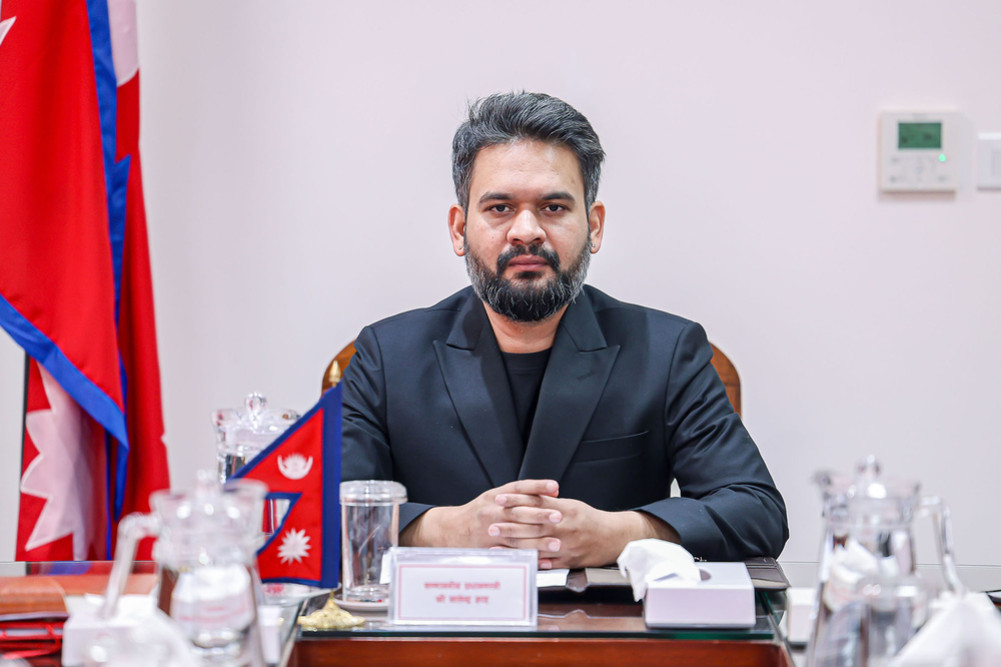
Every anger and rage of the Prime Minister has a meaning. But even those meanings have no real meaning. He gave a majority to the Ravi Lamichhane-led Rashtriya Swayamsevak Sangh (RSS). That arrogance has oppressed him.
We use Google Cloud Translation Services. Google requires we provide the following disclaimer relating to use of this service:
This service may contain translations powered by Google. Google disclaims all warranties related to the translations, expressed or implied, including any warranties of accuracy, reliability, and any implied warranties of merchantability, fitness for a particular purpose, and noninfringement.
While the president was reading the policy and program, Prime Minister Balen walked out. Of course, that incident was an expression of anger against parliamentary tradition, an unparliamentary and undemocratic expression. In the days that followed, he has not followed parliamentary tradition either. There is no need for a big reason for the end of democracy in an underdeveloped society. The easier it is to establish democracy, the easier it is to end it. This is an interesting and important question for all democrats in the world. 'Democracy', which is always on the side of the people, is sometimes undermined by short-sighted rule and incompetent political management of society. The benefits of development and reform cannot be delivered to the lowest level of people without updating the democratic system from time to time. This is an eternal belief. There is no dearth of sociologists who hold this belief in human society. It is an established fact that democracy is the only popular political system in the world. However, ambitious political figures all over the world have interpreted the democratic system according to their own interests. The thought process of politicians who do not want to follow the established norms of democracy has tried to make democracy suitable for themselves. Due to this, there are many examples of the foundation of democracy collapsing and countries falling into the trap of dictatorial systems. How does democracy end? In this context, scholars have studied the events that have taken place in different countries in depth. Either the military has become a means to end democracy, or the rulers of democratic systems have ended it by using the 'slow poison' of misrule. If a dictatorial leadership comes to power in any country through elections, it starts abusing its power and authority in the name of the people and suppressing the opposition. According to Harvard University professors Steven Levitsky and Daniel Ziblat, the excessive abuse of government powers is the reason for the end of democracy.
In this context, both American professors gave the example of Albert Fujimori of Peru and said that Fujimori did not aspire to become a dictatorial ruler of the country. He was the rector of a local university. In 1990, he was tempted to run for the Senate and become a senator. However, no party gave him a ticket for that. Then he started his own party. He did not even have the necessary funds to contest the election. At that time, Peru's economy was on its deathbed due to hyperinflation. Thousands of people had lost their lives in the violence instigated by the Maoist guerrilla organization 'The Shining Path'. The people were fed up with the behavior and behavior of the established parties. In that spirit, they supported Fujimori, who had no status in Peruvian politics. Fujimori's slogan was - I am the president, just like you.
The interim government formed under the leadership of former Chief Justice Sushila Karki after the devastating results of the Gen-G rebellion in Nepal, has brought Nepal to a unique turning point with the elections held on 21 Falgun. The election results have not only destroyed the existence and pride of established political parties, but have also created a kind of fear and panic in the minds of the people. The old-timers have started seeing the result as their victory. The Gen-G rebellion has neither been able to address the dreams of the younger generation, nor has it been able to open the door to the possibility of improving the dire economic situation of the country. The people's right to speak has been stifled. The Gen-G rebellion has not only disrupted the federal republican politics that began in Nepal, but has also led the democratic politics that began in Nepal after 2046 into a strange twist.
In the parliamentary elections on 21 Falgun, the National Independent Party has won a majority, while the Communist Party of Nepal (UML) has been relegated to the third tier. The situation of the Nepali Congress, which was relegated to the second tier in the elections, also does not look good. The Nepali Congress is mired in internal disputes and infighting. The leadership conflict in the party is escalating. Among the regional parties, the Madhesh-based parties centered in Madhesh Province have suffered the most losses.
It was already known that Balendra Shah (Balen), who was active in the election campaign as a senior leader of the National Independent Party, would become the Prime Minister. Accordingly, Shah was selected as the Prime Minister. Because, there was no other person in the Rashtriya Swatantra Party who could stand as an alternative to Shah. A meeting of the parliament was called for the oath-taking of the newly elected MPs. After the oath-taking, the parliament meeting was adjourned. After a short interval of time, the parliament meeting resumed. President Ramchandra Poudel came to the parliament to read out the policies and programs of the Balen government. This was an obligatory task for the parliament. In the parliament, Prime Minister Balen Shah, MPs of the Rashtriya Swatantra Party and other political parties were listening to the President's speech with a very serious attitude. While listening, Prime Minister Balen suddenly got up from his seat and left the parliament building. Perhaps the MPs felt cold. They had doubts - had some big incident happened in the country? Why did the Prime Minister suddenly leave the house?
It was like a scene from a horror movie. But, nothing happened. It was Prime Minister Balen's dissatisfaction. He must have thought - will the President read the policies and programs prepared by the Prime Minister? Of course, it was an expression of anger towards Prime Minister Balen's parliamentary tradition. Unparliamentary and undemocratic expression. In the days that followed, Prime Minister Balen has not followed parliamentary tradition either.
He cannot enjoy himself in Parliament. He wants to relax in the Prime Minister's cabin. There is no question of 'if' and 'but'. There is no one to remind a personality like the Prime Minister of the country. There is no one to remind a leader who has achieved such a big victory for the party.
The number of followers of Prime Minister Balen on social media is in the millions. He became the Prime Minister at the request of those followers, for their happiness. It would be good for the common people to appreciate this feeling of his. Every anger and passion of his has meanings. But those meanings also have no real meaning. He gave the Ravi Lamichhane-led Rashtriya Swayamsevak Sangh (RSS) a majority. That arrogance has weighed on him. Prime Minister Balen's mindset is not in the right place. There is no confidence that he will be able to give anything as Prime Minister.
People with an authoritarian mindset try to take the respect of democratic institutions after reaching the top of power. Prime Minister Balen has already demonstrated that tendency. Prime Minister Balen has already started attacking democracy. The behavior shown by Prime Minister Balen now is only the beginning. Whoever is following him on social media will be happy. However, the Prime Minister should be allowed to do whatever he wants to do now. The supporters of the Prime Minister who won the election should also be allowed to applaud. At this time, there is no shortage of people applauding Prime Minister Balen in the country. The political situation is in favor of the Prime Minister. In the current situation, when the general public considers him a 'savior', it is not appropriate for anyone to disagree. The Prime Minister governs in his own style. Dozens of Prime Ministers before him governed in their own way. The Prime Ministers of the Panchayat period, Surya Bahadur Thapa, Kirtinidhi Bista, Lokendra Bahadur Chand and Marichman Singh, also governed in their own way. The difference is that the Prime Ministers of the Panchayat period followed the orders of the king. The current Prime Ministers are not seen as accountable to anyone.
Nepal has now adopted a democratic political system. This is not the system of yesterday. This is a republic. Well, let's see who will point the finger at it. It seems that the leaders are curled up in the feeling of "π". However, the government has been devastated by a single epidemic. The Prime Minister is making meaningless statements. He has not been able to work. We can work. My words may have sounded a little harsh to Balen, who has just become the Prime Minister. However, Prime Minister Balen should be able to analyze the problems. The environment in South Asia is not comfortable now. If the government cannot control this uncomfortable situation, the country will end up in a worse situation than it is now. Prime Minister Balen should understand this harsh truth.