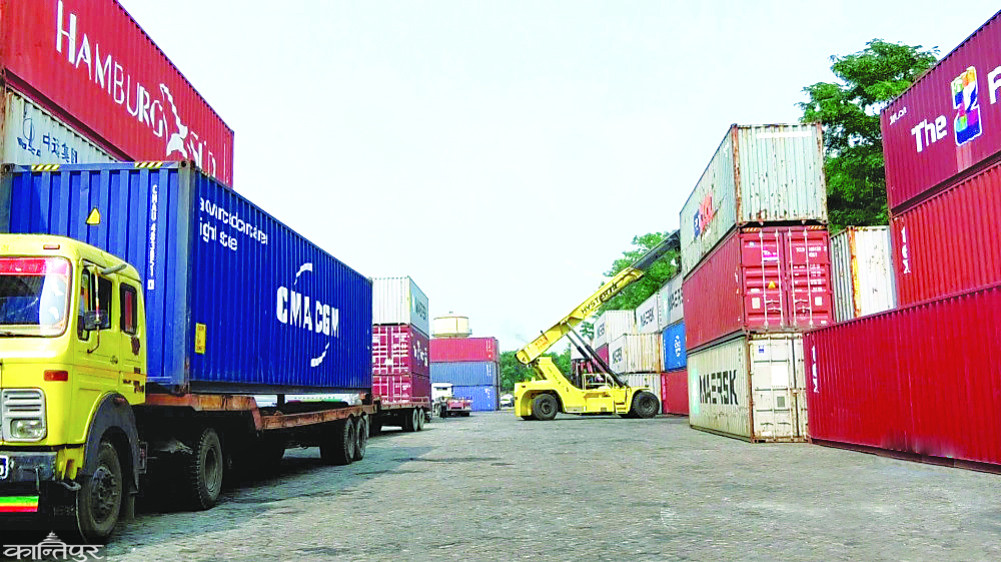
For a landlocked country like Nepal, export competitiveness is a key foundation for sustainable economic development. In line with the concept of ‘weightless-distanceless trade’, the VAT refund system should be made simple, fast, digital and transparent.
We use Google Cloud Translation Services. Google requires we provide the following disclaimer relating to use of this service:
This service may contain translations powered by Google. Google disclaims all warranties related to the translations, expressed or implied, including any warranties of accuracy, reliability, and any implied warranties of merchantability, fitness for a particular purpose, and noninfringement.
Value Added Tax (VAT) is known as an economically efficient tax system. It is considered one of the most important innovations in public finance management of the twentieth century. Its main feature is to exempt investment and exports from the burden of taxation, which increases production efficiency and also strengthens international competitiveness.
According to the Value Added Tax Act, this tax is levied on all goods and services except those that are explicitly exempted. This means that for the purpose of this tax, goods and services are divided into two categories: taxable and exempt. Taxable goods and services are further divided into two categories: normal rate and zero rate.
Suppliers who trade in exempt goods and services are not required to register for VAT or carry out other tax-related formalities. However, they must pay this tax on goods and services that they purchase or import for their business. Since they are not registered, they cannot collect tax on sales. And, they cannot get deduction or refund of ‘input’ tax paid. Therefore, even if their sales tax is exempted, tax exemption does not completely remove the tax burden, but only provides partial relief.
In contrast, suppliers of taxable goods and services (normally or zero-rated) must register for VAT. And, they must fulfill all legal obligations. They must pay tax on ‘inputs’, collect tax on sales and remit the difference to the government. If the ‘input’ tax is higher, they can claim a refund of the excess amount from the government.
Zero-rating is applicable on exports. This means that exports are taxable supplies, but since the tax rate is zero, the tax actually payable on the exported goods and services is zero. On the other hand, the exporter gets a refund of all ‘input’ tax paid in the course of carrying out his export business. These ‘inputs’ include raw materials, auxiliary materials, chemicals, paints, machinery, equipment, office supplies, stationery, information technology equipment, fuel and telecommunication services, etc. Thus, zero-rating completely exempts exports from the burden of tax, which contributes to increased international competitiveness, expansion of foreign exchange earnings, strengthening of the balance of payments and employment and economic growth.
Nepal’s practice
Nepal has implemented the Value Added Tax system in accordance with its basic principles and international good practice. A single rate of 13 percent has been applied to taxable goods and services and a zero rate on exports. And, a system of tax exemption has also been established for some goods and services.
The goods and services that are exempted from tax are listed in Schedule-1 of the Value Added Tax Act. Businesses that deal only in such goods and services do not need to register for this tax. And, they do not need to complete any formalities related to this tax. However, they cannot deduct or get a refund of the tax paid on ‘inputs’.
Schedule-2 of the Value Added Tax Act has provided for zero-rating on exports. This means that even if exports are taxable at zero rate, there is a provision for a full refund of ‘input’ tax. This is in accordance with the principles of Value Added Tax and international practice. However, considering the situation when Value Added Tax was implemented in Nepal, there was some practical deviation in imposing this tax on exports of tax-exempt goods and services.
One of the main objectives of Value Added Tax is export promotion. In the mid-1990s, at the time of the formulation of the Value Added Tax law, carpets and ready-made garments accounted for more than 80 percent of Nepal’s exports to third countries. Since Value Added Tax is zero-rated on exports, exporters were expected to get a refund of the tax paid on ‘inputs’, which would make these goods more competitive in foreign markets.
However, at that time, the carpet and ready-made garment associations did not believe that the government would refund the value-added tax. Therefore, they believed that these goods should be exempted from tax and that registration should not be mandatory for exporters of exempted goods and services until the VAT system is fully implemented and the tax refund system is operating smoothly. Although the exporters of goods and services on the list of exempted goods and services should be registered according to the spirit of the tax, international good practice and our VAT law, in practice, the practice of not registering exporters of exempted goods and services for VAT was adopted. And, this practice has continued till now.
Currently, the need to attract foreign investment and expand exports in Nepal has become a very important issue. In this context, according to the principle of VAT, goods and services in Schedule-1 should be considered tax exempt only for domestic sales. However, there should be a system for applying zero rate to the export of such goods and services, registering exporters for VAT, and refunding the tax paid on ‘inputs’ to the exporters in a simple, prompt and transparent manner. In addition, a comprehensive public awareness program should be conducted for the tax administration, taxpayers and other stakeholders in this regard.
New challenges related to export services
There is no clarity on the issue of applying zero rate to export services, especially when foreign-invested companies supply software and ICT services developed in Nepal to their parent companies. This issue came into special discussion after the tax dispute filed by the Revenue Investigation Department against Cotiviti in late 2080 BS. At that time, when I was working in Liberia, the Secretary to the Prime Minister’s Office and the Director General of the Department of Inland Revenue sought my opinion on this issue.
I had clearly stated, ‘Zero rate should be applied to exported services and tax paid on inputs should be refunded to the exporter without any dispute.’ However, despite no formal decision, companies like Cotiviti are affected as uncertainty persists. And, there is a risk of negative impact on foreign investment and ICT exports.
Legal provisions and amendments
The initial Schedule-2 of the Value Added Tax Act had a clear provision that zero rate of VAT should be levied on goods exported outside Nepal, services supplied outside Nepal and goods and services paid for in convertible foreign currency. However, the latest amendments limited this provision and made a provision that (a) a person residing in Nepal should supply services to a foreign person who does not have any commercial presence, representation or legal representative in Nepal or (b) a person registered in Nepal should supply goods or services to a person residing outside Nepal. That remains the case till date.
This provision is not in line with the basic principles of Value Added Tax and international good practice. The basic principle of VAT is the ‘destination principle’, according to which tax is levied at the place of consumption. Therefore, domestic consumption should be taxed and exports should be completely tax-free at zero rate.
Merely having a commercial presence or representation in Nepal does not prove that consumption took place in Nepal. If it is established that goods or services were exported based on customs documents, proof of receipt of foreign currency and proof of payment of tax on ‘inputs’, VAT should be refunded within 30 days of requesting a refund. In case of delay, the provision to refund with 15 percent annual interest should be effectively implemented.
In this context, Sub-section (a) of Schedule-2 of the VAT Act has created unnecessary ambiguity. It should be removed and a clear provision called ‘services supplied outside Nepal’ should be re-established as per the initial provision.
For a landlocked country like Nepal, export competitiveness is the main basis for sustainable economic development. Nepal has a comparative advantage in traditional products such as carpets and high-value-low-weight information and communication technology services.
Digital services have great potential for export expansion as they can be supplied globally with minimal physical infrastructure. In line with the concept of ‘weightless and distanceless trade’, the VAT refund system needs to be made simple, fast, digital and transparent. Exporters need to be able to track the refund status online and the approved amount needs to be deposited directly into the taxpayer’s bank account.