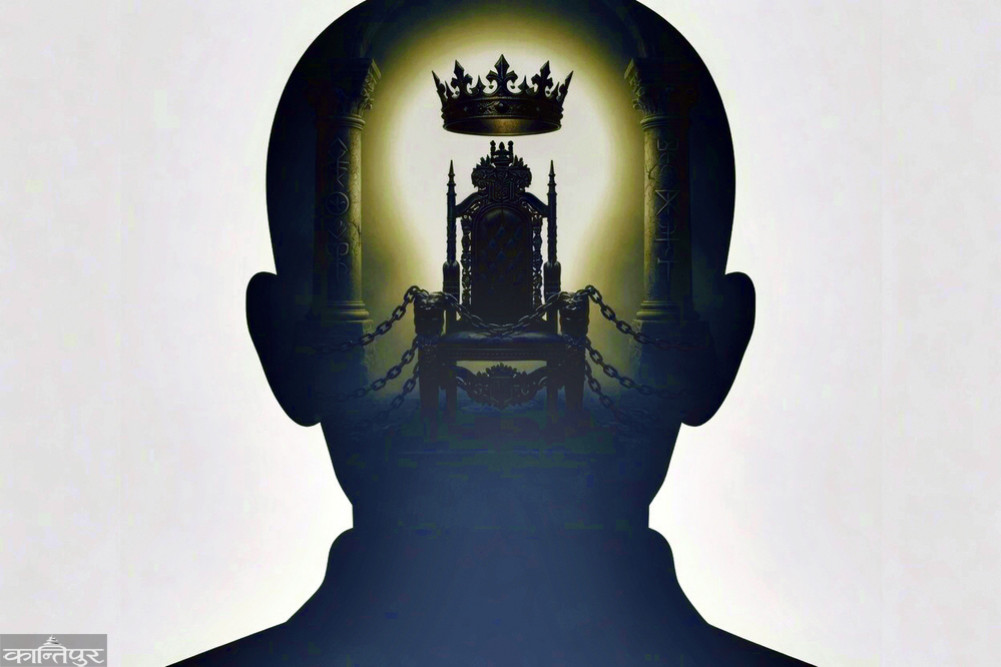
Criticism leads to marginalization, but the greed of becoming advisors, ambassadors, or leaders of various institutions when they sing the praises of the ruler blinds their critical consciousness.
We use Google Cloud Translation Services. Google requires we provide the following disclaimer relating to use of this service:
This service may contain translations powered by Google. Google disclaims all warranties related to the translations, expressed or implied, including any warranties of accuracy, reliability, and any implied warranties of merchantability, fitness for a particular purpose, and noninfringement.
Intellectuals, writers and analysts are considered the ‘guardians of conscience’ in society. Citizens expect constant vigilance, critical awareness and impartial perspective from them. But experience from history to the present shows that some stalwart intellectuals have suddenly abandoned their liberal and progressive values and become absorbed in the ‘footstool’ of power. Especially those who advocate democratic values and institutional strengthening overnight demonstrate nakedly in defense of the right-wing or extremist steps of populist leaders. This trend is called ‘intellectual bankruptcy’ in political science and psychology. This article attempts to briefly analyze this.
With the rise of every authoritarian regime in history, the fact that thinkers, writers and analysts who once stood for the truth gradually became disinterested in praising the ruler is not just a coincidental event. Behind this lies a systematic psychological and social process. Polish writer Jest Mitos has accurately shown in his classic work ‘The Captured Mind (1953)’ – ‘The fall of an intellectual does not happen all at once, it is a series of compromises, each time betraying one’s own conscience.’
Social causes of bankruptcy
Cognitive dissonance : When an intellectual feels that his influence in society is waning or sees the established political system failing, a conflict arises in his mind. To escape this mental stress, he changes his ideology and compromises with the powerful (emerging) current, so that he feels his decision is right and gets self-satisfaction.
Hunger for access : According to the French philosopher Remo Aran, many intellectuals suffer from the disease of ‘being close to power’. When they criticize, they are marginalized, but when they sing the praises of the ruler, the greed of getting advisors, ambassadors, or leadership of various institutions makes their critical consciousness a ghost.
Bandwagon Effect : When a populist wave is going on in society, it takes a little courage to stand against that wave. Intellectuals, fearing that they will become ‘outdated’ and lose relevance when they look different from the crowd, get carried away by the so-called existing wave.
Megalomania : Some analysts have the arrogance of ‘what I write should change the system.’ When democratic institutions work slowly but systematically, they feel ‘slow’. Those who want immediate results end up becoming fans of the authoritarian style of the ‘strongman’ (strong ruler) who destroys institutions.
Psychological causes
According to Leon Festinger's cognitive dissonance theory (1957), the human brain is unable to hold contradictory beliefs together. When an intellectual accepts a benefit (position, prestige, financial security) associated with a ruler, his brain engages in 'rationalization', seeking out the ruler's qualities to reconcile with his previous critical perceptions. The tendency to seek out the ruler's qualities to avoid 'cognitive dissonance' as a way to avoid contradictory beliefs is called 'sycophantic drift'.
According to psychologist Robert Cialdini's 'Commitment and Consistency of Influence' theory, a critic is psychologically pressured to expand on that perception even if he first says 'there are some positive aspects' about the ruler. Sociologist Hannah Arendt showed in her book The Origins of Totalitarianism (1951) that in a totalitarian system, intellectual change is often linked to the need for biological survival. Ironically, this tendency is also seen in free societies - where there is no physical danger, but there is fear of social and professional survival.
International examples
The most influential of the great philosophers of the twentieth century, the German philosopher Heidegger, joined Adolf Hitler's Nazi Party in 1933 and became rector of the University of Freiburg. The context in which he used his philosophical arguments to justify Nazism is considered to be one of the greatest intellectual scandals of all time and one of the most shameful intellectual bankruptcy in the history of philosophy.
French philosopher Jean-Paul Sartre and some European intellectuals initially defended Stalinist autocracy, ignoring the reality of Stalin's brutal repression and labor camps (Gulag) in the Soviet Union. To the extent that writers like Maxim Gorky's accusations that art and literature were used as state propaganda tools in the name of socialist realism cannot be considered mere accusations. In the 1920s and 1930s, European intellectuals praised Mussolini by saying that 'the train runs on time'. On the other hand, the fact that writers like George Bernard Shaw and Walter Durant idealized Stalin's famine within the Soviet regime can be considered a shocking event even for the contemporary media.
After the rise of Viktor Orbán in Hungary, many liberal professors, journalists, and intellectuals gradually became supporters of his alleged nationalist agenda. Political scientist Ivan Krastev has called this trend ‘liberal intellectual capture’.
The incident of prominent intellectuals like Francis Fukuyama (in the early stages) and Christopher Hitchens, who used their intellectual veneer to justify the Iraq War (2003) against Saddam Hussein, advocating for war by giving the false narrative of ‘weapons of mass destruction’ their intellectual veneer, is not a very old incident that embarrassed the American intellectual community.
With the rise of Trump in the US, Modi in India, and Erdogan in Turkey, many journalists and academics who had been advocating liberal democracy and institutional dignity until yesterday have overnight become carriers of their ‘blind-devotee’ or ‘ultra-nationalist’ narratives, and this is now starting to happen again in Nepal. After 2016, many conservative commentators and analysts in America initially criticized Trump's populism and institutional disrespect, but gradually some of those intellectuals turned into Trump's 'Maga' supporters. Journalist Anne Applebaum has made a great ideological contribution by exposing intellectual bankruptcy through 'Twilight of Democracy (2020)'.
When an intellectual puts his intellectual capacity in the service of political partisanship and nationalism, that is 'betrayal'. French philosopher Julien Benda's work The Betrayal of Intellectuals (1927) is still considered a classic work of intellectual bankruptcy. In Benda's words, the main duty of an intellectual is to stand for eternal truth and justice - not political power. When an intellectual puts his intellectual capacity in the service of political partisanship and nationalism, that is 'betrayal'.
‘An intellectual is an ‘outsider’ of society, who can never become a part of power. The job of an intellectual is to ‘speak truth to power.’ He who speaks the language of power is not an intellectual, he is just a propagandist,’ says contemporary political scientist Edward Said in his book ‘Representations of the Intellectuals’. In this context, American linguist Noam Chomsky has given a historical lesson on how modern media and intellectuals ‘build consensus’ in the service of corporate and political power – ‘Most established intellectuals are merely ‘ideological agents’ who maintain the legitimacy of power.’
Michel Foucault has put forward the concept of ‘power-knowledge’. The change of opinion of an intellectual is not just a personal moral weakness, but the power structure controls the production of knowledge. The idea that is in the interest of the ruler becomes the crime of establishing it as 'truth'. The current agitation of some intellectuals in Nepal is nothing other than a leap in this direction. The concept of cultural hegemony put forward by the neo-Marxist philosopher Antonio Gramsci has become the most referenced ideology to date. The ruling class rules not only by force, but also by building a cultural consensus through intellectuals.
The strategy of showing institutional opponents as 'old'
The strategy of challenging those who stand in favor of democratic institutions (judiciary, press, election commission, university, etc.) by misusing words ranging from 'old', 'elite' or 'anti-people' to leftist and Marxist is a bitter cry of populist ideology. It is not unusual to frame this as a ‘rapture of the old order’, as political scientist John Warren Mueller put it, and to launch a campaign to discredit democratic advocates as ‘defenders of the status quo’ or ‘anti-progressives’. In this light, it would not be strange if Joseph Stiglitz, the influential theorist and Nobel laureate who advocated for strengthening democracy by strengthening political institutions, also became a status quoist.
Why does intellectuals force themselves to such a position? The desire to find relevance in the new order must be considered to have transformed them from ideological debaters into ‘intellectual entrepreneurs’. Expressing real or feigned dissatisfaction with the traditional liberal consensus becomes a daily routine for such entrepreneurs. Seeing the ‘energy’ and ‘popular support’ of populist movements, they come to consider it a historical necessity. After this, personal ambition and the expectation of office-seeking became natural.
Harvard political scientists Steven Levitsky and Daniel Ziblatt conclude their book ‘How Democracies Die (2018)’ – democracy often dies from within, not from external attacks, and the silence or active cooperation (leapfrogging) of intellectuals is decisive in this process. When the intellectual class accepts the decay of institutions as ‘necessary change’, that is the beginning of the end of democracy.
The sentence written by Yale University historian Timothy Snyder in his historical summary of twentieth-century authoritarian regimes in Authoritarianism (2017) seems to be exactly applicable to the recent Nepali context – ‘The main reason authoritarianism succeeds is that intellectuals, without any orders, follow the will of the ruler.’ According to the ‘System Justification Theory’ of Philip Zimbardo and John Just, who conducted Stanford’s famous ‘prison experiment’, people (especially those who are part of the dominant system) have a psychological tendency to consider the existing power structure as justified. A similar situation has been observed in Nepal as well. It is a happy coincidence that in ‘Twilight of Democracy’ (2020), Putlizer Prize winner Anne Applebaum has handled the intellectual decline of her former friends in a way that is exactly the same in our context, with Kedar Sharma, Sanitya Kalika and Sujit Mahat. Applebaum says that intellectuals involved in populist movements are often those who feel that they have not found the place they expected in the liberal democratic establishment. They expect to be rewarded by populists who are not even close to the mainstream.
Such a trend is certainly not a new phenomenon in Nepal's political history. There is no shortage of incidents where many writers and journalists who played a critical role during the Panchayat period have gushed out in praise of autocracy over time. During the democratic period (from the Maoist war to the transition period), the spectacle of such ideological gushing among the intelligentsia has been a frequent farce. It is clear that the tendency to portray populist politics as the messiah of ‘change’ by dismissing those who stand in favor of institutional democracy and the rule of law in contemporary Nepal as a ‘traditionalist circle afraid of departure’ is nothing more than a plan to achieve personal appeasement by attacking democratic systems and institutions.
Intellectual bankruptcy is a gradual process, in which small compromises accumulate and lead to serious intellectual decline. As sociologist Karl Popper said, ‘The price of intellectual freedom is also constant self-awareness.’ What we need to keep in mind is that criticizing institutions and supporting the power to destroy institutions are actually two different dimensions. Not understanding this distinction or ignoring it even after understanding it is the weakest expression of intellectual bankruptcy.
The damage caused by ideological bankruptcy not only changes the individual’s thinking but also destroys the foundation of society’s consciousness and conscience. When writers, analysts, and intellectuals become ‘shields’ for the interests of those in power instead of seeking the truth and criticizing the government, then society is said to become ideologically orphaned. Seeing the wave of populist leaders as ‘epochal change’ and applauding the destruction of established democratic institutions is intellectual dishonesty. A true intellectual is one who does not drift with the tide of time, but rather stands firm against the tide of tumultuous currents to guard values and norms. This epidemic poses a great danger in a transitional society like Nepal, because the change of government may have shown many people the dream of a ‘new era’. But the identity of a true intellectual is the quality of seeking the truth and not bowing down to power.