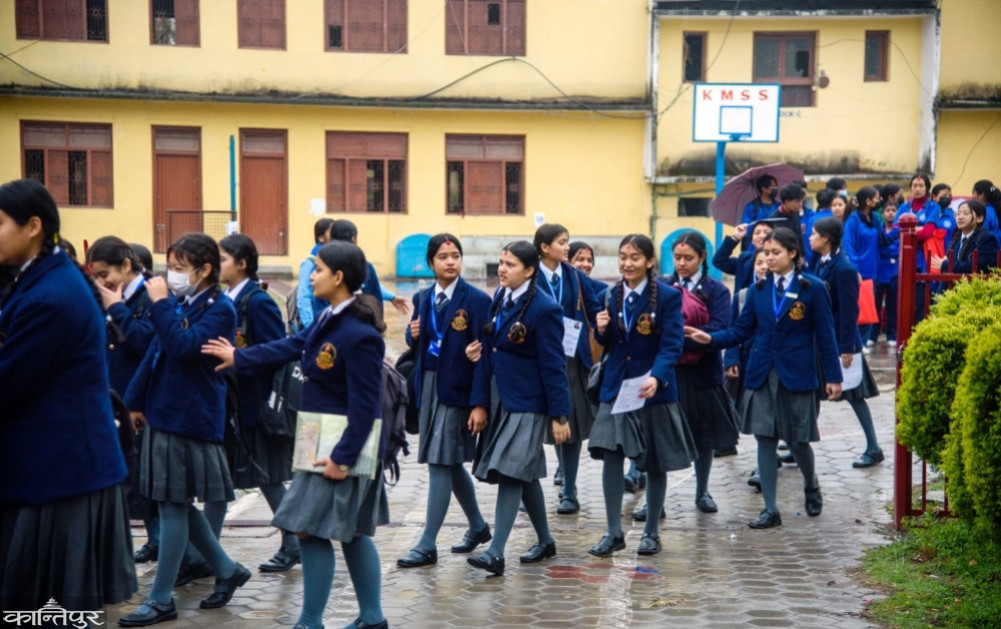
More than 59 percent, or 623,157 children, have dropped out of school or failed and had to repeat the grade. Such statistics are the fate of every year.
We use Google Cloud Translation Services. Google requires we provide the following disclaimer relating to use of this service:
This service may contain translations powered by Google. Google disclaims all warranties related to the translations, expressed or implied, including any warranties of accuracy, reliability, and any implied warranties of merchantability, fitness for a particular purpose, and noninfringement.
The issue of sending children to school and keeping them in school has become a challenge in Nepal. As a result, millions of students have been deprived of the opportunity of school education. In the modern world, it is a shameful situation for any child to be deprived of the opportunity of school education for any reason. The state should be responsible for this. It is too late to make and implement a practical plan to send and keep nearly eight hundred thousand students who are out of school in school.
Otherwise, the situation will continue to arise where the children concerned individually cannot feel the light of education. Over time, society will also be deprived of the educational and academic nourishment they deserve from educated citizens. Against the backdrop of the formation of a strong government, a strong and permanent program should be announced in the budget statement to be announced on 15 Jestha so that children do not have to be deprived of educational opportunities from now on.
In 2073, 1 million 53 thousand 824 students were enrolled in class 1. Students from the same batch participated in the SEE conducted last Chaitra, but only 4 lakh 30 thousand 667 people. The statistics show that more than 59 percent, or 623,157 children, have dropped out of school or failed and repeated the grade. Such statistics are the fate of every year.
One or two programs announced by the federal government to stop this cannot bring a positive impact. Instead, solutions must be found to identify the individual problems of the students. Last January, the National Statistics Office under the Office of the Prime Minister and Council of Ministers had made public through a report that 770,000 children from remote regions and marginalized communities are out of school due to poverty, low income level. Of these, more than 350,000 are not enrolled in school and the remaining more than 350,000 have dropped out of school. It is said that 10 percent of school-age children are out of the classroom.
Study reports and expert assessments and analyses have mentioned some common reasons for students dropping out of school in Nepal. Children do not complete their education due to financial hardship of the family, school being far from home, lack of attraction by the school's educational environment, failure but lack of encouragement, marriage and employment constraints. What is also worth thinking about is that the fundamental right of the constitution states that every citizen has the right to receive compulsory and free education from the state up to the basic level (grade 8). However, the state has not been able to be responsible and accountable for students who do not enroll and who drop out of classes.
The state has been making huge investments in education-related administrative operations, infrastructure construction in the education sector, and teachers and students. It seems that the government has also made efforts to send students to school and keep them there. Even now, enrollment campaigns are being run, students are being fed lunch, and scholarships targeted at the poor are also being given. But such programs have been done only as rituals. For example, students are being given lunch of Rs. 15. It is not possible for every student to get a nutritious lunch with that amount of money, especially in remote areas. The enrollment campaign is also like that. It is held every year.
But millions of school-age children are out of school. A student receives 400 rupees per year for a scholarship targeted at the poor. That amount cannot do anything significant. The government also spends money on teacher training. But the impact of training in the classroom is minimal. It has not been able to bring about significant changes in the teaching method and learning achievement.
There are many reasons why students drop out of school. One or two programs announced by the federal government to stop this cannot bring about a positive impact. Instead, the individual problems of the students should be identified and solutions should be found. Since the government is close, the municipality and ward should work hard on this. The federal government should support. Since the teaching method has not been able to create attraction, the teaching method itself should be made interesting to prevent those who drop out of school.
For that, teachers should be trained, paid attractively, and their personality development should be ensured through the teaching profession. Teachers should also be retained. A program to make parents aware of those who drop out of school due to the compulsion of housework, marriage, and employment is also necessary. In addition, a program to make them financially strong is mandatory.
Even though it is said to be compulsory and free, there is a financial burden as students have to pay fees in some way or the other. The government should strictly implement free education. School adjustment without an option has also left many students without education. The Compulsory and Free Education Act states that basic education should be provided within two kilometers of the place of residence. If it is not possible, it is said that an option should be provided.
Therefore, the Act should be implemented even if it is by providing residential or transportation facilities, otherwise adjustment should not be done alone. Programs should be implemented that connect students with financial income along with education. The program of learning while earning should be implemented in higher education. Many students who go to study abroad are also attracted by the facilities available there to earn money by studying and working there. Such programs, which are regularly included in the budget, should be implemented.