Oli's tendency to say ”that's not appropriate” to any word that goes against the legal format of the oath (and has been recited by the President) during his oath-taking in the name of ”departure,” and Vidya Bhandari's tendency to encourage it with a rude laugh of ”hehe,” are also not very old.
We use Google Cloud Translation Services. Google requires we provide the following disclaimer relating to use of this service:
This service may contain translations powered by Google. Google disclaims all warranties related to the translations, expressed or implied, including any warranties of accuracy, reliability, and any implied warranties of merchantability, fitness for a particular purpose, and noninfringement.
Political analyst Bishnu Sapkota's much-talked-about article 'Departure' is being met with both complete criticism and complete praise for the views expressed in the traditionalist circle and Kantipur Television's program Fireside. This columnist, who has drawn a lot of inspiration from him, is also involved in the debate over the same article and interview.
There was no dispute that Sapkota, who had written a column in Kantipur a few months before the 2079 general election, was a 'change advocate'. Of course, for a scholar like Sapkota, who studied at Cambridge, served as an international consultant in several countries, and has a 'global' image, the government that came with a new public opinion, trying to 'depart' from decades of corruption, shameful partisanship in areas that should have been non-partisan, bureaucratic inertia, etc., should be commended - as everyone else, except for a few people who are fed up with the status quo and benefit from the extreme partisanship of the old ones, feels.
This is not the first time in Nepal's history that an attempt has been made to 'depart' from tradition. Whether it was Chandra Shumsher who saved Nepal from slavery and sati, or Juddha Shumsher, who separated the judiciary (legally only) from the executive in 1997 by issuing a charter of the Supreme Court - both made Nepal 'depart' from traditions that were worth breaking. From BP Koirala, who initiated land reform, to King Mahendra, who brought an act to regulate that land reform, who (to borrow Ravi Lamichhane's language) 'removed' the landownership system that had been entrenched like 'khil' - both were 'departures'. But not all 'departures' may be necessary or result-oriented. In 2065, the Prachanda government's Culture Minister Gopal Kirati, who never tires of chanting such 'departures', said that 'the people have sought a new Pashupati in the new Nepal', which is still fresh in our minds.
Oli's tendency to say 'that does not apply' to any word that goes against the legal framework of the oath (and has been recited by the President) during his oath-taking in the name of 'departure', and Vidya Bhandari's tendency to encourage it with a rude smile of 'hehe' are also not very old. Whether it is the Gagan-Jhakri trend of normalizing the issue of stone-pelting on the streets during student politics or Gyanendra's trend of removing the Prime Minister and becoming the Chairman of the Council of Ministers himself - all of them were 'departures' in a way. The intellectual class, including Sapkota, must have been frightened by those and other 'departures' even then.
The erosion of values
One of the reasons behind the fear of the intellectual circle of Kathmandu with Balen can be found in the world-famous book 'How Democracies Die' written by American political scientists Steven Levitsky and Daniel Ziblatt. In that book, the authors write, citing examples from various countries - nowadays, democracy is not killed by driving military tanks on the streets or by suddenly throwing leaders into jail. Democracy dies slowly, by destroying the rules and procedures one by one, insulting democratic institutions (and also receiving the public's approval for it), and breaking the prevailing democratic values, norms, traditions, etc. one by one. The authors call this process 'norm erosion before rule erosion' (the erosion of norms that occurs before the erosion of laws).
When the intellectual community that read the book published in 2018 sees Balen Shah's behavior that erodes the values, it naturally panics. Seeing Balen, who can shout on social media that if I don't do what I say, 'I will set fire to the Singha Durbar' or can himself hurle vulgar and anti-social insults like 'F-word', why did that intellectual community not like Donald Trump of America, Viktor Orban of Hungary, and Narendra Modi of India Don't forget the
π All these leaders were/are also rapidly moving towards dictatorship (with the exception of Orban, who was defeated in the recent election) and their dictatorships began by making unacceptable language acceptable in society (and appearing very 'non-elitist' and 'common man soaked in mud' to the public). If we recall the gist of the book, 'A leader who violates values and norms today on a whim will also violate the law tomorrow', then Sapkota himself must have been a little shocked!
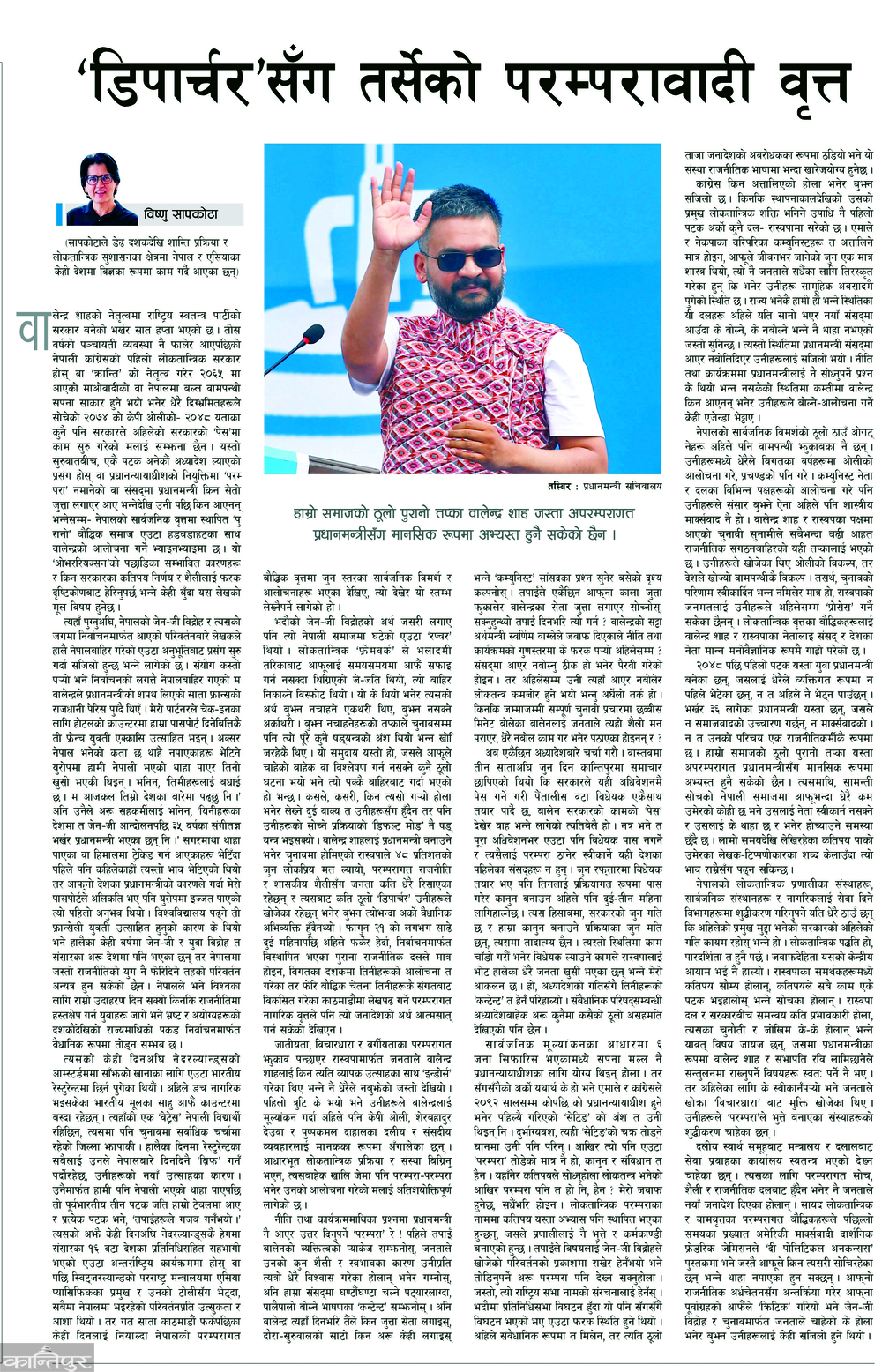 Wearing a black robe and trousers instead of the legally prescribed 'number 3 dress' (white robe and trousers) during the oath-taking ceremony, not addressing the parliament at all, standing up and walking around for no reason while the president is speaking (and not even considering it necessary to inform the president, the parliament and the people with an apology (or without) that he had to stand up and walk around), and enjoying the praise given to him by social media as a very 'non-elitist' and 'pure' image - why shouldn't the intellectual circle that believes in democracy be scared away by Balen?
'Pace' and 'Style'
The issue that scholars like Sapkota and millions of Rashtriya Swayamsevak Sangh supporters (or those who have goodwill towards the Rashtriya Swayamsevak Sangh) really like is the 'pace' ((fast) pace) of the Balen government. The columnist criticized the outgoing Home Minister Sudhan Gurung and wrote in the Kathmandu Post a month and a half ago – the faster and more ‘decisive’ the work is done, the more likely it is that the ‘method’ will not be achieved. Whether it is the sudden arrest of Oli-Khabar, which had to be quashed by the court due to lack of proper investigation, or the ‘Red Corner Notice’ that was tried and failed to be issued by ‘Interpol’ against the Deuba couple without gathering evidence (but failed) – the government’s method in all these works does not seem to have reached the desired level. The (mis)management of the squatter settlement is also an example of this lack of method.
In addition, it may be a bit excessive to give credit to the current government for all the work that seems to be ‘fast’. Aren’t the 45 bills that Sapkota and others gave their approval to the Balen government, which have been formulated since ages? The fact that the drafts prepared by the civil servants before the elections under the direction of the previous governments are also given credit to the new government is another example of Sapkota’s fiercely positive request.
Overconfidence in public approval
Sapkota's claim that 'the public has approved Balen's style of not speaking' is also problematic for anyone who believes in democratic values. The public can and has approved anything, but it is not only time that determines it, but also the timely intervention of a conscious intellectual class. Whether it is Khadga Oli, who brings gas to every stove and rail to every home, or Prachanda, who says 'I will demolish everything old and build a new Nepal' - it seems like the public has approved it. The result of the 2016 'Brexit' referendum in Britain is proof that 'not all public approvals are correct'.
In neighboring Pakistan, military dictators like Zia-ul-Haq and Pervez Musharraf were also approved by the public through referendums. In India, Modi made a racist and exaggerated speech calling Muslims ‘infiltrators’ at a rally in Bikaner, Rajasthan, during the 2024 general elections, but the people voted him back. Trump, who never tires of calling Mexicans and Chinese ‘rapists’ at every election rally, has also received overwhelming public approval twice (the second time was after he urged his supporters to occupy the US Capitol on January 6, 2021).
If an uncritical public approves of the deification of Balen through social media (and is ‘confused’ to borrow the language of the snake), how can the established traditions, processes, laws and politics, socio-political values and norms remain at the top?
Looking at Sapkota's past articles, there is a lot of 'intellectual' criticism of Oli, Deuba, and Prachanda, who came to power with public approval at the time. The columnist believes that the article 'Characters Who Should Disappear in Mangsir' of 2079 was written to inform and educate the people who approved it. In the fireside program, Sapkota himself (humbly) criticized the Balen 'action' that was carried out without a plan, in a hurry, and with human weaknesses to raise the squatter settlements.
But Sapkota easily dodged the question asked by interviewer Rupesh Shrestha, 'Isn't it Balen's 'style' to do such a thing?' Today, when other intellectuals, with the same public approval, are trying to inform the public about the critical aspects of Balen (despite the constant threat of obscene abuse against him and his progeny on social media), it is incomprehensible that Sapkota sees intellectual bankruptcy in him.
Criticality towards criticism
Sapkota has another argument that ‘the ‘core’ of policies and programs was not discussed, only its bark was discussed.’ Sapkota, who has played a leading role in the field of democratic rights from Cambodia to Nepal, certainly understands that the bark (i.e., due process of law) is important in a democracy. If Balen had always been present in parliament, had constantly told the parliament and the people his views, and had he sent his ministers instead of coming on that one day of discussion, Sapkota’s argument would have been justified. After all, the law (Rule 38 of the House of Representatives Rules, 2079 BS) has given the Prime Minister that right. However, hasn't the Prime Minister's absence been criticized for being unresponsive to both the parliament and the people, not facing questions from either MPs or journalists, and not giving clear information (not seeing anyone as deserving of information) when breaking tradition? Yes, as Sapkota said, it is necessary to criticize MPs who lack the ability to question 'content', but should we immediately label them as 'suffering'?
At the end of the fireside, he indicates, 'If democratic rights are upended when Balen leaves power, I will also protest.' The right to housing of squatters (which is not only a fundamental right guaranteed by the Constitution of Nepal but also a right that the Nepal government is obliged to guarantee by the International Covenant on Economic, Social and Cultural Rights, to which Nepal is a party) has already been 'upended'.
How impossible is autocracy?
The answer to Sapkota's argument in Fireside, that 'Nepal is not likely to go towards the autocracy they suspect', when criticizing the criticism of the intellectual community, is found in the book 'It Can't Happen Here' written in 1935 by American novelist Sinclair Lewis (and the study of today's Trump-ruled America that should be done in light of it). Citing the incident in Nazi Germany where Hitler brought fascism by trampling on traditions, laws, procedures, and processes on the strength of the people's disappointment with the old political forces and the fierce hope inspired by propaganda for the new, Sinclair satirized the Americans who said 'It can't happen to us'. Not to mention, we have all seen that Trump's neo-fascism has become dominant in America within a few decades of the book being written. If a president can bring about such a situation within 4-5 years in a country like America with a long democratic tradition and institutional guarantees, what will be the situation of us Nepalis who have been deceived by critical thinking?
Overconfidence in the power of Parliament
Sapkota says at the fireside, if Balen goes too far, Parliament can remove him at any time. Although legally correct, this is practically impossible. When Balen's face (PM-face) in the election and his semi-false PR boost (over-strengthening of public image) on social media that he made Kathmandu a paradise, now he will make the whole country a paradise, is the biggest reason behind such a huge victory in the election, how many MPs of the Rashtriya Swayamsevak Sangh (RSS) have the courage to change the leader of their parliamentary party (which automatically changes the Prime Minister in a parliament with a single majority)? It may not be illegal in terms of procedure, but since changing the person whose face they have shown and whose popularity is at an unprecedented peak would be considered a betrayal of the people (and the same question would be a source of embarrassment when they go to seek votes again in the future), no one in the country will dare to do so.
In fact, the parliamentary election to announce the future Prime Minister (and win it) is in itself an undemocratic practice, which has already undermined the power of the Parliament to bind the Prime Minister, hold him accountable to himself, and if necessary, change him (which is the only virtue of the parliamentary system). Moreover, how can we assume that the Parliament can change the Prime Minister so easily in a situation where even a ‘cricket’ spoke against Balen and he is a victim of ‘digital lynching’ (a torrent of abuse on social media)?
Therefore, there are these and many other reasons for the fear of intellectual circles, which are ignored in Sapkota’s article (perhaps due to lack of space).