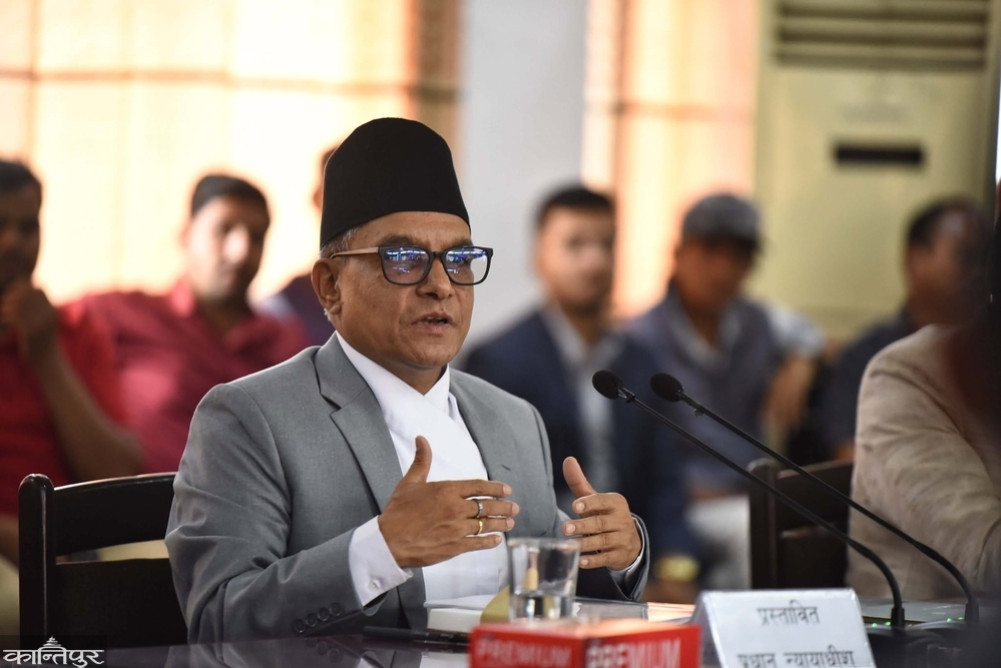
Sharma, who has broken with tradition and become the Chief Justice, will be the measure of his success in terms of how strong his leadership ability is to end the traditional dysfunction in the judiciary and protect the autonomy of the judiciary.
We use Google Cloud Translation Services. Google requires we provide the following disclaimer relating to use of this service:
This service may contain translations powered by Google. Google disclaims all warranties related to the translations, expressed or implied, including any warranties of accuracy, reliability, and any implied warranties of merchantability, fitness for a particular purpose, and noninfringement.
After the name was approved by the parliamentary hearing committee on Tuesday, President Ram Chandra Poudel appointed Manoj Sharma as the Chief Justice and administered the oath. Although there was controversy over the controversial provision in the Constitutional Council Act and the recommendation of a fourth-rank judge as the Chief Justice by the ordinance, the process of appointing the Chief Justice this time has been completed from Tuesday, and there may be continuous debate in society on the issues of controversy and differences of opinion.
However, the wait now will be on how the judiciary will move forward under the leadership of Chief Justice Sharma. How much strong leadership Sharma, who has broken tradition and become the Chief Justice, can show to end the traditional dysfunction in the judiciary and protect the autonomy of the judiciary will be the standard of his success. It will also provide qualitative benefits to the judiciary. Overall, trust in justice will also increase.
Dysfunction and problems have been seen in the judiciary since the past. Public trust has become weak. There are complaints that there is factionalism among judges due to political interests and that the shadow of the party is visible on their faces. There is a strong perception that corruption and middlemen influence the judicial process. The committee, coordinated by Harikrishna Karki, has identified areas of corruption within the judiciary.
The general public's access to justice is poor. Cases take years to resolve. When the strategic plan was first implemented in the judiciary in 2061, the total number of cases in the courts was 1,07,641, but by mid-Asad 2082, the number had reached 3,75,284. As much of the Supreme Court's time is spent on hearing political writs and public interest petitions, it has become difficult for people's cases to get a turn. There is also the problem of non-implementation of judgments.
There may be problems in state organs and agencies, but problems in the judicial sector are considered more sensitive. Because the judiciary can easily resolve problems in other areas, but if the judiciary itself gets involved in problems, a web of problems is created everywhere. Therefore, the judiciary should first prioritize the work of ending the internal conflicts. Since access to justice is mainly weak, the work of reform should start there. For that, digital systems can be adopted, hearings can be organized, and the process of justice and the writing of judgments can be simplified.
Chief Justice Sharma must take the lead in ending the internal conflicts within the judiciary. He will also have to be successful in implementing the action plan that he himself submitted to the parliamentary hearing committee. The process of seeking justice should be made less expensive. To increase trust in the judiciary, fair justice should be ensured. The factionalism among judges that has been going on for a long time is still visible. Therefore, the challenge for Chief Justice Sharma is to end the factionalism among judges within the Supreme Court. Coordination with the Nepal Bar will be required. If he is not successful in this, the judiciary may become further weakened during his leadership.
Sharma will also have to answer the questions raised about himself through his work. Because, people have been suspicious since the background set for his recommendation. After ending the parliamentary session that had been called by the President, the government issued an ordinance related to the Constitutional Council (among many others). The ordinance related to the council changed the theoretical definition of majority. If the votes of 3/3 of the 6 members of the council are divided, there is no majority, but through the ordinance, a provision was made that three members of the Prime Minister's side will be considered a majority.
Finally, despite the written 'note of dissent' of two members, Sharma was recommended as the Chief Justice on 24 Baisakh, breaking the established tradition of recommending a senior judge as the Chief Justice. The MPs in the parliamentary hearing committee were not given even a day's time to study the action plan and the complaint. The hearing was started within an hour of the complaint being filed. Such favoritism available to Sharma is now in doubt. To overcome that doubt, he will have to be able to keep the judiciary free from the influence of power during his tenure. Perhaps if the public comes to a situation where his decisions and decisions are identified with the current appointment process, it will be an irreparable loss for the judiciary.
Chief Justice Sharma must take the lead in ending the chaos within the judiciary. He must also be successful in implementing the action plan that he himself submitted to the parliamentary hearing committee. He has prioritized judicial good governance, transparency, professional efficiency, impartiality, and speedy justice. Similarly, making the implementation of judgments effective and increasing access to justice are also among his priorities.
He must break the past tradition of submitting action plans, being appointed, and being indifferent to their implementation. He is expected to provide a point-by-point progress report on his own action plan in a timely manner. He also has the responsibility to resolve the well-known problems within the judiciary that the people have experienced and expected to improve. He must also address the upcoming challenges through his leadership capacity. He must be able to keep the independence and autonomy of the judiciary intact. He must be able to protect the glorious legacy of the Supreme Court in the rights of citizens and political issues.