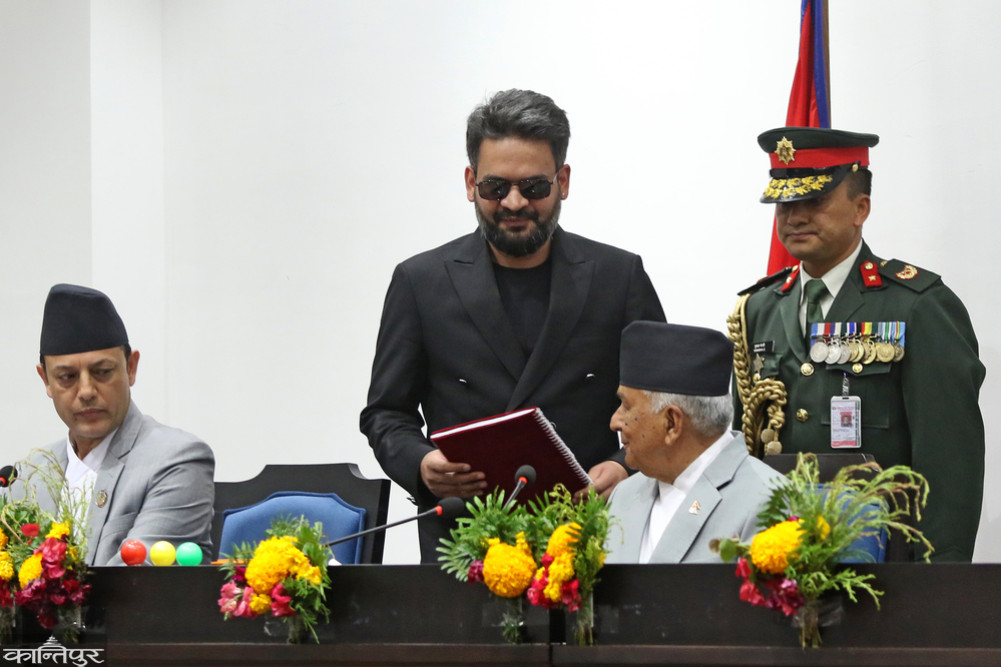
Prime Minister Balendra Shah is disregarding parliamentary procedures, procedures, and traditions, breaking rules and conventions. Concerns have grown: Is the country heading towards an elected dictatorship?
We use Google Cloud Translation Services. Google requires we provide the following disclaimer relating to use of this service:
This service may contain translations powered by Google. Google disclaims all warranties related to the translations, expressed or implied, including any warranties of accuracy, reliability, and any implied warranties of merchantability, fitness for a particular purpose, and noninfringement.
The annual policy and program presented by the government in the parliament is its one-year agenda and manifesto. This is such an important manifesto of the government, on the basis of which serious discussions are held on issues such as the backbone of the nation's social, economic development and international policy. Earlier, the time for such important debates used to be 6/7 days. Now, by limiting it to 6 hours, an attempt has been made to silence the voice of the parliament. This culture of not wanting and not respecting the parliament reminded me of the Sanskrit verse, 'लोचनभ्यां बिहिनीस्य दर्पनः किं करिष्याती' (चाणकयनीति) i.e. 'लोचनभ्यां बिहिन्स्य दर्पनाह किं करिष्याती' i.e. 'लोचन्यां बिहिन्स्य दर्पन्तिती' i.e. 'लोचन्यां कार However, the way in which decisions are being reached based on the arrogance and arrogance of the majority without being part of that process, it does not lead to the right destination.
It has also been heard in Parliament that the opposition does not understand the policies and rules. The constitution is the basis for the operation of parliament as accepted by the world. Then, in our context, it is the rules of the House of Representatives. The precedents, traditions and international practices established in previous parliaments are. We have sufficient information about the precedents established in India, Britain, Japan and Australia based on the parliamentary system. The Prime Minister is the central responsible party for the annual policies and programs presented in the parliaments of each of these countries. Therefore, it is a universal parliamentary belief that the Prime Minister must be present at least in the response to the policies and programs of the Parliament and that he must respond.
If anyone shows an incident where the Prime Minister has not been present in such discussions and responses in Parliament for one and a half years after 2015 and until today after 2048, I am ready to accept defeat. Article 76 (10) of the Constitution clearly states, ‘The Prime Minister and the Ministers shall be collectively responsible to the Federal Parliament.....’ The collection of individuals is a group. A group does not become a group without an individual. The head of the group is responsible to the Parliament both collectively and individually. The spirit of the Constitution is that the Prime Minister should not be responsible to the Parliament. And should not the Prime Minister be responsible to the Parliament? Is this our parliamentary tradition? And, the rule of law and parliamentary norms that we are trying to establish?
It is my wish that the country will gain momentum from the majority that the ruling party has received from the people. However, it cannot be done by disregarding the Parliament. It is sad that the decision that has been reached by putting aside the system and process and relying on arrogance and arrogance is being reached. This policy and program is a document of hope and despair that sells dreams and hides reality.
The government's policies and programs also include some welcome issues. We, the opposition, will have a constructive and supportive role in that. Among the programs that I like are - developing Nepal as a world spiritual tourism center and the Devbhoomi Nepal National Campaign. I welcome it wholeheartedly. Another important issue in this is - commitment to good governance. From the abolition of trade unions and student unions to squatter settlements, indiscriminately creating dozer terror will not solve the problem. It leads to a situation of rebellion and conflict in society. The spark of fire is small, but it does not take long to become terrible.
Good governance is a corruption-free society, fairness, transparency and the rule of law.
1. In terms of controlling corruption, the government has formed the Money Laundering Commission, which I welcome. I have been constantly saying in Parliament during the tenure of all the previous governments that such an investigation commission should be formed.
2. I remember the Finance Minister telling me, 'You should have raised your voice a little more about the looting that is happening as policy-level corruption....' . Legal arrangements should be made immediately to define and investigate policy-level corruption . Only decisions that are not included in the constitution or law but are urgently needed for the needs of the country can be policy-level . A decision like awarding the construction contract for a particular project to such and such a person cannot be a 'policy decision' . Therefore, a law should be made to clearly define policy decisions .
3. The commission formed under the chairmanship of Judge Bhairav Prasad Lamsal to investigate the assets from 2048 to 2055 BS has prepared a report with great effort and submitted it to the government . The government should make that report public and dare to take necessary and just action .
4. Even during my party's government, I kept raising the voice that 'if corruption is to be eradicated, the one thousand and five hundred rupee notes should be demonetized'. But, no government listened to this. There is a misconception among the public that the houses of those who have once become ministers have piled up with thousand and five hundred rupee notes and undisclosed assets. That is why I have been saying this for a long time. And, I am saying it now. This current government, which was formed with the promise of eradicating corruption after the Gen-G movement, should implement it immediately.
5. The illegal assets of Nepalese people, who are among the poorest in South Asia, should be investigated in banks from Switzerland to Singapore, from Dubai to Cambodia and other similar banks. It seems that the illegal money going from Nepal to Swiss banks is increasing every year. Just as a national inquiry committee was formed after the youth movement in Bangladesh, I demand that a similar commission be formed in Nepal as soon as possible.
If we really want to establish good governance, our friends who came to power with an agenda of change should behave accordingly. We also had many shortcomings in the past. I have no objection to accepting and speaking about those shortcomings. The Nepali people sought change against those shortcomings. The result of that is that the ruling party friends are now in power and are the carriers of change. Nevertheless, I would like to remind the ruling party friends that in Britain, the parliament gave birth to the parties. In Nepal, the parliament was born through the tireless struggle, sacrifice and dedication of the parties. It is important for everyone to understand this originality of the struggle of the parties in Nepal. The 63-point Magna Carta issued in Britain in 1215, the continuous struggle between the people's representatives and the kings, and the incident of the king being cut off in the parliament itself, led to the establishment of the parliament in a strong form. And, parties were established through parliamentary practice.
Breaking the chain of 104 years of Rana rule and slavery, the decade of confusion from the decisive revolution of 2007 to 2015, the parliamentary elections of 2015 and one and a half years of parliamentary practice after 2016, and the subsequent 30 years of continuous struggle to establish a parliamentary system, this parliament was established. Today's parliament is the result of the continuous struggle of these parties - everyone needs to understand this. Therefore, we are ready to support and cooperate in every step of the country's development and prosperity. Our belief is that decisions should be reached through consciousness, not through the clash of excitement and ego, not through impulse.
However, we will never compromise with the eternal democratic and constitutional rights, the supremacy and freedom of the Nepali people, the parliamentary system and its basic values. If this system is violated, we are ready to struggle again.
The overwhelming majority in parliament is not permanent, but temporary and periodic. Public opinion is also temporary and changeable. The public opinion that the current ruling party received in the last election was only 48 percent. It is important to note that 52 percent of the public opinion is still outside. However, democracy is permanent.
From the abolition of trade unions and student unions to the indiscriminate use of bulldozers in squatter settlements, there is no just solution to the problem. This leads to other rebellions and conflicts in society. The spark of fire is small, but it does not take long to become terrible. I urge you - the country should not go in the direction of conflict and confrontation. The majority in parliament is not the only thing that is paramount. The will of the people and the preservation of democratic values are important. We will never compromise with the eternal democratic and constitutional rights, the supremacy and freedom of the Nepali people, the parliamentary system and its basic values. If this system is violated, we are ready to struggle again.
I would like to give the example of Britain again. Sir Gordon Hayward was an exceptionally talented lawyer of the twentieth century, who became a British MP for ten years. However, he entered the judicial service and became Lord Chief Justice (Chief Justice). Why would a person who had been an MP at some point become the Chief Justice? This controversy never came up there. He used to say - a new authoritarianism can also be born from democratic elections. The reason I am raising this issue is that we are preparing such a negative commentary – the commentary that one cannot become a judge or Chief Justice of the Supreme Court after being an MP in a certain period is wrong.
I would like to draw the attention of the ruling party again through Parliament. Prime Minister Balendra Shah is ignoring the parliamentary system, its methods and traditions, and is breaking the rules and norms. This has raised our concern that the country is heading towards an elected autocracy. In fact, democracy is not just a system, but an integrated form of process and tendency.