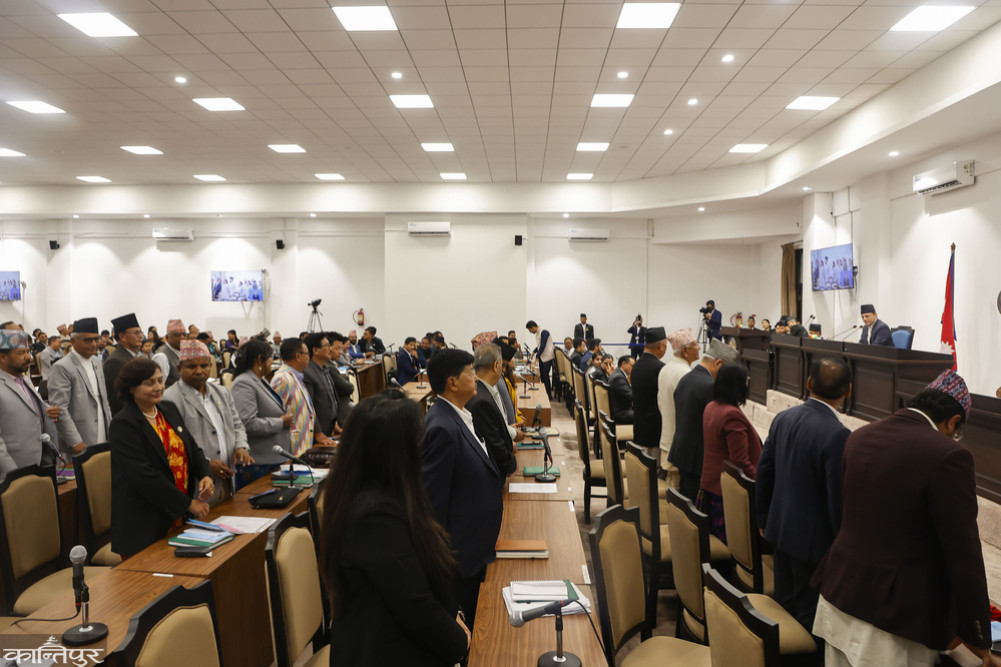
If the Prime Minister runs the affairs without speaking, how will the relationship between the citizens and the government be established? How will a cycle of criticism and support be established? How will accountability increase? Perhaps, then the government will start operating on 'guessing'.
We use Google Cloud Translation Services. Google requires we provide the following disclaimer relating to use of this service:
This service may contain translations powered by Google. Google disclaims all warranties related to the translations, expressed or implied, including any warranties of accuracy, reliability, and any implied warranties of merchantability, fitness for a particular purpose, and noninfringement.
If you are a supporter of Prime Minister Balendra Shah, let me make it clear at the beginning that this is not an article written in his name . If you only want to hear the praises or praises of Balendra Shah, then let us tell you, this article will disappoint you . And, if you only enjoy reading criticism of Balendra Shah, then let us also tell you, this article is not palatable for you . Of course, the central question of this article starts with Balendra Shah .
However, here we are talking about the post of Prime Minister . Because, this article focuses on the question of whether the Prime Minister should speak (in Parliament) or not, how much he should speak or what happens if he does not speak . Therefore, Balendra who comes here is just one of the characters in the context . In particular, the theoretical question that this article is trying to raise is that of democratic norms and governmental responsibility . Which is directly related to whether the Prime Minister should speak or not or where he should speak and how much he should speak .
How this context originated is well known. However, let us recall that we are currently facing a question-and-answer debate between two interesting debate centers. One debate center says that the Prime Minister should speak in Parliament. And the other says that the Prime Minister does not need to keep talking, it is enough to work silently. Those who say that the Prime Minister should speak believe that speaking in Parliament is not only the Prime Minister's moral responsibility, but also a matter of respect for elected representatives and accountability to questions. This is a question related to the spirit of democracy. But those who hold the opposite view believe, 'Why did he have to speak? If he did the work, it would be done.' In particular, those who believe that previous Prime Ministers spoiled things by talking too much feel that the new Prime Minister should break the tradition of talking too much.
Those who are saying that the Prime Minister should speak believe that speaking does not mean chatting, making noise, telling jokes, or stopping work and talking. Of course, here it is said that one should speak responsibly. Because the alternative to talking a lot is not to not speak, but to speak properly. And, speaking here does not mean talking nonsense, nor being irresponsible. In fact, speaking here does not mean making meaningless speeches, talking nonsense, or enjoying public consumption. What people are saying here is that the Prime Minister should speak means being responsible.
It means answering commonly raised questions, eliminating doubts about one's policies and programs, and addressing public suspicions. Here, those who are saying that the Prime Minister should speak argue that the Prime Minister should explain his purpose. He should explain his dream. Because only then do the dilemmas inherent in people disappear, questions are answered, and hope is awakened. Here, saying that the Prime Minister should speak in Parliament means respect for the institution. Such an institution, which has been established as a representative of the people.
Let us be clear, here we are not trying to make a request to the Prime Minister saying, ‘Sir, please say something’. Here we are not trying to make a request to the Prime Minister saying, ‘Sir, the entire nation is eager to hear some sacred words from your mouth.’ Here his speech is interesting and it gives a new direction to Nepali politics, so Sir, please say something is not being given a value. And, speaking here does not mean talking without doing anything. Speaking here means answering.
In a parliamentary democracy, the Prime Minister is always responsible to the Parliament. Therefore, it is the responsibility of every executive to answer the questions raised in the Parliament. Otherwise, if a Prime Minister considers himself above the Parliament, it is arrogance. That is an insult to the citizen’s opinion. That is totalitarianism. And, mistakenly true, if a Prime Minister runs away from parliamentary responsibilities, it is the beginning of his downfall. Whoever makes it clear, there is no democratic character and sense of responsibility in him. That is why the Prime Minister cannot run away from Parliament or evade it. If that is done, it will lead to contempt and humiliation of the people's representative institution. It will make the executive powerless. This is outside the principle of separation of powers. And, yes, a dangerous, undemocratic and irresponsible situation.
As far as the argument that 'the work is done' is concerned, this argument certainly looks attractive on the surface. But there are confusions, misunderstandings and prejudices inherent in this idea. For example, first of all, how should work be defined? Or, what is meant by work here? Because isn't the fact that a Prime Minister is accountable to Parliament (to the voters) a work in itself? Second, how is the justification of work confirmed? Is there a planned sequence of work or is it just something that the Prime Minister does on a whim? Third, is it not necessary to ensure transparency in how the work is being done? Fourth and most importantly, if a question arises about the work itself, should the Prime Minister answer it or not? Therefore, the argument that ‘the work is done’ is an irresponsible argument here. Because as important as the work is, the dialogue that needs to be done on the work is. It can also be said that sometimes speaking is also a task. And, here, the Prime Minister is expected to do the same.
Otherwise, in a democratic system, just like in a dictatorship, if there comes a time when the Prime Minister has to guess what he is thinking by looking at his mood, what could be more stupid, apolitical and undemocratic? That is why it is said that the Prime Minister should inform the citizens about his policies, priorities and programs through Parliament. As per the need, he should communicate with the media from time to time. Because it not only disseminates information, but also builds a bridge of trust between the government and the citizens. In some cases, the doubts that arise are eliminated and immense hopes are awakened in people.
The question arises, what happens if the Prime Minister remains silent? Some people who support the Prime Minister with superstition think that it is okay. They may say with devotion, the Prime Minister does not make mistakes, so he does not need to answer. Some servants may feel that the Prime Minister is the most qualified, so he does not need to prove his qualifications by speaking. Such thinking has become a trap. This has become superstition. Neither the state nor politics runs on superstition.
Let us think, if the Prime Minister runs the affairs without speaking, how will the relationship between the citizens and the government be established? How will the chain of criticism and support be established? How will accountability increase? Perhaps, then the government starts operating on 'guessing'. When it is necessary to guess what the government is doing, then democratic values gradually start to erode. That is why it is said that not being present in parliament, not answering questions or staying away from dialogue is undesirable for the Prime Minister. This cannot be dismissed as someone's personal style, this is the beginning of the decline of democratic politics. This cannot be forgiven or accepted in any way.
What needs to be understood is that in a democratic system, the Prime Minister's 'speaking' is not just a formality, it is the basis of his moral and institutional credibility. Various experiences around the world show that the speech of leadership solves many things. As it is said, when the anti-apartheid revolution was completed in South Africa, which was once ravaged by internal conflict, there was a great risk of retaliation against whites. However, when Nelson Mandela, as president, gave a speech of justice, peace and prosperity for all, everything was taken care of.
This is a very powerful illustration of why it is necessary to speak. Similarly, people also discuss the public address given by Prime Minister Jacinda Ardern after the shootings in New Zealand in March 2019 as a testament to the power of speech. What the then Prime Minister Jacinda Ardern said when fear, conflict and chaos increased in New Zealand after the terrorist attack was not just a speech, it was a message of emotional unity, religious tolerance and moral responsibility between the government and the citizens for the current situation.
The practice of the UK can be very interesting to understand why question-answering in parliament is necessary. There, the Prime Minister has to go to Parliament every week and answer questions directly from members. This program is conducted every Wednesday at 12 noon when the House of Commons is in session. Although its time is officially set for 30 minutes, this time can be extended according to the need and the decision of the Speaker. What happens is that as soon as the question-answer session begins, the first question is asked to the Prime Minister, ‘What are your programs today?’
Then, depending on the Prime Minister’s busyness and work, the question-answer session begins. And, current, sensitive or controversial political issues are raised during the question-answer session. There, the leader of the opposition party usually gets the opportunity to ask a few questions in a row and can challenge the Prime Minister. The important message of this exercise is that in a democracy, the Prime Minister is not just the executive head, he is an officer directly accountable to the Parliament.
These are just a few examples, which make it clear that the Prime Minister should speak in the Parliament, not a request, but a necessity. Moreover, a new leader, who is in power for the first time, has to face and answer even more questions. So that his identity is established among the people and voters can be assured. So the question here is not ‘Why does the Prime Minister speak?’ but rather ‘When, how and why does the Prime Minister not speak?’.
However, all this does not mean that the Prime Minister needs to make unnecessary statements, propaganda-oriented speeches or speak for continuous public consumption. But the Prime Minister must speak clearly, responsibly and factually at a specific time, place and context. Let us make it clear here that the ideal character of a suitable Prime Minister is the style of ‘speaking less but saying the right thing at the right time’. Otherwise, if the Prime Minister does not speak even in Parliament, it is considered that the executive is ignoring the legislature. It is the most undemocratic and rude thing for the executive to ignore the legislature that represents the people. This is not acceptable.