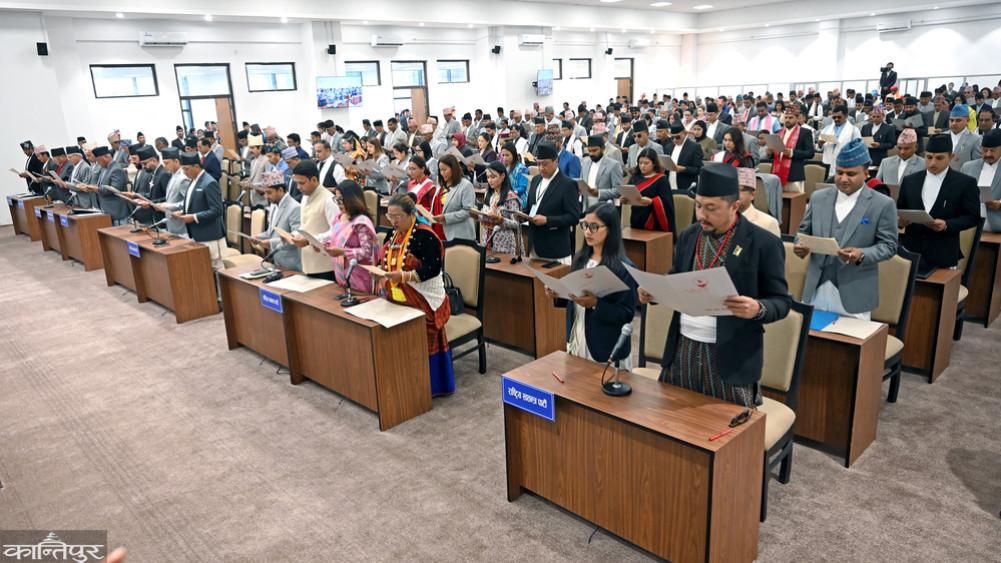
MPs should emphasize the importance of having factual and publicly defensible opinions. It should be remembered that the dignity of parliament lies in factual speech.
We use Google Cloud Translation Services. Google requires we provide the following disclaimer relating to use of this service:
This service may contain translations powered by Google. Google disclaims all warranties related to the translations, expressed or implied, including any warranties of accuracy, reliability, and any implied warranties of merchantability, fitness for a particular purpose, and noninfringement.
The highest seat of public representation, Parliament, has some basic responsibilities - making laws, appointing or dismissing the government, monitoring and holding the government accountable, and bringing issues of public concern to the House. The House is playing its role in different responsibilities. MPs are constantly expressing their opinions in the House on the problems of their constituencies, contemporary issues, and national and international developments.
There are also MPs who study seriously before expressing opinions on behalf of individuals and parties, consult with experts, and practice their expressions to make them communicable. Some MPs also make unfounded accusations and insults against individuals and organizations during important times in the House. They are also speaking 'unparliamentary language'.
The language used to express passion and fame instead of presenting studies, facts, and issues that give momentum to the country in a civilized manner is also weakening the dignity of the House. Therefore, MPs should emphasize the issue of expressing opinions that are factual and can be defended publicly. It should be remembered that the dignity of Parliament lies in factual speech.
On April 29, during a discussion on the government's policies and programs in the House of Representatives, UML leader Ram Bahadur Thapa raised questions about the political rise of the Rashtriya Swayamsevak Party, the Gen-G movement, and the role of the Nepali Army. After the demand of the Rashtriya Swayamsevak Party and the RPP MPs, Speaker Dol Prasad Aryal ruled to remove some of the words included in Thapa's statement from the official records of the Parliament. Similarly, after the demand from the UML, the words used by Rashtriya Swayamsevak Party MPs Ganesh Parajuli and Ramesh Prasai were also ordered to be removed from the record.
In the past, too, some words uttered by MPs while expressing opinions have been removed from the record on the grounds that they were unparliamentary. There is a history of not only MPs, but also the Prime Minister's statements while standing on the rostrum being removed from the record. For example, the question raised by the MP on policies and programs was removed from the record after the then Prime Minister KP Sharma Oli called it 'nonsense' on 24 Baisakh 2076. There are many such instances in parliamentary history.
Voices are raised in the House regarding various public figures, organizations and events. It is also the responsibility of the MP to encourage wherever positive efforts are being made and to warn if there are weaknesses. The government's attention should also be drawn by raising their voice in the House. However, in the process, when the MP gives expression by prioritizing emotions and requests over facts, confusion can spread in the society. Negative commentary can also be created.
The image of the person and organization concerned can be negatively affected. It can also cause damage. Since there are many people in the society who trust public representatives and the expressions of the MP can spread through them, the MP himself should be aware. The audio, video and text of the opinions expressed by the MP remain safe for a long time. Later, people who conduct research can also use it. Therefore, not only for the immediate future, statements made based on incorrect facts can also affect the perception formed in the future. Therefore, MPs should feel responsible for giving factual statements and drawing the attention of the government.
There is another side to this. There is no solid basis for measuring what words are unparliamentary. That depends on the discretion of the Speaker. It is his prerogative. But when the Speaker uses his discretion, there is a greater risk of creating additional identification with the ruling party. In such a situation, the Speaker may be interested in removing critical political words used to criticize the government or the ruling party from the record.
Along with this, any words spoken by MPs of the ruling party can remain on the record. Therefore, the Speaker should be able to conduct the assembly in a balanced manner that protects the autonomy of the debate within the House and discourages unfounded and contemptuous statements. The role of the Speaker should be impartial. He should maintain his credibility. He should be able to convey the impression of being the leader of the House with an impartial working style.
Overall, MPs should not make statements that encourage discrimination, spread hatred against gender, religion and community, and cause conflict. The Speaker should also not discourage the political language of MPs while exercising his authority. That alone will help the House move forward in a balanced manner.
Suggestions are needed to speed up the country in a dignified manner in Parliament. There is a need for a debate in Parliament on maintaining the balance of power between the judiciary, executive and legislature and strengthening democracy. The government can be guided to maintain a balanced behavior in foreign relations. There is a need to increase the morale of the private sector to reduce the compulsion to go abroad due to reduced investment due to lack of employment opportunities.
There is an issue of the safety of youth in foreign employment. Discussion is needed on solving the many problems of quality education and health and providing services to the general public. Revenue is not enough to build infrastructure. Farmers, landless, squatters and other people living below the poverty line have a serious responsibility to uplift them. Nepal, a least developed country, is beset by many problems including these. The people have elected and sent MPs with the hope that they will solve these problems. MPs need to understand this serious responsibility.