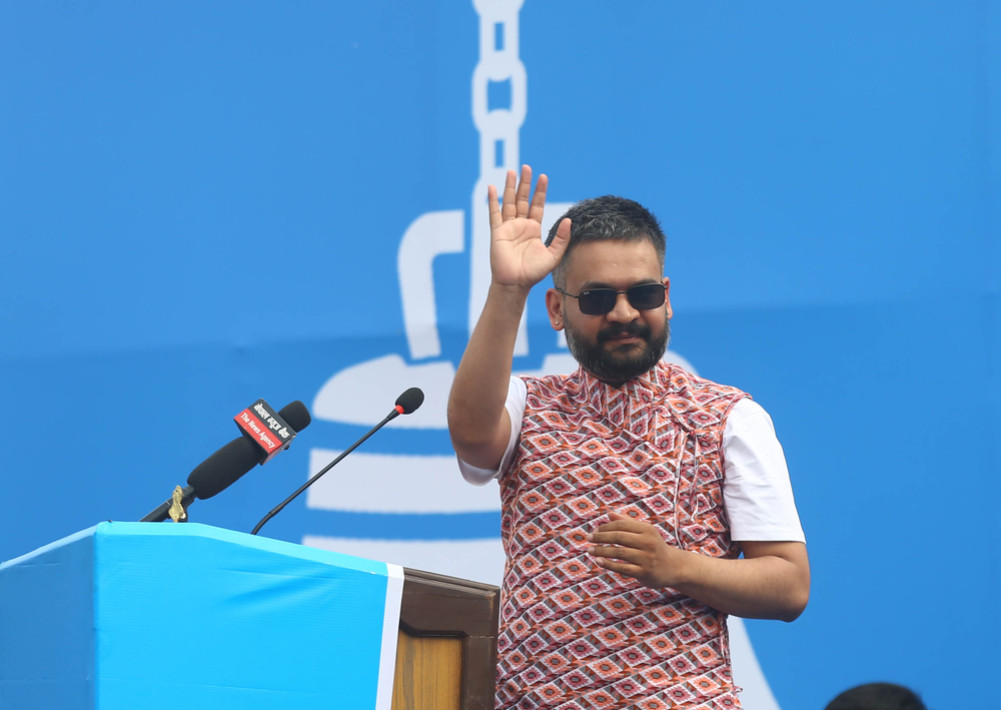
A large, older section of our society has not yet mentally adapted to an unconventional prime minister like Balendra Shah.
We use Google Cloud Translation Services. Google requires we provide the following disclaimer relating to use of this service:
This service may contain translations powered by Google. Google disclaims all warranties related to the translations, expressed or implied, including any warranties of accuracy, reliability, and any implied warranties of merchantability, fitness for a particular purpose, and noninfringement.
It has been just seven weeks since the formation of the National Independent Party government under the leadership of Balendra Shah. Whether it was the first democratic government of the Nepali Congress after throwing out the thirty-year-old Panchayat system, or the Maoists who came in 2065 after leading a ‘revolution’, or KP Oli in 2074, when many deluded people thought that the leftist dream had finally come true in Nepal – I do not remember any government since 2048 having started work at the ‘pace’ of the current government. Amid such a start, whether it is the issue of bringing multiple ordinances at once or not following ‘tradition’ in the appointment of the Chief Justice or from why the Prime Minister came to Parliament wearing white shoes to why he did not come later – the ‘old’ intellectual society established in Nepal’s public circle is in a hurry to criticize Balendra. The possible reasons behind this ‘overreaction’ and some points why some of the government’s decisions and style should be viewed from a different perspective will be the main topic of this article.
Before we get there, I think it would be easier to start the story with an experience the author had recently outside Nepal about the Gen-G rebellion in Nepal and the changes brought about by the election. Coincidentally, I, who had left Nepal immediately after the election, was on my way to Paris, the capital of France, the week that Walendra was sworn in as Prime Minister. As soon as my partner handed over our passports at the hotel counter for check-in, the French girl suddenly became excited. She was happy to know that we were Nepalis in Europe, where people often don't know where Nepal is. She said, 'Congratulations to you.' I read about your country these days.’ And she said to her colleagues, ‘In their country, a 35-year-old musician has just become the prime minister after the Gen-G movement.’ I had sometimes felt that way before when I met people who had experienced Mount Everest or had come to trek in the mountains, but this was the first time that my passport had gained even a little respect in Europe because of the Prime Minister of my country. The reason why the French university student was excited was that in recent years, Gen-G and youth uprisings have also occurred in other countries around the world, but nowhere has the kind of change that would change the political era like in Nepal been possible. Nepal, on the other hand, has been able to set a good example for the world because if young people wake up to intervene in politics, it is possible to legally break the decades-long hold of the corrupt and incompetent on the state through elections.
A few days before that, we had entered an Indian restaurant in Amsterdam, the Netherlands, for dinner. Sahu, an Indian-origin businessman who is now a Dutch citizen, is sitting at the counter. One of the waitresses there is a Nepali student, from Jhapa, a district that is hotly debated in the elections. In recent days, he has had to ‘brief’ everyone in the restaurant about Nepal every day, due to their newfound enthusiasm. After learning that we were Nepali, the former Indian came to our table three times and said each time, ‘You did a great job.’ A few days before that, at an international event in The Hague, the Netherlands, attended by representatives from 16 countries, and later when he met with the head of Asia Pacific and his team at the Swiss Foreign Ministry, everyone was eager and hopeful about the changes taking place in Nepal. But looking back on the few days since his return to Kathmandu last week, I feel compelled to write this column, seeing the level of public debate and criticism that has taken place in Nepal’s traditional intellectual circles.
Whatever the meaning of the Gen-G rebellion of Bhadau, it was a ‘rapture’ that occurred in Nepali society. It was an explosion that brought out whatever was stuck because the democratic ‘framework’ could not cleanse itself from time to time in a noble manner. There were some who did not want to understand what it meant, others who could not understand. The section of those who did not want to understand kept trying to say that it was all part of some conspiracy even up until the election. This community is such that if any big event happens that is not what they want or that they cannot analyze, it must have been caused by someone else. They do not have two sentences to write about who, how, why did it, but the ‘default mode’ of their thinking process has become a conspiracy. The 48 percent popular vote that the Rashtriya Swayamsevak Sangh (RSS) won in the election to make Walendra Shah the Prime Minister was a legitimate expression of how angry the people were with traditional politics and governance and how much of a departure they were seeking from it. Looking back now, almost two and a half months after Falgun 21, it seems that not only the old political parties that were displaced through the election, but also the traditional reading public in Kathmandu, who had criticized them in the past decades but had developed their intellectual awareness through their association, were unable to assimilate the meaning of that mandate.
It seemed that many did not understand why the people, through the RSS, had ‘endorsed’ Walendra Shah with such widespread enthusiasm, setting aside traditional tendencies of ethnicity, ideology and class. The first mistake is that they still adopt the party and parliamentary behavior of KP Oli, Sher Bahadur Deuba and Pushpa Kamal Dahal as the standard when evaluating Balendra. The basic democratic process and institution have not been damaged, and I find it exaggerated to criticize him for just any tradition.
The ‘tradition’ that the Prime Minister should come and answer questions on policies and programs! First, you should remember Balendra’s personality package, think about what style and nature of his people have put so much trust in him, and remember the ‘content’ of the speeches that go on for hours in our parliament. And imagine the scene of Balendra sitting there all day listening to questions from ‘communist’ MPs asking why he wore white shoes, why he wore something else instead of a daura-surwal. You should take off your black shoes and put on Balendra's white shoes, and think, could you do that all day long? What difference has the quality of policies and programs made so far because Finance Minister Swarnim Wagle answered instead of Balendra? I did not advocate that it is right to come to Parliament and not speak. But to say that democracy is weakening by not coming there and speaking so far is a lame argument. Because didn't the people like Balendra, who spoke for twenty-six minutes in the entire election campaign, and send him to work without talking too much?
Now let's discuss the ordinance for a moment. In fact, three weeks ago, the day when the news was published in Kantipur that the government was preparing forty-five bills simultaneously to be presented in this very session, it was at that time that I thought, "Wow," seeing the 'pace' of the Balendra government's work. Otherwise, the previous parliaments of this country would not pass a single bill throughout the entire session and accept it as a tradition. Even at the speed at which the bill is prepared, it will still take two to three months to pass it procedurally and make it a law. In that sense, the speed of the government and the opinions of our law-making process are not identical. In such a situation, I estimate that many people who voted for the RSN are happy with the bill being brought so that we can work quickly. Yes, with the speed of the ordinance, their 'content' has to be seen. Apart from the ordinance related to the Constitutional Council, no one has shown major disagreement with anything else.
Out of the six recommended people based on public evaluation, Sapana Malla was probably the most qualified for the Chief Justice. But another reality is that she was part of the 'setting' that was already made by UML and Congress to decide who would succeed who as Chief Justice until 2092. Unfortunately, she also fell into the trap of breaking the cycle of that 'setting'. After all, that too is just breaking a 'tradition', not the law and the constitution. Some may ask here, after all, democracy is also a tradition, isn't it? My answer would be, not forever. In the name of democratic tradition, some such practices have also been established, which have made the system a ghost and a ritual. If you look at the issue in the light of the changes sought by the Gen-G rebellion, you may be able to see other traditions that need to be broken. For example, look at that structure called the National Assembly. When the House of Representatives was dissolved in Bhadau, it would have been a different situation if it had also been dissolved at the same time. It may not be constitutionally compatible now, but if it is established as an obstacle to such a large fresh mandate, this institution will be more defunct than in political language.
It is easy to understand why the Congress is in a panic. Because for the first time, the title of its main democratic force since its establishment has been transferred to another party - the Rashtriya Swayamsevak Sangh (RSS). The communists around the UML and the NCP are not only panicking, but they are in a state of collective depression wondering whether the people have rejected the only scripture they have known all their lives forever. These parties, which used to say that the state is ours, now sound like they do not know what to say or not when they come to the new parliament. In such a situation, it was easier for them to come to the parliament without asking the Prime Minister. In a situation where they could not say what the question that should have been asked of the Prime Minister on the policy and program, they at least found some agenda to talk about and criticize why Balendra did not come.
Those who occupy a large space in Nepal's public discourse are still of the leftist leanings. Many of them criticized Oli in the past years, and Prachanda too. Even though they criticize communist leaders and various aspects of the party, the mirror through which they understand the world is still classical Marxism. The electoral tsunami in favor of Balendra Shah and the RSVP has hurt this section outside the political organization the most. They were looking for an alternative to Oli, but the country looked for an alternative to the left. Therefore, it is only because they cannot say no to the election results that they have not been able to 'process' the RSVP's public opinion so far. It is psychologically difficult for intellectuals in democratic circles to consider Balendra Shah and the RSVP leaders as leaders of the parliament and the country.
For the first time since 2048, such a young prime minister has become a prime minister, whom many have neither met before nor will meet now. The prime minister, who has just turned 36, neither advocates socialism nor Marxism. Nor is he known as a politician. A large section of our society has not yet mentally adapted to such an unconventional prime minister. Moreover, in the feudal-minded Nepali society, if there is someone much younger than them, there is a problem of not accepting him as a leader and belittling him for what he knows. That sentiment can be read well when examining the words of some elderly writers and commentators who have been writing for a long time.
There are so many places that need to be purified in the institutions of Nepal's democratic system, public institutions and departments that serve the citizens that the main issue at the moment is that the current momentum of the government should be maintained. It is a democratic system, transparency is a must. Accountability has been made its central dimension. Some of the supporters of the Rashtriya Swayamsevak Sangh (RSS) may be benign, while others may want everything to be done at once. All the issues of how effective the coordination between the RSSSP and the government will be, what its challenges and risks will be, are legitimate, which automatically include issues that Balendra Shah and President Ravi Lamichhane, as Prime Minister, will have to balance. But for now, what must be accepted is that the people sought freedom from empty 'ideologies'. They wanted the purification of institutions that were made ghosts by 'tradition'. They wanted to see ministries independent of party interest groups and service delivery offices independent of brokers. For that, the people must have given a new mandate because they did not want traditional thinking, style, and political parties. Perhaps the traditional intellectuals of the democratic and leftist circles do not know why they think the way they do, as the famous American Marxist philosopher Frederick Jameson said in his book ‘The Political Unconscious’. If they interacted with their political subconscious and ‘criticized’ their own prejudices, it would be easier for them to understand what the people want through the Gen-G uprising and elections.