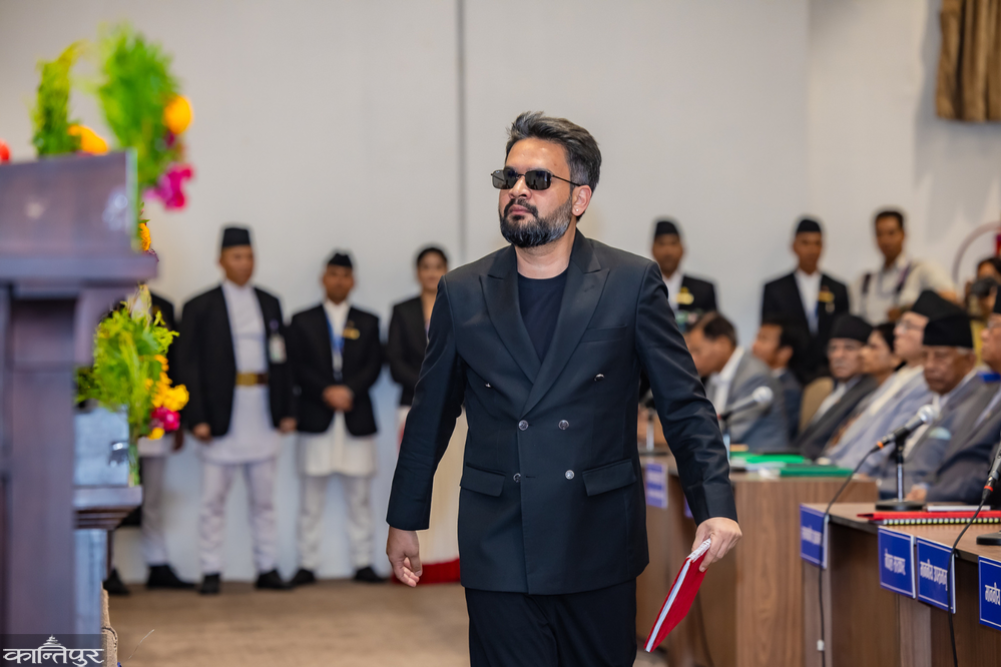
Article 76(10) of the Constitution states that the Prime Minister and ministers are accountable to the House. However, Prime Minister Shah seems to be reluctant to give the House time. The Prime Minister's behavior towards the House that elected him is contrary to that spirit.
We use Google Cloud Translation Services. Google requires we provide the following disclaimer relating to use of this service:
This service may contain translations powered by Google. Google disclaims all warranties related to the translations, expressed or implied, including any warranties of accuracy, reliability, and any implied warranties of merchantability, fitness for a particular purpose, and noninfringement.
When a strong government is formed, there is a lot of hope and a little bit of doubt. Hope in the sense that the government will be able to do what it promises and will be forced to deliver. Doubt in the sense that the government risks destroying the constitution, laws, procedures, traditions, and the institutional relationship of ‘checks and balances’. Prime Minister Balendra Shah’s activities seem to have pushed Nepali citizens towards a similar dilemma. While the government’s readiness to do its job in some areas is being praised, the Prime Minister’s own behavior towards the Parliament is currently being criticized. Article 76 (10) of the Constitution states that the Prime Minister and ministers should be accountable to the House. However, Prime Minister Shah seems to be showing reluctance to give the House time. The Prime Minister’s behavior towards the House that elected him is contrary to that essence.
The Prime Minister has not addressed the House for a month and a half since his appointment as Prime Minister. That is, he has not even thanked the people who made him the Prime Minister and the Parliament that represents the people. Since 28 Baisakh, criticism and comments have been increasing regarding the Prime Minister’s behavior. While President Ram Chandra Poudel was reciting the policy and program that he handed over that day, he got up and left. Was this behavior towards the President and Parliament due to his personal compulsion or something else? He has not said anything about it. He was sought in the House on Wednesday and Thursday, but he did not come. Therefore, the question has arisen at this time - what is the Prime Minister's understanding of accountability and responsibility towards Parliament?
The Prime Minister has not addressed the House for one and a half months after being appointed Prime Minister. That is, he has not even thanked the people who made him the Prime Minister and the Parliament that represents the people. It is customary for the concerned minister to be present when a matter within the purview of a departmental minister is discussed in the House. The policy and program is the entire government's year-round work direction. It is the Prime Minister's perspective. That is why it is the practice for the Prime Minister to hand over the policy and program to the President and the President to read it. The Prime Minister's presence in the House is expected during the discussion on this. He should also answer the questions raised. On the other hand, the policy and program is the business that the Prime Minister himself gave to the House. He does not seem to have taken ownership of the business that he gave himself.
In fact, the House of Representatives Rules allow other ministers to respond instead of the Prime Minister. At present, the government and the ruling party, the Rashtriya Swayamsevak Sangh (RSS), are emphasizing this provision of the rules more. The Prime Minister does not always attend the tabled motions or the replies he gives. However, policies and programs are special issues. The Prime Minister should understand its seriousness. Even at such times, if the Prime Minister does not give the House time, the people should know the reason. He should inform them that the Prime Minister is ill, is on a foreign trip, or is busy with some other work that is more sensitive and important than the presence of the House. Would the Prime Minister's dignity as a member of the House increase or decrease when he went to the House and answered the policies and programs? Would that strengthen or weaken suspicion towards him?
Tradition also has a meaning in Parliament. Tradition is adopted like law on issues that are not directly addressed by the law and rules or where there is controversy. The system we are practicing is parliamentary democracy. It has its own expansion and limitations. It is a system that reaches conclusions through sufficient discussion and questioning. Its beauty is that it takes time, but it matures. The people are searching for the meaning of contesting elections based on this system, expressing public commitment to it, and forming a government but not trying to adopt it. The foundation of the 21 Falgun elections is the Gen-G movement of 23 and 24 Bhadra. That movement sought transparency, accountability and responsibility. The government that came on the foundation of that movement and the elections should realize this. However, at this time, Prime Minister Shah does not seem to be able to realize it/make it so.
On the other hand, a strong government is also about establishing laws and raising the dignity of institutions. Democracy is a concept of collectivism. It is not possible for the Prime Minister alone to remain respected by weakening the dignity and dignity of the President, the Legislature and the Judiciary. The ruling party, the National Independent Party (RSVP), should also clarify this issue. What is the relationship between the Prime Minister and the Parliament that the party is trying to bring? What kind of history does the RSVP want to write? Did it create a situation where the House was shrunk by becoming a strong party or did it make it effective? If we want to make the House effective and active, we must play a role in making the government accountable. Therefore, at this time, the people are expecting answers from the Prime Minister as well as the Rashtriya Swayamsevak Sangh (RSS).
In conclusion, in a parliamentary system, the Prime Minister must be accountable to the House. Since the Parliament represents the people in a parliamentary system, accountability to the House is ultimately accountability to the people. Deceiving the House means deceiving the people. If there is any compulsion, the people should be informed. Therefore, Prime Minister Shah should also respect the suspicions created about him and the concept of accountability that is imagined.