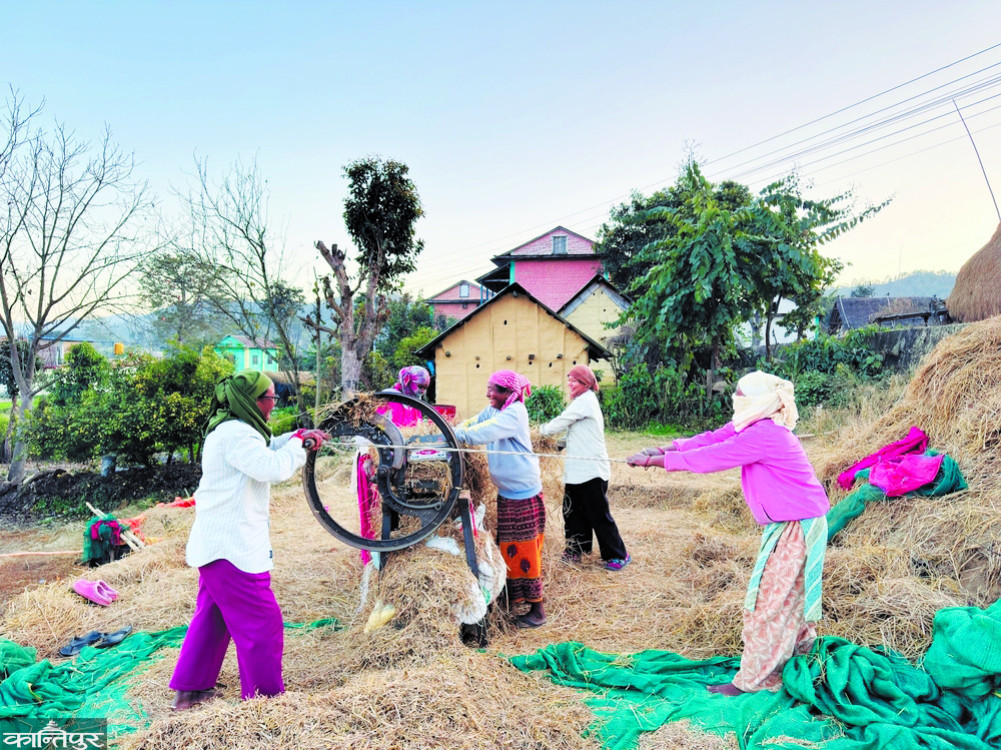
Although the reservation system has increased participation in the political-administrative sector, women from Karnali do not have a meaningful presence in policy-making and decision-making levels.
We use Google Cloud Translation Services. Google requires we provide the following disclaimer relating to use of this service:
This service may contain translations powered by Google. Google disclaims all warranties related to the translations, expressed or implied, including any warranties of accuracy, reliability, and any implied warranties of merchantability, fitness for a particular purpose, and noninfringement.
Women are considered the pillars of development and the 'builders' of society. They are the main carriers of the cultural values and norms of the family and society from one generation to the next. Historically, women are facing discrimination due to patriarchal values, norms and customs, and are currently moving towards 'empowerment' and 'leadership'.
According to the 2078 census, the total population of Nepal is 29.164 thousand 578. 51.1 percent of the total population is female. Almost 50 percent of the total population in the world is female. In the field of labor and economy, most women are more active in 'reproductive labor' such as housework, caregiving and child rearing.
According to the report of the Women's Rehabilitation Center for the financial year 2080/81, a total of 1,393 incidents of violence have been recorded across the country. The highest number of complaints were registered for domestic violence, with 911 complaints, while 185 incidents of rape were registered. The highest number of incidents have been seen in Koshi Province.
In the field of health and education, more than 40 percent of women are still deprived of formal education. The condition of reproductive health and nutrition is still poor in remote districts. More than 80 percent of the gender-based violence complaints registered with the Nepal Police in the last one year have been domestic violence cases. In addition to beating, mental torture, not giving food, and torture due to dowry, the main criminal incidents are burning alive, accusing a woman of being a witch and even feeding her excrement, and applying black soot. In most of the cases, the perpetrators are found to be their own husbands, in-laws or close relatives, family members and neighbors.
In 2082 Kartik, a 14-year-old girl from Sija Village Municipality of Jumla gave birth to a child due to the rape of her grandfather. After the incident came to light, the grandfather committed suicide. The girl She recently took the SEE exam while staying in a safe house.
A teenage girl was forced into prostitution while working in a hotel in Jumla headquarters. One day, she was suddenly beaten up for not satisfying the customer and thrown out on the street, bleeding. A women's rights activist rescued her and placed her in a rehabilitation center after treatment. She is currently HIV-infected and is undergoing skill-based training.
According to the Karnali Institute of Health Sciences, Jumla, there were 4 men and 60 women who were victims of sexual violence in Jumla from Chaitra 2082-2083. Looking at the status of labor participation, the participation rate of women in the labor force in Karnali is about 68 percent. This is considered positive. However, most women work in informal and low-wage sectors. When analyzing the status of access to property, the results of the latest census show that the trend of property ownership in women's names is increasing.
An increase in ownership of houses or land or both in the name of women has been found in about 23.8 percent of Nepali households. This is a modest increase of 1.1 percent compared to 2068. About 11.8 percent of households have houses and land in the name of women. According to the latest report of human rights organizations
(2025/2026), more than 90 percent of women in Karnali still do not have houses or land in their own names. However, some improvement has been seen in the recent process of transferring land in urban areas to women's names. In the health and education sector, more than 40 percent of women are still deprived of formal education. The situation of reproductive health and nutrition in remote districts is still poor.
According to the Central Statistics Office, the share of women in parliament is about 34 percent. In local government, the provision that one of the chief or deputy chiefs should be a woman in local level elections has resulted in more than 41 percent of women reaching local leadership positions. For the first time in history, Nepal has had a female president, a female speaker and a female chief justice in high positions. Events such as Sushila Karki's interim leadership at the end of 2025 seem to confirm the competence of female leadership. The current cabinet comprises about 37 percent women.
Looking at the leadership level, the presence of women at the local level and in the provincial assembly is encouraging in accordance with the constitutional provisions. The first female civil servant secretary from Karnali (Lakshmi Kumari Basnet) indicates that women's leadership is also increasing in the administrative sector. For policy reforms, the Karnali provincial government is implementing a 'Gender Equality and Social Inclusion Policy' and various awareness-raising programs (such as programs related to the care economy). When analyzing the education and health sectors, according to the National Census 2021, the female literacy rate is 69.4 percent. It is considered that there has been a significant improvement in female literacy compared to the previous decade. Due to access to health services and awareness, the maternal mortality rate has decreased significantly.
Due to geographical remoteness, women in remote areas and Karnali have difficulty in accessing legal treatment and justice. Harmful social traditions and customs, social evils, chhaupadi, child marriage, lack of access to health services, malnutrition, burden of labor on women, and lack of ownership of property are the main reasons why women are lagging behind.
The literacy rate of women in Karnali is very low compared to the national average. Even after enrolling in school, the high dropout rate is another major challenge. Many women in Karnali are deprived of opportunities due to lack of information about their rights and available government services. Violence and lack of access to justice and domestic violence are equally challenging. Although the reservation system has increased participation in the political and administrative sectors, the meaningful presence of women in policy-making and decision-making levels is still challenging. Domestic violence caused by alcohol consumption and illiteracy is a major problem here. Due to geographical distance and procedural hassles, women who are victims of violence cannot easily reach the police or courts. Most incidents are ignored due to reconciliation at the local level.