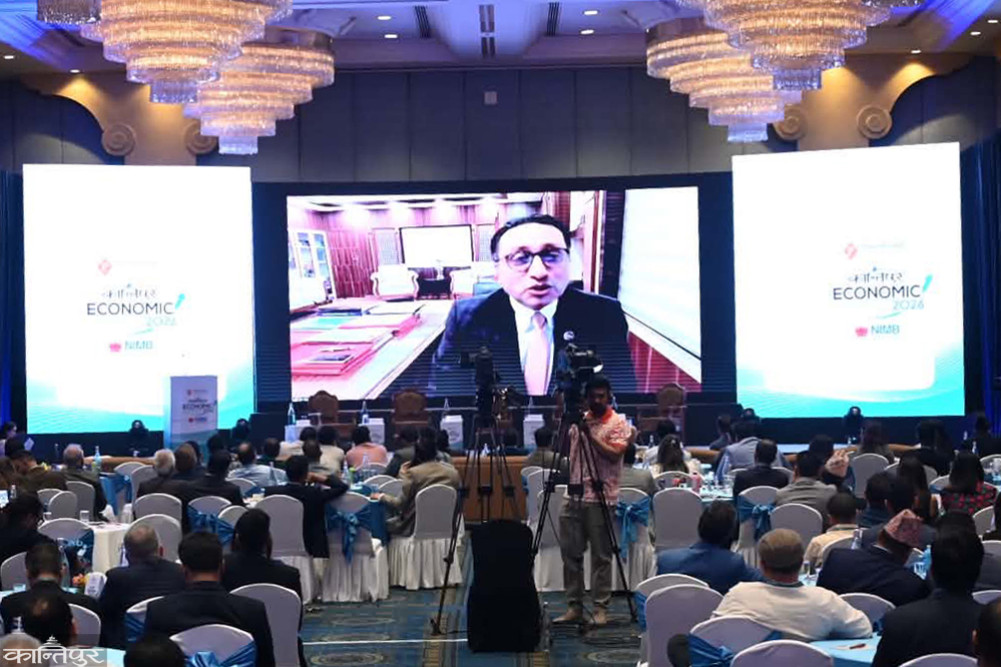
When the middle class is secure, stable, and economically empowered, both the country's overall development and democracy can be sustainable. Otherwise, this country can never rise.
We use Google Cloud Translation Services. Google requires we provide the following disclaimer relating to use of this service:
This service may contain translations powered by Google. Google disclaims all warranties related to the translations, expressed or implied, including any warranties of accuracy, reliability, and any implied warranties of merchantability, fitness for a particular purpose, and noninfringement.
French philosopher/author Jean-Baptiste Alphonse Carr said – ‘The more things change, the more they stay the same.’ Sometimes this saying seems to apply to Nepal itself. The parliamentary environment on Wednesday remained the same. It seems as if we have moved 10 steps forward after the election. But fundamentally, it seems that society has not been able to catch up with that pace and rhythm. However, in the current context, there is a strong desire to make economic leaps and progress throughout the country. What kind of economic message will the upcoming budget give? There is now anxious waiting and interest in it.
A few days ago, the President presented the government’s policies and programs for the upcoming fiscal year. From many angles, it is like setting the long-term and future agenda. Accordingly, the priorities and principles of the budget are now being presented in the House of Representatives. If the parliamentary deadlock ends, it will be presented on Thursday itself.
The appropriation bill, the economic bill, and the debt collection bill come together. We understand its mixed form as the budget. The biggest part of it is the Appropriation Bill. This covers the issues of economic reforms, spending methods, and how the economy touches or affects other sectors. Even after the principles and priorities of the budget are presented in the House, a glimpse of the budget will be available.
We have been paying the price of a long period of misrule. Now it is time to reap the dividends of good governance. I will now talk about the angle from which principles we will move forward. We have been speaking and writing about the issue of 'good governance' in many places. The current government has come with a mandate. We really want to clean up the political and economic aspects. By mixing both, we have said that we will clean up the political aspect. The National Independent Party had done this issue before the election. This issue is also in our manifesto. We have written/said what we will do before the election. I also see some friends being surprised. The Nepali people approved our issue in the election. The manifesto has a hundred points. There are also a hundred points on governance reforms. The policy and program have also come in a hundred points. The first 19 points written in the pledge are related to good governance. The next 21 issues are related to the economy. In total, 40 points are related to good governance and economy. Good governance and economy are our first priority.
Then there are issues of agriculture, forestry, health, education and finally foreign affairs. Now the rhythm of the government is also at the same pace. We have not limited ourselves to the issue of the manifesto/pledge being a mere ritual. We are now implementing the pledge. Part of the pledge came in governance reform. Policies and programs have come in the language of the pledge. The process of budget formulation has moved forward based on the pledge.
The priorities and principles of the appropriation bill will also revolve around it. The budget coming on Jestha 15 will also institutionalize the same issues we talked about with points. We have been paying the price of a long period of misrule. Now it is time to reap the dividends of good governance. The process of freeing Nepal from the institutional and policy-based occupation at the 'micro' level has begun. We will continue this in a concentrated manner. We will also provide good governance at the 'micro' level. This will be implemented from three angles. First, e-governance. Second, digital service delivery. Third, building a digital economy.
We will work using various data obtained from state bodies. Work will be done through collaboration and coordination between state bodies. This practice has not been done so far. Even if it was less, it was less. We will work in an agile, economical and expedient way by using data and digital to reduce arbitrary powers. That will institutionalize e-governance.
Every established technology will be arranged to provide services directly to the citizens. Land revenue, passport, and license offices will provide services in a convenient manner. We will also link all of them to the Nagarik app. Currently, citizens receive only 5-7 services from this. We have moved forward in a short time to provide 100 services only through the Citizen App. The service will be made more efficient by using data centers, G Cloud, and AI. For this, legal structures will also be improved. We will move forward to make Nepal a very attractive destination.
There has also been a discussion about Nepal being a suitable place to establish a data center. New facts, figures, and technologies are coming. We will also use that. This will help in the digital economy. By combining all these three pillars, the benefits of good governance should be reaped in the immediate, medium, and long term. The Prime Minister also has a big priority in this. The issue of having an IT authority in the Prime Minister's Office has been envisioned. For this, a decision was made on Wednesday to have only 18 ministries, including the Prime Minister's Office. Now, all IT-related work will remain under the Prime Minister.
The second priority is restructuring the economy. Our economy is still dependent on remittances. The tax system is also mainly based on trade taxes. Production is shrinking. The potential for service exports will be expanded through digitization and the development of IT-based industries. For this, an environment should be created in the policy form.
This creates an opportunity to provide services in the global market even while staying within the country. It will be especially useful for the youth. The tax policy related to freelancing and digital services has also been improved. For example, there may be a system where freelancers can legally manage the income earned from services provided abroad by paying a five percent tax. But when the same person enters the formal company structure, there are complaints that there is inequality in it as the tax and liability structure is different. Efforts are being made to make it balanced and incentive-oriented.
Overall, the goal is to reduce the tax burden, simplify the system, and make the service-based economy formal and competitive. These reforms are considered necessary to achieve the long-term objectives of the social market economy. We are also emphasizing on reviving the agricultural sector. In the industrial sector, efforts are being made to prioritize green industrialization and a development model linked to regional production networks. Similarly, a policy is being taken forward to make the tourism sector more broad and multidimensional. Which is expected to help advance various sectors of the economy in an integrated manner.
Currently, our economy is mainly dependent on remittances and foreign exchange earnings. Since per capita expenditure from the tourism sector is relatively low, it has not been able to create the expected economic impact. Therefore, it has been concluded that this structure is not sufficient in the long term. Our aim is now to gradually move the economy, which depends on more than 20-30 percent remittances, towards a production-oriented and export-oriented structure. For this, a review of the industrial policy is necessary. Especially, under the concept of temporary protection, we will adopt a policy of supporting some industries in the initial stage and later bringing them to a state where they can become competitive.
Such protection provides initial support to the industries. They can be able to compete in the market. In this context, the traditional industrial policy is being restructured with import substitution and production expansion as the center. This will help in the improvement and structural transformation of the overall economy. Similarly, connectivity has been given special priority. It is being taken forward from an integrated approach of road, rail, digital and air connectivity. We have also restructured the ministries in the same way. For example, the Ministry of Physical Infrastructure and the Ministry of Urban Development have now become one.
which will make infrastructure development more focused and effective. Since a large annual budget is mobilized, this ministry has been strategically strengthened. It will help make processes like land acquisition, public procurement and project implementation more effective. Many structural reforms have also been taken forward in coordination with the Ministry of Finance. Our clear goal is that for every one rupee of public investment, four to five rupees of private investment can be attracted. This expands the financial base of development projects and maximizes the effectiveness of the limited resources of the state.
Another of our objectives is all-round social upliftment and expansion of the middle class. When the middle class is secure, stable and economically empowered, both the overall development and democracy of the country can be sustainable. Otherwise, this country can never rise. The size of the middle class must increase for democracy to be institutionalized. The expansion of the middle class is also necessary for improving the traditional standards of development.
Therefore, we have looked at basic sectors like education, health, nutrition, financial access and integrated social security from the perspective of the middle class. This does not mean that the state will not look after the poor. The state is the only support for the poor. Various social welfare programs are focused on them. Our goal is to include the low-income group within the circle of the gradually growing middle class. This will continue for five years. From health insurance to other areas, many fundamental reforms will have to be made. We will also work to make it sustainable and practical. Signs of that will be visible in the budget.
We have looked at basic sectors like education, health, nutrition, financial access and integrated social security from the perspective of the middle class. This does not mean that the state does not look after the poor. For the poor, the state is the only support. Next, we have called strengthening soft power. This means that we are trying to rise above traditional diplomacy and relationship management in the international arena. Our aim is to make it a major part of economic diplomacy. We are working to increase the foreign budget of 8 billion to 11/12 billion. We will strengthen our presence in necessary places. But there is a plan to reduce the structure in unnecessary places and move forward in a systematic manner. There is also a plan to move forward by linking the fields of culture, tourism and other areas with the practice of soft power. This will spread Nepali identity, pride and prestige around the world. Currently, 60-70 million people of Nepali origin live abroad. In the expansion of this benign power, we have taken the Nepali diaspora as a major partner.
We are setting priorities and programs on these five theoretical grounds - dividends of good governance, economic restructuring, prosperity, integrated infrastructure, all-round social upliftment, expansion of the middle class and strengthening of benign power. May this become such a strong foundation that our subsequent journey is automatic. We are moving forward with the belief that with the right policy and right intention, capacity management will also become easier once the system and methodology are in place. We have put forward a major legal reform agenda to improve the service system.
I repealed 15 old acts at once. I restructured the Revenue Investigation Department. There was a complaint that it was causing a lot of suffering to the private sector. Work was done towards transferring its necessary work to the Internal Revenue Department and abolishing the remaining structure. Recently, there has been criticism of the use of ordinances. But we believe that real reforms cannot be delayed for another 4-5 months in the legal process. That is why we brought the ordinance. However, there is a mandatory provision that the ordinance must be approved by the parliament. That process has also progressed.
We have given high priority to reforming the legal framework. Equal use, creative and multifaceted use of information technology has also been taken forward. Government agencies used to spend a lot of money when purchasing software and hardware separately. Now, work is being done to integrate it and make it safe and effective.
For economic growth, it is necessary to re-prioritize sectoral resources. We will have to focus limited resources on key areas of development. We are also prioritizing equality of opportunity in the social agenda.
In the past, trying to give everyone the same result not only made it difficult to achieve, but also led to various distortions. But equality of opportunity is a legitimate development goal. It has been included with priority in the policy documents. Concrete steps are also being taken for multilateral capital mobilization in the agenda of physical infrastructure and proximity.
Large projects cannot be completed by spending only the government's limited budget. Therefore, we will go beyond the government's balance sheet and bring in private capital. An unprecedented policy of capital mobilization will be adopted. We are aware that if capital cannot be mobilized with awareness, our great national aspirations will not be fulfilled. Finally, special attention will be paid to diversifying international relations for the expansion of benign power. The budget for the coming year will move forward within this framework. Harmony, cooperation and collaboration are expected from everyone.
( Edited excerpt of Finance Minister Wagle's address at the 'Kantipur Economic Summit' on Wednesday )