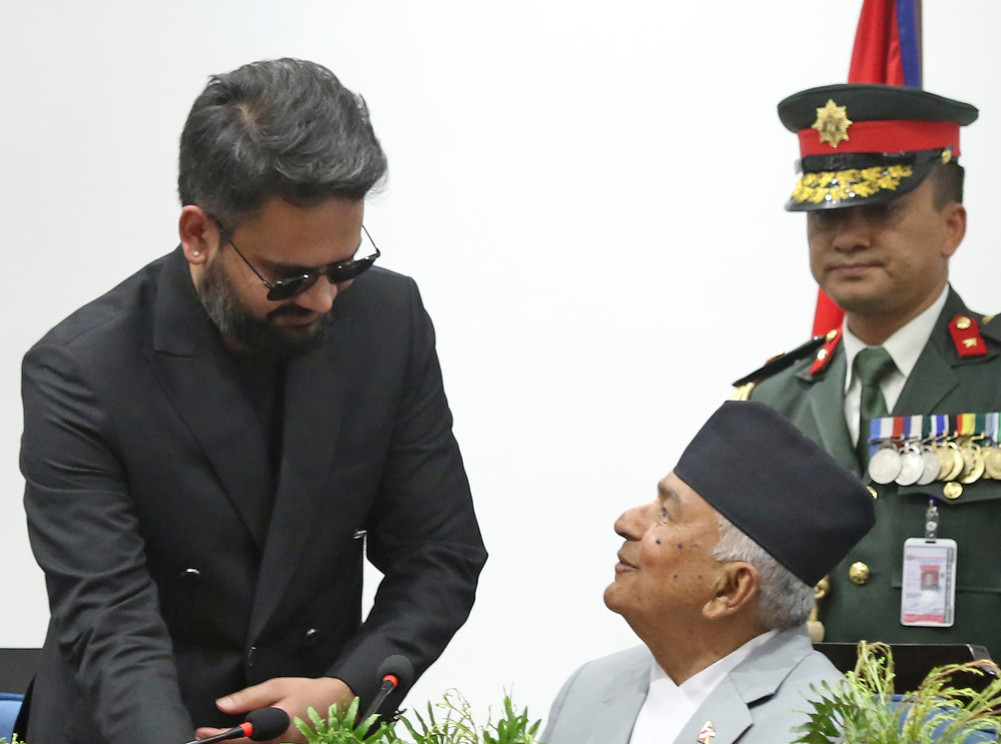
If the Balendra Shah-led government fails to deliver and disappoints the youth, the poor, and farmers, the next situation may not be a democratic option. The disappointment that may come may say that elections do not change anything, that the protests are just a drama.
We use Google Cloud Translation Services. Google requires we provide the following disclaimer relating to use of this service:
This service may contain translations powered by Google. Google disclaims all warranties related to the translations, expressed or implied, including any warranties of accuracy, reliability, and any implied warranties of merchantability, fitness for a particular purpose, and noninfringement.
Read the policy and program (document) carefully. It looks like a manifesto written in two languages. One language is Nepali and the other is the ‘language of consultants’. ‘Investment Express’, ‘Skill Passport’, ‘Citizen App’, ‘Nepal Investment Visa’, ‘Remittance-Investment Matching Fund’, ‘Reverse Migration Incentive Package’, ‘Net Zero 2045’, ‘Brand Nepal Campaign’ – the document is filled with such words. Some of these ideas are truly excellent. But, think for a moment, who are these written for? These plans are written for young entrepreneurs sitting in Naxal and reading ‘The Economist’. They are written for expatriate investors in Sydney. They are written for IT entrepreneurs in Lalitpur waiting for tax breaks.
But, they are not written for those tea shop owners in Birgunj who lost their livelihood after a bulldozer hit their business. Not for the widow of Achham, whose child is buried at a construction site in Qatar. Not for the workers forced to breathe in dust particles while working in a brick kiln, even though the promise of a clean environment is evident just a few paragraphs into the document.
India has already experienced this story under a different name. Prime Minister Narendra Modi’s schemes, launched in 2015 with acronyms like ‘Smart Cities Mission’ and ‘Smart Cities Challenge’, have cost years and billions of rupees. Yet even today, many cities there do not have the capacity to drain the streets after an hour of rain.
Beijing’s story is similar. In 2021, Xi Jinping’s ‘shared prosperity’ campaign promised to look after China’s rural poor and bring balance. But in the end, it was reduced to a campaign to control technology companies. And, the lives of migrant workers and rural families remained where they were.
Language crafted from above often rewards those at the top. The names keep expanding, but common life remains the same.
The document has only one paragraph on the minimum support price for agriculture. There are five on the digital economy. There is only a general mention of squatters and the landless. But an entire section has been set aside for hydrogen, AI computing and cloud parks. It is natural for the future to find its place. But, where is the present? Where is the existing suffering and struggle? That too has to be seen.
In this document, the poor and lower middle class are presented as the subject of policy, not as the subjects of policy making. They appear only as ‘target groups’, ‘beneficiaries’, ‘sensitive communities’. However, they are nowhere the main characters. There are hundreds of Buddhas, but the ordinary citizen who meets at Gongabu Bus Park is not given a place to speak his mind.
Perhaps, this is called ‘lost in translation’. The government that came to power on the strength of the moral outrage of young Nepalis against the corrupt elite has now started speaking the language of the same elite in its first policy and program.
The language of Dang has disappeared and now the vocabulary of Davos has taken its place. The word ‘agriculture’ is still in the document, but the real farmer – his real debt, the real lack of seeds, his son in Malaysia – all these things have disappeared. He is now seen only as a beneficiary of a ‘unified digital platform’. Ask any farmer in Madhesh once and see, which ‘app’ saves his life?
Nobel laureate Abhijit Banerjee, who patiently tried to understand what the real lives of the poor are like, has been repeating a theme for two decades: Poverty is not a single problem with a single big solution. It is a web of thousands of small obstacles and difficulties. And, the policy that will succeed is the one that begins to understand those small problems.
His book ‘Poor Economics’, co-authored with Esther Duflo, begins with a quiet warning. The reason most development policies fail is not that the poor are in trouble, but that policymakers do not try to understand how the poor actually live. Wallendra Shah’s policies and programs seem to start with the exact opposite thinking. Here, ideas are formulated first, and people’s lives are expected to follow suit later.
Another serious issue is that this government is a government that must fail. This does not mean that it cannot fail. However, the consequences of its failure will be so dire that the country will find it difficult to bear the cost.
In 2008, the US used the term ‘too big to fail’. It was for banks whose collapse could bring down the entire financial system. Ironically, the term ‘too big to fail’ became a concession to negligence, because those banks knew that they would be rescued in the end.
The situation in Nepal is exactly the opposite and even worse. There is no one to save them.
If this government fails to work and disappoints the youth, the poor, and the farmers, the next situation that may come may not be a democratic option. The disappointment that may come after that may say that elections do not change anything, the protests are just a drama, and the only language Kathmandu understands is stones and boots.
This country saw 2046. It saw 2063. It has recently seen 2082 as well. Each disappointment has made the place of democracy even narrower. Another disappointment can close that door completely.
It is not necessary to tear up this document and throw it away. It is enough to simply change its direction – from the investor lounge to the bus park, from the cloud server to the stove. A few small changes can do a lot.
Let's start with cash. The poorest 20 percent of families can be directly transferred money every month – through their national identity cards and bank accounts. No middlemen, no commission, no humiliation. This is not a donation, it is a fundamental right of citizenship.
Employment must be guaranteed. Every family should be given a job in infrastructure work with a salary of 100 days a year, which the village council chooses itself.
India, despite all its shortcomings, has learned this lesson through the MNREGA scheme. Nepal can improve it further. Construction work should become a program that creates jobs in itself.
Minimum support prices need to be made real. There should be a state procurement system for all of these. The statement that fixes the support price only at the time of harvesting does not make any sense. The previous government used to announce support prices, but hardly any farmer could sell his produce at those prices. This government must be different, otherwise it will not be fundamentally different from the previous governments.
Grants should be given, not loans. Women, Dalit, Madhesi and indigenous entrepreneurs should be given grants ranging from Rs. 50,000 to Rs. 200,000 to start small businesses. They should be given capital, not a burden of debt, and what they build should be seen.
The age limit of old age allowance should be reduced by five years and the amount should be increased by half. This one decision alone will change the economy of rural households at a rapid pace. And, its cost is certainly less than the dreams of digital railways scattered in documents.
At least five lakh units of respectable rental houses should be built in ten big municipalities, for migrant workers and the urban poor. Housing is an asset that the working class was never allowed to accumulate. Build them a house, rent it cheaply, and let them live with dignity in the city they earned.