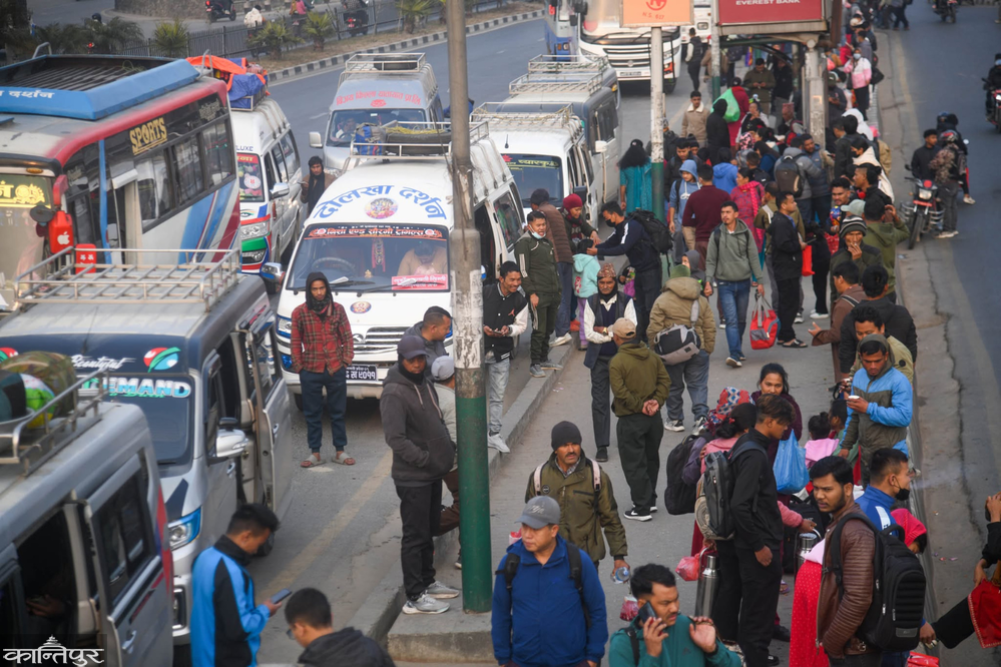
The middle and lower classes have become destitute as citizens' incomes remain stagnant or unstable, inflation increases in every sector, and the government's presence is invisible.
We use Google Cloud Translation Services. Google requires we provide the following disclaimer relating to use of this service:
This service may contain translations powered by Google. Google disclaims all warranties related to the translations, expressed or implied, including any warranties of accuracy, reliability, and any implied warranties of merchantability, fitness for a particular purpose, and noninfringement.
As soon as there is a slight downturn in the country's economy, the middle and lower classes are the first to be affected. The financial burden of having to live on a fixed income adds to the daily burden. A similar situation has emerged in the country at the moment. After the West Asian War, fuel prices have increased drastically. As a result, inflation has increased in every sector. However, even after two and a half months since the war began and its effects have reached the kitchen, the government does not seem to have been able to take effective initiatives to provide relief to the citizens. The middle and lower classes have become helpless due to the situation where the income of the citizens remains unchanged or unstable, inflation increases in every sector but the government's presence is not visible. Therefore, the government's immediate, medium and long-term strategy is necessary to minimize the cyclical impact created by inflation. At this time when the citizens are facing difficulties, the government should make them feel its guardianship.
When the purchasing power of essential goods decreases, income is unstable or does not increase, and the financial burden increases, the journey towards poverty begins. Since the US and Israel started the war with Iran, the price of all types of fuel used in Nepal has increased drastically. The price of petrol, which was 157 rupees per liter in mid-March, has now reached 217 rupees. Similarly, the price of diesel has increased from 142 to 225 rupees. This has made travel more expensive for the middle class. Those who use public transport have seen their fares increase. Because, with the increase in the price of diesel, the government has recently increased the fare of passenger vehicles by an average of 16.71 percent. Secondly, the fuel costs of those using private vehicles have also increased. People with middle-income earners or those engaged in business mostly use two-wheelers. With the increase in the price of petrol, it is difficult for them to adjust to the increasing expenses. Consumers who spoke to Kantipur have experienced an increase in fuel costs of around 35 percent. This can also be felt in their difficulties.
Electric vehicles are considered a strong option all over the world to reduce fuel costs. Nepal has also adopted a flexible policy in introducing electric vehicles. According to the Customs Department, the share of electric vehicles among imported four-wheelers last year was 71 percent and that of diesel-petrol vehicles was 29 percent. The figures for electric vehicles seen in four-wheelers have not been reflected in two-wheelers. According to the department's own data, the share of electric bikes among imported two-wheelers last year was only around 6 percent. It is understood that the middle and lower classes have been hit hard due to the fare of public vehicles and the fuel cost of private (two-wheelers). The common reason for the failure to increase the attraction towards two-wheelers is the 'range anxiety' of the time they can drive after charging once. Just as it is now easy to install charging stations for four-wheelers, if the installation of public charging stations for two-wheelers can be taken forward as a campaign, the attraction towards this can also increase and relief can be obtained from the impact of fuel costs. Similarly, electricity generation should also be expanded further. The private sector is demanding easy production
permission and even construction of transmission lines. It should be facilitated.
The problem is not only that road travel is expensive. Every consumer is feeling the impact of the increase in fuel prices, which has increased the cost of transportation and the cost of daily necessities. The prices of items such as rice, pulses, cooking oil, sugar, nuts, and vegetables have increased. There has been no strong monitoring of how much the price increase in items is natural or artificial. If it is artificial, the government should adopt a policy of strict monitoring and action against those involved. Meanwhile, the price of gas has also reached Rs 2,160 per cylinder since 2010. Even if it is by providing relief or subsidies for this, if it can be attracted towards using electric stoves, the citizens will get relief, and the large amount spent on purchasing gas will also remain in the country.
When the purchasing capacity of essential items decreases, income is unstable or does not increase, and the financial burden increases, that is when the journey towards poverty begins. If inflation continues to rise but there is no government presence, citizens will be pushed towards poverty. For example, the situation after the 2072 earthquake can be taken. At that time, when houses collapsed, crops were destroyed, and livestock were destroyed, seven hundred thousand ordinary people were forced to be pushed below the poverty line. Even if poverty does not increase in one fell swoop like then, it may increase gradually. Given such a risk, it is imperative for the government to immediately formulate and implement its strategies to provide relief to the citizens.
If the purchasing power of the citizens is weak, demand will decrease, which can also lead to a decrease in production and disrupt the cycle of the economy. This will further slow down the sluggish economic activity. Mainly, the middle and lower class citizens are being affected the most by the current situation. Therefore, the government should immediately announce relief packages targeting those classes. Some issues can also be announced through the budget. For example, income tax can be made favorable to the middle and lower classes. Tax exemptions can be given on goods and services used by those classes. Convenience stores can be opened. The government can have many ways to provide convenience to the citizens. Mainly, the government should realize the difficulties being faced by the middle and lower classes and show readiness to implement plans that will provide relief to them.