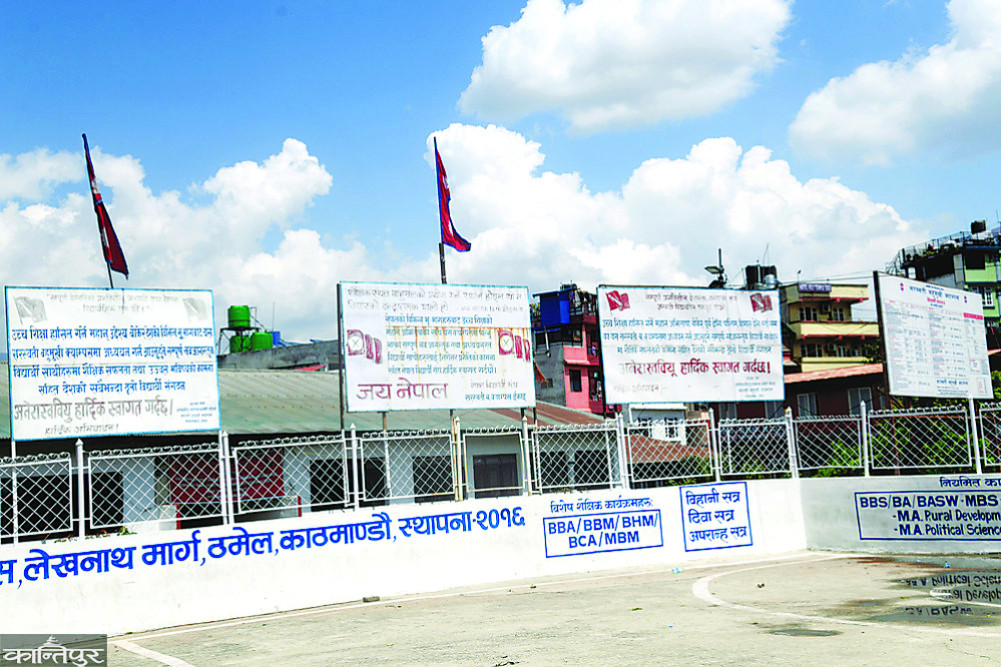
The debate now should not be about ending student politics, but rather about freeing it from partisan control and making it academic, policy-oriented, and accountable.
We use Google Cloud Translation Services. Google requires we provide the following disclaimer relating to use of this service:
This service may contain translations powered by Google. Google disclaims all warranties related to the translations, expressed or implied, including any warranties of accuracy, reliability, and any implied warranties of merchantability, fitness for a particular purpose, and noninfringement.
After the government decided to abolish student organizations within the university, society has been divided into two poles. However, the Supreme Court has ordered not to implement such a decision through a short-term interim order. But society is divided on whether or not to abolish them. This context will be debated in this article.
In fact, the problem seen in student organizations is more in their character, structure and purpose than in their existence. Therefore, the solution needs to be sought not in abolition but in structural reforms and dynamic regulation. Freedom of association is a fundamental right in a democracy, but when any public-academic institution starts becoming a center for partisan demonstrations, it infects the original purpose of the institution. This is also the problem of Nepal.
In a democracy, students should not be alienated from political consciousness, but they should be developed as independent ideological citizens, not as 'cadres' of a particular party. Unfortunately, student organizations in many universities in Nepal have developed as fraternal organizations of political parties rather than as independent organizations. The result was seen in the form of riots, vandalism, lockouts, self-interested pressure on professors and administration, improper interference in admissions and appointments, displays of physical bravery, and devaluation of the academic environment . The debates in the university began to be more partisan than academic . Due to which the academic culture and ethics were tarnished . However, this does not mean that the concept of student representation is wrong .
In developed democracies of the world, student organizations exist as an important part of university governance . In some universities, student unions are legally autonomous . Student representation within some universities is not based on partisan power struggles like in Nepal . There, ‘student councils’ or ‘student unions’ mainly focus on the students’ own academic, administrative, and welfare issues . Their role is to be active in improving the quality of education, creating a research-friendly environment, mental health, inclusive campuses, student rights, and making university administration accountable . We can learn from such experiences .
Nepal's universities should immediately try to move from 'partisan student organizations' to 'independent student representation'. For this, an autonomous student council system can be developed (which is also in line with the concept of the Rashtriya Swayamsevak Sangh-led government), where students elect their representatives through direct elections. In addition, the role of student representatives should be clearly limited to academic and administrative matters. They should advocate for issues such as university quality, infrastructure, library, research, scholarships, gender security, mental health and employment-oriented education. Violent activities, strikes, pressure or political demonstrations should be controlled through a strict code of conduct. This will also protect the democratic rights of students and will not harm the academic dignity and dignity of the university.
The problem is not in the original concept of student politics, but in the partisanization of it. In Nepal, student politics has gradually become a means of expanding the power of political parties rather than free ideological debate. As a result, student politics has turned into a distorted structure. Therefore, the debate now should not be about ending student politics, but should be focused on freeing it from party control and making it academic, policy-oriented and accountable.
Structural reforms, clear legal framework, autonomy, code of conduct and effective regulation. Therefore, today's debate should not be limited to 'reject or not'. Rather, it should focus on 'how to reform'. Universities should not be made a 'hub' of 'academic excellence', 'ideological discourse' and 'creative activism', rather than a political 'recruiting venue'. In a democracy, restrictions on ideas cannot be tolerated, but institutional dignity, rules and conduct are necessary.