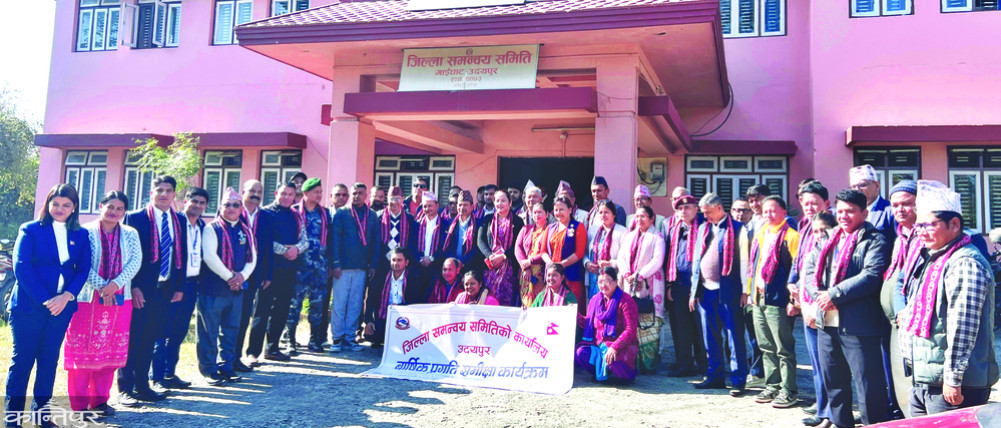
If there is no political will, let's abolish Jesus forever, and stop making it a place for workers to gather. The District Assembly and Jesus should be abolished and their work and budget should be handed over to the provincial and local levels.
We use Google Cloud Translation Services. Google requires we provide the following disclaimer relating to use of this service:
This service may contain translations powered by Google. Google disclaims all warranties related to the translations, expressed or implied, including any warranties of accuracy, reliability, and any implied warranties of merchantability, fitness for a particular purpose, and noninfringement.
During the constitution-making process, Nepal adopted a three-tier federalism – the union, the provinces and the local level. The constitution also provided for the District Coordination Committee (JUS) at the district level as a part of the local government. However, even after more than a decade of the implementation of the constitution, the justification of JUS is still being debated. It was neither authorized nor repealed. Rather, it was kept in confusion. Therefore, the justification of the billions of rupees being spent every year on it has not been confirmed.
The current government has prioritized constitutional amendment among 100 proposals related to governance reforms. A task force has also been formed under the leadership of Asim Shah to amend the constitution. In such a situation, this article will debate the justification of JUS.
The constitution has given JUS some responsibility and authority. The government allocates billions of budget for JUS every year. There are well-organized offices in the grand buildings of the old District Development Committee, but there is no business throughout the day and there is silence in the office. People have forgotten where the office of Jesus is due to its lack of role in service delivery. To be clear, municipalities do not count Jesus, they question its existence and legitimacy. Jesus comes last in the priorities of the province. The union sometimes remembers it only out of compulsion when sending the budget. Let's say, Jesus is in a neglected state now.
Article 56 of the Constitution has specified municipalities and Jesus at the local level in the state structure, while Article 220 has clearly provided for the district assembly and Jesus, and according to Clause 7, Jesus has specified four main functions. First, to coordinate between rural municipalities and municipalities within the district. Second, to monitor development and construction work. Third, to coordinate between federal and provincial government offices and local levels in the district. Fourth, to perform other tasks in accordance with the provincial law. Has Jesus fulfilled his responsibility? Since Jesus is the only district coordination committee, his main responsibility is coordination. But the main question is how effective is this coordination? There is a monitoring committee in each local level under the coordination of the deputy chief/vice president. Its main task is to monitor local level programs and is being done by this committee. Local level representatives say that when Jesus comes to monitor, there is a situation of conflict due to duplicity. And, most local levels naturally reject Jesus' monitoring and consider it an encroachment on their autonomy. However, there is no legally binding provision that requires any level of government or body to accept the suggestions given by Jesus. Jesus has the status of giving suggestions and recommendations, but Jesus is innocent in the matter of implementing those recommendations.
Some Jesuits have also tried to work – mediating between municipalities involved in border disputes to find solutions, coordinating with federal and provincial bodies in disaster management, and preparing multi-municipal joint plans for common problems such as river erosion.
Less business but costly structure
There are 11 people's representatives in the 77 Jesuits in 77 districts, including the chief, deputy chief and 9 members. In this way, there are a total of 847 people's representatives and thousands of employees in the Jesuits across the country. After becoming people's representatives and employees, there is no question that the state will not provide salaries, allowances and facilities. Looking at the annual budget of the 77 Jesuits, about one billion rupees are allocated from the association every year. If we add the additional amount given by the provinces to this, the figure is even higher. However, what needs to be understood is that there is no guarantee of the province's contribution and it is irregular.
The state's share of this much budget in capital expenditure is almost zero. The main part of the budget is spent on administrative facilities. It is seen that some permanent and contract employees work in each Jesus, but there is also great frustration and anger among them. Representatives and employees are frustrated due to the lack of clear authority, objectives and scope of work, for eight years. The question is alive – why the expensive structure of Jesus when business is low?
Jesus is ignored by all governments
In the experience of about 9 years, the federal government seems to view Jesus only as a constitutional obligation. There is no more interest than providing the minimum budget required for Jesus annually. The union does not seem interested and active in giving Jesus more authority. If any province wants to give Jesus more work, it has given constitutional authority to give it, but most provinces have not made any concrete law in this regard so far, which shows apathy.
As local governments, rural municipalities and municipalities often openly say that Jesus is a structure imposed on them.
There are well-organized offices in the grand buildings of the old District Development Committee, but there is no business throughout the day and the office is silent There has been a continuous stream of criticism that the leaders of various parties have used this structure to manage their workers. On the one hand, the workers may have been managed, but even representatives of the JS have started saying that it would be better to abolish it rather than keep it.
What is the district level like in other countries? Generally, when choosing a person to send to the JS leadership, political parties have sent people who have not had opportunities elsewhere or who are less prioritized. It is natural for the political influence of the JS to weaken further as junior and less influential leaders within the party reach the JS.
Let's look at international examples. Germany has made the district level a useful and effective level by empowering it. And, Switzerland has abolished the district level that was initially envisioned and reduced its number.
In Germany, there is a district structure between the federal and state levels. These district administrations are responsible for coordinating local planning, water supply, waste management, and secondary education, and act as a bridge between local and state governments.
Looking at the Swiss experience, the district level performs the function of administrative coordination and judicial management. In some cases, there are examples of reducing the number of districts or completely abolishing the district-level structure after evaluating the effectiveness of the district. In the context of Nepal, it seems wise to review its justification when the JIS has not been able to play the expected role.
In the Swiss system of governance, power and authority are seen to be based on the principle of proximity between the federation, cantons (provinces), and municipalities. According to this principle, the higher level does not do the work that can be effectively performed by the local government. The federation and provinces do not interfere or duplicate the budget in the work that the local level can do. The higher level provides support and facilitation only if the local level is unable to do so.
Nepal must choose one of these two paths, abolishing or empowering. India's experience can be useful for Nepal in terms of what the role of the district level should be in the federal system.
The structure of district coordination in India is different. Administrative coordination is led by the District Collector, who is appointed by the state government and has executive powers. According to Article 243 ZD of the Constitution, India also has a District Planning Committee. It integrates the planning of the Panchayat Raj Institution and the municipality of the district. The Indian District Planning Committee is more powerful than the Nepalese one. It also plays an executive role as it decides on budget allocation. However, this structure is not equally effective in all states in India. If we look at Kerala and Karnataka, this structure seems to be successful, but it has proven to be weak in Uttar Pradesh and Bihar.
A decade of experience: Now is the time to decide
This year marks a decade since the implementation of the Constitution of Nepal. On this occasion, it is necessary to have a comprehensive assessment of the federal structure. This is the best time to decide the future of Jesus.
There are only two options here. First, make Jesus meaningful. This cannot be done without amending the constitution. Jesus should be given the legal authority to prepare district-level coordination plans and implement them. It should be given the power of binding mediation in disputes between municipalities. District-level federal and provincial bodies should be made accountable to Jesus. And, political parties should take the responsibility of sending competent, experienced leaders to lead Jesus.
Second, Jesus should be abolished forever. If there is no political will, let's abolish it forever and not make it a place for cadres to stagnate. It would be wise to abolish the district assembly and Jesus and transfer its work and budget directly to the provincial and local levels.